Innovation

Yesterday I said I was going to discuss how patents impacted innovation. However, I think the first thing we need to do is clarify what innovation is. Schumpeter, described innovation as bringing a product to the market. He claims that without innovation, invention is worthless. Indeed, patents play this out. There is no legal requirement to actually manufacture anything that you’ve patented. I will discuss that in more detail tomorrow though. Schumpeter also notes that these innovations are the source of creative destruction in the economy. He claims that through innovation we are able to keep growing. He called these the long waves. See the picture below for a representation of these waves and the innovations that drove the economy at the time.

Based on Schumpeterian principles we can see that we should expect growth slow down and potentially economic issues at these times. So, if an innovation is bringing a product to a market, in what ways can we innovate? There are four ways in which innovation can occur in a product; Incremental, Modular, Architectural and Radical. Please see the picture below:

Henderson and Clark ,1990

Most innovation occurs in the upper left hand corner, incremental innovations. These are fairly obvious and most people aren’t surprised to see these products. Products like iPhone 3G after the iPhone first came out. this was an incremental innovation on this product. While Apple did a fantastic job making it sound like it was a radical innovation, it simply wasn’t.

The next most likely is the modular. In this case it could be considered that an electric car might be a modular change. As you only have to change one part of a larger piece of equipment. In this case a combustion engine is replaced with an electric engine.

The architectural changes are less common than either of the previous. As these ones typically require a great deal of changes within a firm. An architectural change can be described as going from a ceiling fan into a box fan (Henderson and Clark 1990). Seems pretty simple right? Well, there are a lot of changes that go into this innovation. You have to think about how to keep the box from falling over. How to keep the noise down. How to protect the users. You also have to manufacture everything differently. So, in many cases there are two innovations within an architectural innovation. One at the product level and one at the firm level. Another example is the reintegration of the original developers of the Mac into Apple after the successful product launch.

The final type of innovation is the radical innovation. This is the stuff that “creative destruction” is made from. When these types of innovations occur most of the previous knowledge base is blown away and the innovators have to start all over again. I’d say the most common example of something like this would be with game consoles. Basically each time a new one comes out everything starts all over again. Other examples can include things like the Jet engine from the propeller. Not only did this require changes in the aircraft but it also required changes in the runway, it needed to be longer than before.

There are many cases of Radical innovations and in some cases they completely reworked our economy. IT/ICT is the most recent set of radical innovations that is shaping our economy. These technologies are heavily patented and impact our economy. Tomorrow I will look at how these patents interact with innovation to increase or decrease the rate of innovation.

Further reading/Citation:
Henderson, R., Clark, Kim. “Architectural Innovation: The Reconfiguration of Existing Product Technologies and the Failure of Established Firms” Administrative Science Quarterly, Vol. 35, No. 1.
http://dimetic.dime-eu.org/dimetic_files/HendersonClarkASQ1990.pdf
Let’s bring in the lawyers (Patents)

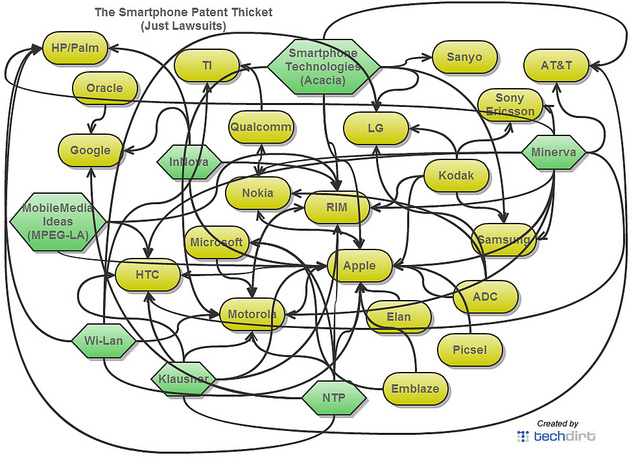
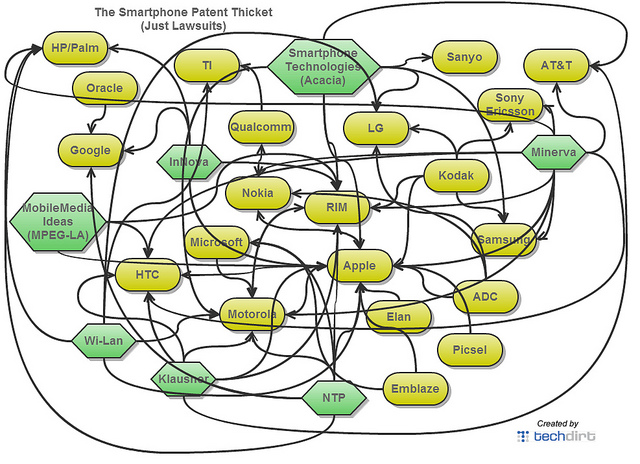
So, building on my previous post, What is a patent?, I’m going to discuss some of the reasons why lawsuits happen due to patents. Depending on how long this discussion is, I may or may not get to how this impacts technological innovation. If I don’t then I’ll cover it on Monday.  Starting again with this lovely drawing from Tech Dirt of all the law suits related to smart phones I’ll discuss how something like this can happen.

Patent Thicket Lawsuits

As I mentioned in the previous post patents are to be awarded for non-obvious, novel, useful ideas. This can be extremely difficult to actually judge. For instance, there is a patent owned my Smuckers that describes a method to crimp the edges of a peanut butter and jelly (PB&J) sandwich with the filling layered in a specific order. So, let’s say you’re a patent examiner. You’re a technical expert in some field, the one related to food processing perhaps. How would you look for examples of prior art? Where prior art is articles, technologies or anything that does the same process. For crimping a PB&J sandwich where would you start? Well, in this case the examiner wasn’t able to find anything and awarded the patent. However, there are two problems with this. This is a fairly obvious way of making a PB&J sandwich. I’m sure many people ate sandwiches like this in their youth. The other problem is that there was a company in Michigan that had been making these from the 1800s, which means it’s not novel. Once the patent was awarded Smuckers sued this little ma and pop restaurant over patent infringement. For more information on this exact story please read Jaffe and Lerner’s Innovation and Its Discontent (2006).

In the Smucker’s example presented in this way, it’s fairly obvious that this patent shouldn’t have been awarded in the first place. However, it was. So that means the only way to invalidate the patent is in court. However, this can be extremely expensive. According to Jaffe and Lerner (2006) these law suits account for roughly 25% of R&D expenditures and that many lawsuits cost hundreds of thousands of dollars regardless of the fine or impact to production. While this case was straight forward more advanced technologies are much more difficult to analyze in this fashion.

Here is a link to an Apple patent for Gestures for controlling, manipulating, and editing of media files using touch sensitive devices. Here is a claim that Apple is saying is unique to this specific invention:

1. A computing device, comprising: a touch-sensitive display; a processor; memory; and one or more programs, wherein the one or more programs are stored in the memory and configured to be executed by the processor, the one or more programs including instructions for: playing-back a video file on the touch-sensitive display; displaying a play progress bar on the touch-sensitive display, the play progress bar including a timeline indicating a time span of the video file being played; detecting two touch points making initial contact at respective initial positions on the play progress bar; detecting the two touch points moving away from each other on the play progress bar; and, in response to detecting the two touch points moving away from each other on the play progress bar: expanding a portion of the play progress bar in accordance with the movement of the two touch points, wherein the portion of the play progress bar that is expanded is determined by the respective initial positions of the two touch points; and contracting a part of the play progress bar outside the expanded portion.

This basically is how most people are interacting with their phone to zoom in for pictures or whatever. However Apple is claiming that this specific gesture is unique to this patent because of the specific application of the gesture. Fortunately, this patent has not been granted yet and I hope that this does not get granted.This is a software patent and it’s difficult to say if this will be granted or not.

Regardless of what I want, this patent may be granted. With the broadness of the first claim it is difficult to tell what sort of impact this patent would have on the smart phone industry and could introduce additional lawsuit from Apple towards firms like Google, HP, HTC, Microsoft, etc. Additionally, with the wording of this claim it is difficult to say if there aren’t other patents that have a similar claim to being unique.

As you can tell these claims leave a lot of wiggle room and can increase the likelihood of a lawsuit in a fast growing new technical area. These new technical areas are still being explored as firms are patenting technologies related to it. In many cases the Patent Office hasn’t fully decided if specific types of patents should be allowed.

Tomorrow I will look at some of the potential impacts on innovation of this type of patenting.

Additional readings:

A.B. Jaffe & J. Lerner (2006). Innovation and Its Discontent.  NJ: Princeton
University Press.

USPTO http://patft.uspto.gov/netacgi/nph-Parser?Sect1=PTO2&Sect2=HITOFF&p=1&u=%2Fnetahtml%2FPTO%2Fsearch-bool.html&r=14&f=G&l=50&co1=AND&d=PTXT&s1=Apple.ASNM.&OS=AN/Apple&RS=AN/Apple

What is a Patent?

In the news we hear about various lawsuits from high tech companies over patents. Right now there is a tangled mess of patent lawsuits flying back and forth between firms like HTC, Microsoft, Apple, Google, Motorola, Nokia, and the list goes on. So what are they suing each other about? Why are they suing each other? What kind of impact does this have on innovation in general?  All of these are important questions. To answer these first we need to understand what a patent is. In the most basic form a patent is a contract between the government and an inventor. This contract bestows certain rights to the inventor and certain obligations that the inventor must fulfill for the government. However, not everyone can enter into this contract. There are requirements for earning a patent. Note I say earning a patent not obtaining one. This is important.

Smart Phone Patent Thicket
So, how does the inventor earn this patent? Well, there are three basic criteria. The invention has to be novel, non-obvious, and useful. To be novel means it has to be new, no one has come up with this idea before. To be non-obvious, it has to be something that a person couldn’t figure out by looking at the device. For example if there is a patent on nail clippers, you can’t get a patent on a larger nail clipper. It’s an obvious invention. To be useful means it has to be intended for some sort of use and isn’t just technical details of something that cannot be used. This are the general requirements of patents. However there are some other nuances. For example, in Europe you cannot patent software but you can in the US. In Europe and the US you cannot patent genes. Basically these nuances are part of the reason why patent lawyers exists.
This doesn’t explain the patent mess shown above though. How does this happen? Well, the patent bestows a temporary monopoly for the inventor. Typically this is about 20 years, in some cases it can be extended like for pharmaceuticals. Here’s a link to a patent, i just picked one at random from RFIDs. So looking at this, if you scroll down until you see the word “Claims” these are what actually are protected. These items are what the inventors actually have the monopoly on. These are typically worded very vaguely and broadly to ensure maximum coverage under the law. Which means it’s easy to step on people’s toes. Which they will sue you for. I’ll discuss this in more detail in another blog post.
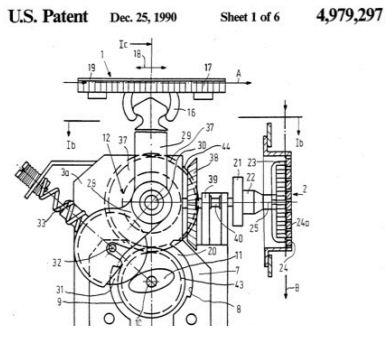
Since this is a contract, what does the government get in return? The inventor has to give full disclosure of how this invention works. Below you can see a picture from Philips’ electric razor. 
Philips electric razor USPTO
The release of this information should allow any competitor to recreate this technology in their lab. 
That is basically a patent. Rights to protect the invention with release of how the invention works. I will answer some of the other questions I posed in later blogs.

But it’s JUST a theory.

The point of this post is not to defend evolution, but to investigate the different meanings behind the word theory. However, this point comes up most frequently when people discussion evolution and possibly climate change. The word theory has become a very loaded word during discussions between scientists and non-scientists. It causes scientists to come across as arrogant to non-scientists. What causes people to believe that these scientists are arrogant? Well in Professor Dawkin’s documentary “Root of all Evil” Ted Haggard claims it has to do with how certain scientists are about their “theories.” Where scientists look down upon non-scientists in their ignorant views. For science this is a dangerous proposition where the people scientists need to convince the most that many different forms of scientific research needs to be conducted and funded publicly, scientists come across as arrogant know it alls that refuse to explain anything to the common person. This has also been noted in a Pew Science Survey.

So, why are scientists “arrogant” about their “theories?” Well, first it’s not arrogance. It’s extreme confidence in the current understanding of the world. The “theories” describe the state of the world and how we interact with it. However, there is a misunderstanding about the word theory. This can come from two ways. First, intentional intellectual dishonesty. In this case there is not much to be done, other than attempt to bring out this fraud and discredit the person on this basis. The second is an honest misunderstanding of the word. This may be difficult for many scientists to actually believe, but I think this can legitimately happen. While people who are actively interested in science are constantly being refreshed and reminded of how science works why it works and all the great things it has done for us, people who aren’t interest forget these things. Many of them haven’t had a refresher on how science works since high school, and that’s if they were paying attention to their teacher. They believe that a theory is a general idea of how something works, a educated guess.

I plan to elaborate on the differences in definitions through using a model presented through psychology in 1986. The study claims there are folk theories on how technology works, specifically thermostats. It is clear that there is the correct “scientific” theory of how the thermostat works, so it will be easy to compare the differences in the two different thermostat theories.

Willet Kempton’s article “Two theories of home heat control” is a survey of residents of Detroit Michigan of how the thermostat works in their house. The survey shows two prevailing theories. The valve theory and the feedback theory. The feedback theory is fairly straight forward, the thermostat detects the temperature and either turns on or off the furnace based on the deviation from the set temperature. The valve theory is a little different, this theory claims that when you turn up the thermostat you are increasing the flow of hot air the furnace is producing, which will increase the rate the house warms up. There maybe some reasons why this theory was popular, the fact that the thermostat was a knob and that many people were used to using radiators to heat their house previously. These two theories were defined as “Folk Theories” which fall into the general category of educated guess or a hunch of how it works.

However, we know that both of these cannot be correct. So at this point we have competing paradigms or research programs. So to determine which one is correct we conduct experiments. We collect temperature data of the air coming from the ventilator at various different thermostat settings. This allows us to test our hypothesis that the thermostat is actually a valve. Since the feedback theory is basically correct our data would show that the temperature of the air is constant or near constant regardless of the temperature setting on the thermostat.

Now we can move onto test the theory of the feedback mechanism. We can create more sophisticated tests to determine what the on/off points are for the furnace and create a model of how the thermostat interacts with the furnace to maintain the heat in a house. Over time we can build confidence in our model and other people can test our model in their own home and check the validity.

When people accept this model based on empirical evidence we then can say we have a scientific theory. However, this theory, while it may have been formed from a folk theory, has been thoroughly tested and replicated by many individuals. We can find many different examples of this in science, from biology, theories of gravity, relativity, the origin of the world, the list goes on and on.

Folk theories are hunches and educated guesses. Scientific theories are verifiable, testable and may be contradictory to our personal intuition.

What is Science?

In my first two post I haven’t really touched on any of the three main points of my blog. So, i’m going to start from the beginning with what I mean by science. Science to me is the searching for an understanding of the natural world using rigorous tests to validate the data. This is a bit vague as I don’t define on which side the hypothesis needs to be formed. In most cases, if you remember the scientific method, the hypothesis is formed first and then it is tested. This is true for the most part. However, some times you have the data first and you have to get an understanding of the data before you can do that. Once you understand the data you are free to create hypotheses where you use the given data to test these hypotheses.

There is a great deal of debate over how science actually functions. There are three main philosopher’s of science, Thomas Kuhn, Imre Lakatos and Richard Feynman. The first two are basically related to creating paradigms or “research programs” which are similar but slightly different than paradigms. Basically a paradigm is something like Newtonian physics. This had a large set of assumptions and rules that were both confirmed by the data and had issues with the data. For instance Newtonian physics couldn’t explain the motion of Mercury. So, there is a shift from one paradigm to the next through a revolution. Basically, the support for the first paradigm is so degraded it gives way and another one replaces it. In the case of Newtonian physics it was replaces with relativistic physics, based on Einsteinian  principles. Research programs are similar but more than one can be going on at the same time. You could say string theory and m-theory, which are very similar and part of each other, but some people support only string theory and don’t agree with m-theory, while supporting m-theory means you support all of string theory, but there are also people that reject both theories. The large hadron collider is being used to test these theories.

I think science does have radical shifts between major though processes and it can be very disorientating for people within the field. They tend to fight these changes, as we all do. They are human.

Regardless, I feel that science illuminates truths of how this world works and improves the human condition. While it may not always directly intend to do this, there are spill over effects that make this happen. Astronomy is a science that in no way directly impacts humanity (unless they find an asteroid that will hit earth or alien life) there have been spill overs that have made life better for people.

Science is a noble pursuit that does have ambitions larger than itself. It attempts to be the fully objective observer, but it’s not completely. However, it’s the best thing we have. It will continue to get better the more we do it. It has created wonders for us, and I for one am deeply indebt to all the scientists out there. Thank you for your hard work and helping me appreciate the wonders of the world.