GDP a Tragedy of the Commons

In my Novel Technology and Human Behavior course we have an assignment related to a specific novel technology and how it interacts with philosophical ideas and psychological reasoning. So, of course my group member Timmy and I decide to do work on something that is mostly unrelated to actual technology. We decided to look into different metrics for growth. GDP is the current standard for everything. High GDP and GDP growth is currently construed to mean that you have high well being in a given country. However, this is not what the metric was originally designed to measure. So what does GDP measure? It measure most major economic activity. It measures production, hospital bills, and end good sales for example. However, it excludes factors like education, house hold activities and the black market. These are serious gaps. As most people will tell you that have been employed we tend to focus on the activity that is measured. So if you’re at work and you need to get defect counts down or shorten call time for tech support you will do everything you can to make that happen. Even if it’s actually bad for the company you work for. So, if you have high defects you can reduce your measuring frequency to make it look like your defects are better. Or if you’re on a phone call you can be rude and just give the minimum help you can. These are negative results from a measurement.

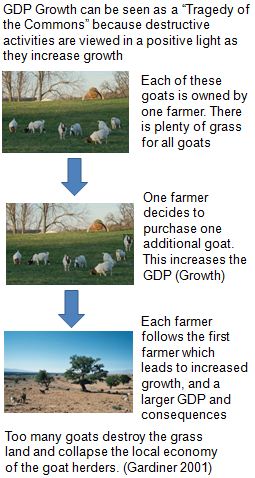
In our poster we argue that something similar happens with GDP. So a tragedy of the common happens all the time. It can be something as inconsequential as replacing the water from a community water cooler. Most people won’t do it because you assume that some one else will. Below is an example of what I mean by how GDP is a tragedy of the commons.

Even the collapse of the local economy may be seen as increasing the GDP. As the goat herders are trying to save the land they may slaughter additional goats, buy fertilizer, get some seeds, buy fencing to block off an area so it can regenerate from the goats. All of these things are seen as beneficial to the economy when it is actually very destructive to this aspect of the economy.
So what can we do about it? Well there are some different metrics that can be used to measure well being while taking into account sustainability, such as Green GDP. China actually attempted to implement this, but decided against it as it lead them to have smaller growth numbers and may have put them at a competitive disadvantage. Timmy and I believe that some good ways to deal with this, is to focusing on what is preventing people from adopting more sustainable technologies, and then trying to create incentives to drive further adoption. We’re finding that this problem is a bit of a catch-22, you can’t get people to adopt the different measurements without people adopting green technologies, but you can’t get huge investment in green technologies without incentives from a new indicator.
Further reading/Video watching:
Bergh, C.J.M. van den (2009), The GDP paradox, Journal of Economic Psychology 
20 (2009) 117-135
Gardiner. 2001, “The real tragedy of the commons” Philosophy and Public Policy Vol 30, No. 4
Tim Jackson, writer of the book “Prosperity without growth” for instance http://www.youtube.com/watch?v=_Jq8WUp1x8k (7:19)
David Korten, writer of the book “Agenda for e new economy” for instance: http://www.dailymotion.com/video/xgeykn_david-korten-on-ways-to-create-an-economy-that-values-life_lifestyle (13:42)
Hans Rosling: New insights on poverty and life around the world http://www.youtube.com/watch?v=YpKbO6O3O3M (20:55)

Regulation and Broadband investment

Just finished reading a rather interesting paper from Telecommunication Policy: Regulation, Public Policy, and investment in communications infrastructure: Johannes M. Bauer.

This paper deals with the different regulatory frameworks that relate to Next Generation Networks for telecommunication. There are two major implications for implication. First, looking at opening up the network to additional services will have a short term impact, but may hamper innovation in future networks. Second, investment and innovation at the market platform can lead to higher prices and in some cases slower penetration where there is minimal return on investment on the infrastructure (think middle of no where US).

This is important as in the US we hear about how prices are cheaper for services in Europe. This is very true and some countries have significantly better broadband infrastructures than the US. Such as the Scandinavian countries, South Korea and Japan. Many of these countries have had very active partnerships between public institutions and the private firms rolling out the new network.

We all can remember what it was like on dial up back in the mid to late 90s, and how after some time we started to see a huge increase in the number of service providers. This is because the regulators did something called “unbundling” which forced the telecoms to open up their network to any service providers. This caused a drop in price, but it reduced any sort of infrastructure investment at the dial-up level. With broad band we are starting to see this to some extent, but not nearly at the level we saw it with dial-up. This has to do with the fact that these networks are still being deployed. If these networks are opened up to just any old service provider the incentive to continue to invest drops off as a firm like Verizon will make less money off of their large investment to lay down fiber.

However, we should concern ourselves with the medium of the broadband. Cable services are much more prevalent than fiber networks, dynamic regulations are required to account for the differences in the network. Opening up the cable networks at this point may be desirable as the infrastructure for the network is well established with high prices for these services. Perhaps it is time to unbundle the network from the services.

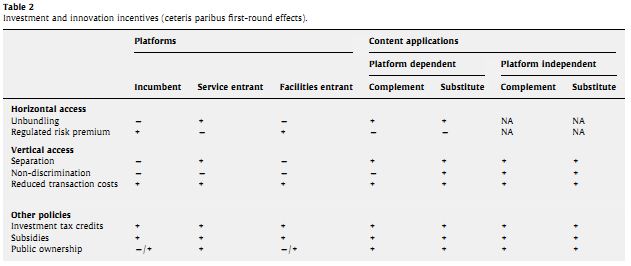
In the picture above are the different types of regulations and the short term impacts on innovation and investment. From this table, it’s clear that depending on the situation of the network different regulations need to be in place.

So, my take on this: we need to have extremely flexible regulations that work to drive incentives for investment and innovation. In the US there needs to be different regulations than in Europe as there has been a different history of regulations. However, to drive down costs while pushing for innovation into the next generation of networks, I think a fair method would be to allow for something similar to patents for these networks. A given time period after a large portion of the network has been installed where the telcom that laid down the network has exclusive access. Then after a given period, 5 years or so, the network has to be opened up and no preference to the data can be allowed. This will allow the firm to recoup investment as well as plan for the next generation of networks. So possibly faster fiber switches, or all wireless or whatever.

I still think that the networks need to be data neutral because there can be consequences on unregulated markets if the networks aren’t open. For instance gaming and video streaming would be the first to take a hit. This would have repercussions in a network completely unrelated to the broadband company, yet still have potential for financial impact. In other words, gamers may get pissed and stop gaming.

Trying this Blogging thing out

Well, it’s been suggested by a few people that I should start a blog. I’ve been living in Europe for close to a year now. I’ve been away from my wife, we’ve been married nearly a year now. I’m going to school for Innovation Sciences at Eindhoven University of Technology or TU/e.
What is Innovation Sciences? Well at one point before I went to school it was a technology and public policy program. There is plenty of science and technology in it, a mixture of policy courses, however many of these are aimed at Europe. Which is fine, because I can learn a lot about these ideas and policy remedies and try to figure out how to get them to work in the US. I’ve also learned a lot about economics, not just traditional economics, but also evolutionary economics. It’s interesting stuff.

My hopes and plans for this blog? I’m not really sure. I feel that I’ve been shouting out into the darkness of both twitter and facebook for the past few months getting a few interesting conversations going, but nothing really spectacular. I’m hoping that with this forum I may get more responses, or less. But i’m going to put a running commentary of the articles I find and then hopefully each night before i got to bed put up some overall commentary of what I’ve read for the day. I plan to include scientific articles i’m expected to read for class, which are now basically over, as well as any book i’m reading at the time. So there will probably be some nerdastic books I’m reading.

Hope whoever reads this enjoys.