Economic Growth: two paradigms

So, I talk a lot on here about science, innovation and technologies. I have also mentioned before why innovation is important to economic growth. So, why?  What’s the big deal? Well, simply put, it’s a perspective of economics. There is one major school in Economics, with a few competing schools. I study one of the competing schools, the largest in fact. This branch is referred to as Evolutionary Economics. The traditional type of economics is called NeoClassicalism.

Neoclassical economics is split between micro and macro economics, where at a micro level there will be some demand and some supply and between two people a price agreement will be set based on the factors that go into costs and how many people want the good etc.  Then there’s macro economics which looks at growth at a regional, or country level using terms like gross domestic product (GDP), which I discussed previously. In this post I will focus on macro economics, tomorrow, I will discuss how evolutionary economics at a micro level is different than neoclassical.

GDP measures some very specific things, however, it does not include all economic activity. Despite limitations it currently is the best measure we have for economic activity. Based on the GDP, many different economists have attempted to create theories based on the GDP that will model growth. These started in the mid 50’s with Solow and his model based on savings rates, salaries and previous GDP levels. This model is still the basis for most mainstream economists models. It is a horrible measure as it leaves a huge portion of economic growth as a residual, or as one economist put it “the measure of our ignorance.” This measure is about 75% of the growth.

In 1982 two guys put together the basis of evolutionary economics, which focused on micro level transactions instead of macro level events. However it has been extended to the macro level quite easily. The major argument is based on Schumpeter and that innovation drives economic growth. These economists basically ignore savings and things like that, and focus on knowledge capabilities. They were able to show that technology growth accounts for a massive amount of the economic growth in an economy.

Through these challenges neoclassical economists have adopted something called endogenous growth model. Where technology change is part of the driving force economic change. Before, it was considered an external factor that just happened to the economy. However, there is still a severe limitation to this theory: knowledge is a public good freely available to anyone anywhere. As we all know this is absurd. Basically we can see how this is a failed theory through the discussion I have on the patent system.

I will discuss more of this topic tomorrow.

Further Reading
Neoclassical:
Kuznets, S. (1973), Modern Economic Growth: Findings and Reflections, The American Economic Review, Vol. 63, No. 3 (Jun., 1973), pp. 247-258.
Mankiw, G.N. (1995), The Growth of Nations, Brookings Papers on Economic Activity, Vol. 1995, No. 1, 25th Anniversary Issue, pp. 275-310.


Evolutionary:
Verspagen, B. (2005), Innovation and Economic Growth in J. Fagerberg, D.C. Mowery and R.R. Nelson (eds) Handbook of Innovation, Oxford University Press (I have this and can email it to you if you’re interested)

Silverberg, G. and Verspagen, B. (2005), ‘Evolutionary theorizing on economic growth’ in K. Dopfer (ed.), The Evolutionary Foundations of Economics, available as IIASA Working paper.

NASA

I’ve gotta say, it’s hard to be a lover of space, NASA and scientific exploration right now. With the end of the shuttle program around the corner, and a new bill to cut a huge amount of funding from NASA (article) things are looking rather down right now. Basically this would kill the James Webb telescope. I think this would be a terrible thing.

Why should we invest? Well, the US prides itself on being number one in everything, even if we aren’t actually number one. Without continuing to push the frontier of research we will fall behind eventually. The article above, or another article mentioned congress killing the Super Collider in Texas, it would have been able to produce the novel results that the Large Hadroc Collider is producing now. The US would be the world leader in particle physics. We are starting to fall behind. Europe is going to be the world leader, and in the future we will be reading articles written by Europeans. We could be excellent teaching centers for particle physics for years to come, but the best of the best will not be in the US.

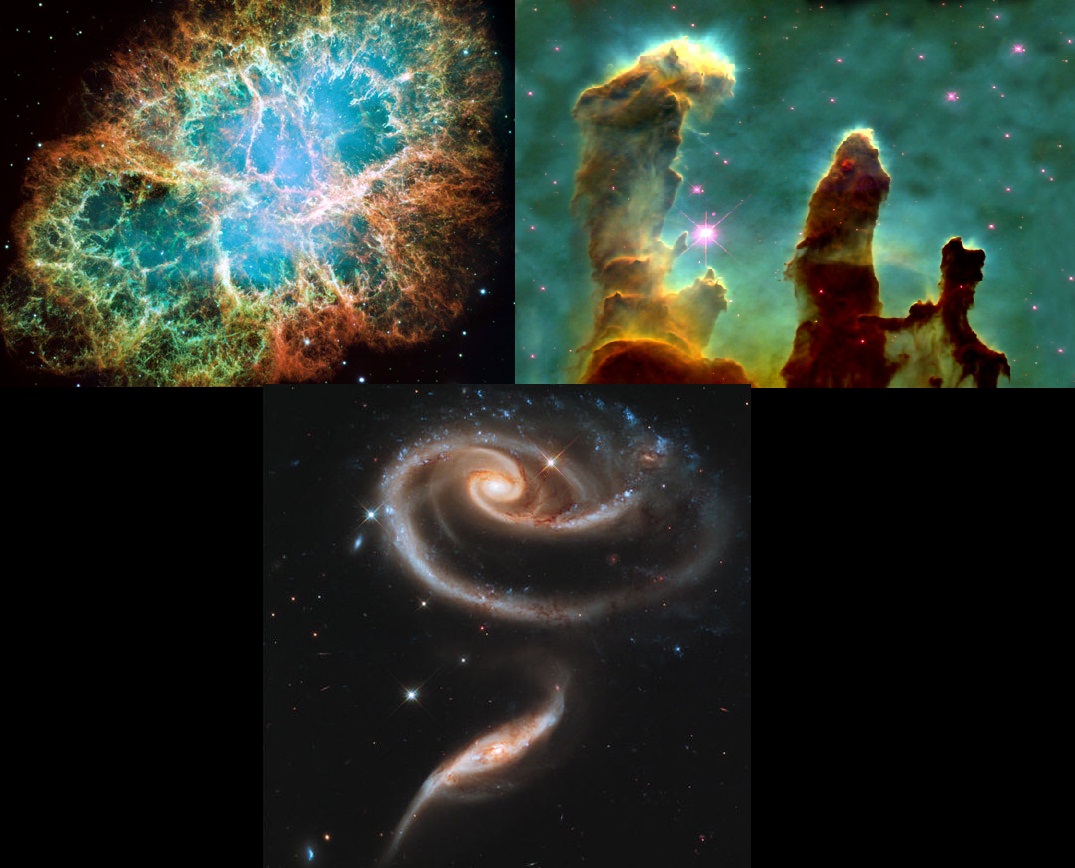
The same could happen with astronomy. The Hubble Telescope led to over 9,000 scientific papers being published. Yes, that may seem like we were probably spending more money on research than just the money that we spent on Hubble, but remember we were also producing jobs to support those scientists that were writing the papers. The Webb Telescope is going to be significantly more powerful than Hubble. We have had some amazing picture of space and the universe around us because of Hubble. Pictures of the Crab Nebula, Pillars of Creation and the Rose Galaxy. See below.

Top Left Crab Nebula, Right Pillars of Creation Bottom Rose Galaxy

For me, these images instill a feeling of awe and wonder. Through the Hubble we’ve expanded our understanding of how the universe works and how dangerous of a place we live. The rose galaxy, or galaxies, are two galaxies colliding with each other. Our galaxy is actually predicted to collide with the andromeda galaxy in a few million years. We know this because of Hubble.

We are also starting to realize that what we’re learning at the particle level may interact with the origins of the universe. For example, string/M theory also is a theory about how the universe was started. We need to be able to keep seeing back in time to understand how these theories interact with each other.

Controversies IV – Vaccines

Today I learned something interesting. A guy who does Judo with me told me that in France there are concerns over Hep B shots and Multiple Sclerosis. Apparently, this is based on a discredited publication and health authorities have not been able to convince the French to begin taking the vaccines again. This is of serious concern for me, because he also mentioned that the vaccination rate was something like 30% or so.

In some ways France is lucky, because the vaccine isn’t as serious as the vaccine people are rejecting in the US. They are rejecting MMR (Measles Mumps and Rubella), which are highly contagious. What can we learn from these two cases?

First, it is extremely difficult to overcome personal beliefs on scientific evidence. In both cases many different studies have been conducted to verify the safety of the vaccines. In the US, the connection was completely debunked. The Journal the Lancet it is the UK medical journal, actually went so far to retract the article. It was a flawed study where there were only 12 patients, they were unwilling included and the author was also being paid. There were many cases of ethical violations and the guy isn’t even allowed to practice medicine in the UK any more. He now works in the US. So, despite mountains of evidence to the contrary people still believe these findings.

Second, we learned that it’s not only conservatives, or a segment of the population that is uneducated that hold these anti-science beliefs. The topics I’ve talked about have focused primarily on that group. This controversy is with the liberal well educated group of people living in California. They have celebrity spokespeople and many of these people are engineers or some other scientifically based  profession. These people should know better.

What are the risks if we don’t vaccinate though? Well, vaccination works through protection of the herd. Everyone needs to be protected in the “herd” otherwise everyone is at risk. Well, that just sounds like a scare tactic. Ok, yes a bit, however vaccines don’t always work. You could have gotten vaccinated for MMR and it didn’t actually give you the anti-bodies you needed. It’s difficult to test for these things and expensive. Not something you’d want to subject a small child to. So, lets say that unknown to you, your child’s vaccine didn’t work, and another kid in class was intentionally unvaccinated. He some how comes across measles and comes to school with it. Your child could become ill, as well as any other person in the school that the vaccination didn’t work for or intentionally wasn’t vaccinated.

Ok, let’s say you’re right, why is Autism increasing? Well, partially we’ve changed the standards for what fits autism over time. In the past only people like Rainman would have been considered autistic, now there’s a well defined spectrum that includes a lot more types of behaviors. Other reasons may be from who are having children together. A recent study (WSJ summary) showed that Eindhoven has a significantly higher rate of autism than two other areas where there are many less technology jobs, thus less engineers and scientists. This also would indicate a possible reason why Silicon Valley might also have a higher rate than other places in the US. This does need additional research to compare regions in the US to regions like this and others around the world.

In conclusion, just because you believe non-scientific things does not mean you are stupid. There are a lot of changes in scientific literature. However, we need to develop techniques to educate people and convince them that the new data is right and that there is not some grand plot to make some one money (anti-vac think its the pharmaceutical companies lying) or destroy our economy (anti-climate change thing it’s a conspiracy to destroy the US economy). These groups are increasing risk to everyone. We need to as a general public, figure out a way to address these problems.

Further Reading:
http://www.wired.com/wiredscience/2008/01/california-stud/
http://www.wired.com/magazine/2009/10/ff_waronscience/

Controversies III – Evolution

So, we have some ideas for how to deal with climate change. Will they work? I don’t know. I hope my friends that read my last post will discuss will educate themselves on climate change and work to talk with their friends about it. Also, let me know if you do and how it goes!

How do we deal with evolution though? This one is a lot trickier, not that dealing with climate change is easy (but I think my idea is a step in the right direction). People who are much smarter than I am have been attempting to tackle this one for some time, including Richard Dawkins who is extremely knowledgeable about the topic. He wrote a fantastic book about evolution called “The greatest show on Earth” where he discusses each of the “counter” claims of ID (Intelligent design) advocates.

However, in some ways this is even besides the point. The major issue is that people are trying to remove evolution from the classroom. This is the biggest problem. This would destroy our capabilities to compete in the future in biomedical applications.

Why are people trying to fight evolution? Well, they feel that it will drive people to atheism. This isn’t true. There are many people that have figured out ways to reconcile their religious beliefs with evolution. The biggest problem is that it directly contradicts the bible. Which in the US there is a growing minority that take the bible literally. The next issue is the growing minority that falsely claim the US is a “Christian Nation” which this CNN contributor debunks.

It appears that we need to not just worry about scientific accuracy but also historical. For it is impossible to really understand the “controversy” without understanding the context that it is being framed within. Without this claimed backdrop there would be no basis under which to fight having evolution in school classes. Evolution is not a religion. With the pope accepting it, it’s as much of a part of catholicism as it is part of secular humanism or part of the accepted scientific facts of an atheist. Since the supporters of ID place the argument within this framework though we must first refute the framework of a christian nation and from there we can show that it is impossible to teach ID in school while evolution must be taught in school.

Additional ponderable thoughts:
Nothing in Biology Makes Sense Except in the Light of Evolution” is a 1973 essay by the evolutionary biologist and Russian Orthodox Christian Theodosius Dobzhansky, criticising anti-evolution creationism and espousing theistic evolution. The essay was first published in the American Biology Teacher, volume 35, pages 125-129. (Wikipedia)


We teach our vets, doctors, nurses and pharmacists biology. Without a clear understanding of biology from a young age the quality of our healthcare can only go down. As a country we will not be able to stay on top of the life sciences research and pharmaceutical production.


If we fail to education our students on biology how do we keep up, and how to we keep our economy running?

Controversies II

It’s been a few days since I posted. Mostly because my friend Brian just moved to Eindhoven and I’ve been busy showing him around. But i also had an exam on friday and was kept busy with that.

In my last post, a reader pointed out that I was perhaps being a bit over generalizing with the group of people that refute climate change. I said that it was rural christian republicans that most likely refused to accept the evidence for climate change. I still say this is true, however, not everyone that falls into this description refuses to accept climate change.

Indeed, we should be thankful for that. In a study that was looking to determine how trust is developed in an informational source it was determined that similarity in other opinions increases trust in topics unrelated. Meijnders et al (2009) investigated the trust that develops with sources related to Genetically Modified foods.  They found that when there is no other information about the source other than what they wrote about an unrelated topic if the opinions matched it increased trust in the source. So if an author wrote about a cash register and the reader agreed with the author, and then the reader read an article about GM foods by the same author there would be higher acceptance of the information in the source. It also found the opposite to be true as well. That if there was a difference in opinion then it would lead to a rejection of the author and they would dispute their claims.

What does this have to do with climate change or any other controversy though? Well, who are the people that speak the most about evolution and climate change? Scientists, and as Neil deGrasse Tyson pointed out in his talk on naming rights that 40% of scientists in the US don’t believe in God and 85% from the National Academy of Science. For the group that has the biggest issues with these topics this reduces any  trust between the reader and the author. The amount of evidence presented become inconsequential as there’s no trust between the two and the evidence may in fact strengthen the rejection of climate change or evolution.

How can we deal with this? Well, one way is through more communication with the general public. It may also include educating the religious leaders of how the science works and why they should accept the evidence. Many atheists may not like that idea, but these leaders can reach a lot of people and they are a trusted source of information on other topics. The next step would be to have christian scientists that work within the field of evolution (there are some not many) and climate change explain how these two accepted scientific principles do not conflict with belief in god.

The catholic church has already accepted evolution, and have made positive remarks on climate change. This helps some, but most US citizens are not catholic, so we need to go after different people. Evolution is going to be much more difficult to succeed in this. As pastors are leading the charge against evolution in many churches. However, there is no reason why an approach like this would not work for climate change.

In controversial topics, science would be better served to be inclusive in educating as many religious leaders as possible to ensure that their followers are getting correct information from the best sources. This is in additional more scientific communication in general. More scientists need to function as journalists and start their own blogs.

References:
Meijnders et al, 2009, “The role of similarity cues in the development of trust in sources of information about GM foods”, Risk Analysis vol 29, no 8 http://onlinelibrary.wiley.com/doi/10.1111/j.1539-6924.2009.01240.x/full
http://www-personal.umich.edu/~bnyhan/nyhan-reifler.pdf