The future of employment

I posted this Slate series a little bit ago on my facebook and twitter feeds. It’s an interesting read about the future of robotics in the work place. Most people think of robots only in the automobile industry. However, they are in nearly every major industry now. All new semiconductor fabs can be run with only a handful of people over seeing the production of the product. The author notes that robots are making headway into pharmacies and other professions with menial tasks being a large component. In pharmacy computers also help ensure patients aren’t on conflicting medicines, with medical records in the computer it can easily flag potential issues. You could argue that this isn’t robotics it’s automation, personally I don’t see much of a difference. You use a machine to make a task faster and automated, it doesn’t matter if there are moving parts or not.

This isn’t the only recent discussion on the longevity of jobs. CNN had an opinion piece about 3 weeks ago discussing if jobs were obsolete. Which if this is the case we will have to take a serious look at our current capitalistic system. As an evolutionary economist (or at least having some training in it) I can see that this perspective is somewhat accurate. Between these two articles it really indicates that in the near future we’ll have a great deal of mechanized labor through robotics and computer programs. We will need dramatically less and less people employed in the western societies. This will even eventually trickle down into the developing societies.

My roommate argued that we should stop creating pointless jobs. That we should create a system that supports these people that continually fall out of the labor pool through job type elimination. This would take a complete reworking of our society to make this sort of change happen. Also, for a huge amount of people this freeloading kills them. We hear anecdotal evidence about some old fart at a company that is forced to retire and then within the year is dead. Whether we want to admit it or not, for the vast majority of people employment is tied to self worth. There’s increases in suicide rates when people aren’t able to work and cannot support their families. Depression is also higher among the unemployed.

There are further problems with this future. The CNN article discusses how we should be ok with just a white collar work force. I completely disagree. When I worked at Samsung some great ideas came from the technicians fixing our tools. The greater the variety of knowledge sets the higher the number of ideas. Sure a great deal of them may be really crappy, but the ones that end up surviving through the competition end up being better ideas. Make the workforce more homogeneous would reduce this affect.

I don’t have an answer to this. We need to be realistic and try to understand the fundamental changes that our economy is going through. If we see that jobs are in fact going the way of the dodo we basically have to throw out all free-market economics. Why? Because there’s no one to buy anything except an elite few and they just do not have the buying power to keep an economy of this size going. We will have to evaluate our morals, ethics and goals in life. It will not be easy.
On Being the Product

Today I’ve read and reposted a few articles (another) about users being the final product for several companies. These of course are facebook, twitter, google (in various forms including plus), yelp and the list goes on. Personally, I think that the claims that we are only the product is a bit of simplification. There is no doubt that we are the product, however, it’s also a matter of to whom are we the product? For instance, my blog, which I post on facebook, twitter and Google Plus allows others to be consumers of my content. The people who are my friends, followers or in my circles are able to consume my content. We are not merely products to companies, but we are products for other people as well.

We consume what are friends put out there. We have habits an manners in which we’d like to be able to consume that information. However, we’re running into a bidirectional problem. We’re losing control over what information we’re sharing and we’re losing control over how we consume this information. In Tom Anderson’s (of myspace fame) post about the changes in facebook, he mentions something called seamless sharing, where you have to do nothing and it’s instantly shared. This, to me, raises all sorts of privacy concerns. In this TED talk the speaker addresses the problem of filtering algorithms in google and facebook.

I think it’s very obvious that Facebook still realizes that we’re consumers of the information. For without our work as the product, posting links, pictures and statuses, there’d be no facebook. However, without us as consumers reading various different posts and clicking related links there’d also be no facebook. The product we are to non-fellow consumers comes down to our network, what the people in our network are interested in and whatever information that is automatically shared with facebook through our web browser.

We need to be aware that this trend is going to continue. We as users and consumers need to fight to get control over our data and the right to control what we share when we share it. This gets back to my points in my earlier blog posts about pseudonyms and truly being anonymous on the web. If you are interested in knowing at least some of the information that you’ve shared on facebook over the years in some countries you are able to download a copy of your facebook history. I haven’t done so yet, but I plan on it. If it is not available in your country, try to get the rights to your data.

While facebook is using you as a product, you still should have the right to demand the information they have on you and are selling to 3rd parties. Being the product isn’t fun, however, it’s nothing new. We’ve been the product for years and have never really complained. The difference now, is that the information about your personally has never been better and is only going to get better the more you give them. For free.

Antitrust and Cell Phones

In my last three posts (onetwo and threeI have been discussing the risks of antitrust for Google. With Android Google controls what applications are installed as the base as well as the search function. In South Korea apparently this is a big deal. Which took me the points of IE and WMP in my last post. Most people use the default programs on their computer or phones unless they have some external reasoning to use a different product. In the case of iTunes and WMP it was the iPod which drove the usage away from the default. However for many people that don’t have an iPod there isn’t much point is using anything else. Especially if you only play CDs on your computer or you have a very small MP3 collection.

There are, of course, other factors which may drive users to other products, such as seeking the ability to play lossless files instead of MP3s. On computers, in my opinion, it is much easier to take control over the device and install other applications or systems to replace the default. You just need to know how to find the program you want and install it. With phones this is much more difficult. I think that the Google Search functionality is going to be the first of many of these investigations.

For other applications that serve the same function as the search, it may be difficult to acquire a different app. At the app store for whatever phone you’re using, there’s a gate keeper (is there a confused keymaster too?). In the case of Apple they reject applications that duplicate a program which comes preinstalled on the phone. I’m fully expecting that these rejections will eventually become the target of some antitrust investigation. Google is better than Apple in this regard, however there is control over what goes into the app store. Interesting note there are at least 4 Bing search apps in the Android market place.

Google does allow third party app stores on Android. I think that this is a really smart move. This will actually prevent some future antitrust investigation that I think Apple will have to face. There will be a market of app market places that cater to different kinds of needs or may be phone company specific. For instance Samsung has their own app store on my Galaxy S. I would not be surprised if Steam, EA and other digital content providers are already planning on creating app stores for the phones. While some of the major game developers aren’t creating games for phones yet, I believe that will change in the future. With Windows 8 going to be used for PCs, Tablets, and phones why wouldn’t larger game developers created stripped down versions of their games to be played on phones?

However, I’ve wandered a bit from my initial point. While phones are different than computers in some pretty significant ways, they are small computers. They are more powerful than the computers I grew up with. Google will need to be aware of this and will need to evolve how it deals with the android system. The controls put on users in phones will eventually be forced out of existence by law suits and users demanding more freedom over their phones. Eventually, phones will require as much freedom as a PC, especially as we start to bridge between the two platforms.

Disruptive technologies and long term impacts III

As I discussed yesterday, disruptive technology’s impact can be mitigated by extensive networks. So how do these networks form? Well, they can be formed by movement of employees, which can lead to an exchange of tacit knowledge as well as increasing the likelihood for a collaboration. For instance, my roommate’s employer has asked if his former professor would like to collaborate with them. This would lead to a direct knowledge flow from a large university in the US to a public-private research organization in the NL which would then diffuse to that organization’s partners. These networks can help reduce uncertainty through an ability to acquire additional skills sets which are not currently possessed within an organization.

The networks can be built through previous collaborations, suggests of a previous intermediary organization, such as a publisher in the video game sense. Or there could be other forms of collaboration such as licensing technologies like the Quake/Unreal engines in video games. This allows for a full knowledge transfer of technology from one organization to another through formal methods. However, the reason for adopting one technology over the other could come down to a single employee which used to use one or the other technology at a previous job.

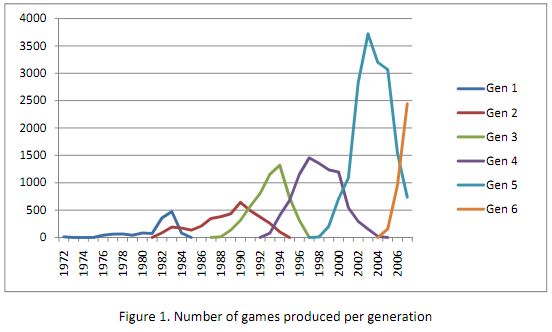
Now, how do these impact long term innovations and economic growth? I haven’t talked about that at all. It’s not exactly straight forward. In some ways, as you can see from the network diagrams yesterday, these disruptive technologies have clearly lead to an explosion of growth within the video game industry. This is most likely why it’s over a multi-billion dollar a year industry. Extensive networking and collaboration at the beginning of a new generation of technology is good for the console maker and the consumer as it leads to a faster ramp of video games. See the graph below:

So, these networks help expand the options for consumers and lead to growth in the industry. Disruptive technologies are really good for the economy. Otherwise, we’d see a steady decline in prices and demand for products as people will already have them. In the example of video games, there are other drivers forcing the continued evolution of console technology, such as competition with the PC gaming platform, as well as continued expectations of better graphics and better game play. While there are a lot of people that scoff at the consoles, they do drive expectations for better graphics. People get tired of the same visual representation of their football teams. They want to see the graphics improve, the physics engines improve. Basically they need a continued improvement of technology to meet these expectations. These in turn help push the boundaries of PC games as well.

This is a fairly rosy picture of this march forward. There’s no concern for intellectual property, any licensing that is being done is obvious. I don’t expect this to continue. Which brings us back to the software patenting issue. We all know it’s a horrible thing.

References:
Vaan, Mathijs de, “Interfirm Networks and firm performance in the face of technological discontinuities” 2010 Druid conference

Disruptive technologies and long term impacts II

Yesterday I discussed how disruptive technologies can drive our economy through creating new opportunities. However, it can obviously have some very negative impacts at the firm level. Let’s look at consoles again. First, as most of us are aware, there are only three major console manufacturers in existence. There have been a pretty steady number of console makers since the 90’s however the players have changed. Sega and Nintendo were the biggest players when I was young, however this shifted to Sony and Nintendo in the mid 90’s with the N64 and Playstation. The console makers are only half of it though. Without publishers, like EA, game developers, like Bungee, the gaming industry would die.

The people impacted by the changing in consoles are not just the console makers themselves, but also the publishers and the developers. In fact, it could be argued that the different platforms (consoles and PC) make it as difficult or more difficult for the developers. Some games the console makers want specifically for their console only. This cuts into the potential profits of a game developer. Additionally, there are difficulties of learning how to program for the new systems. Not all game developer or publisher is going to get early access to the new console. This makes it very difficult for them to actually compete with other developers, which do.

In a pretty cool paper (Vaan, 2010) that looks into the survival rate of developers and publishers after a disruptive change, they investigate the role of a networks. Below is a time series of network changes. Which show that the closer you are to the center of the network increases survival rate.

Network of video game developers (Vaan, 2010)

These networks are important outside of the video game industry as well. In my next blog I’ll go into more details about the importance of networks in surviving new technologies.

References:
Vaan, Mathijs de, “Interfirm Networks and firm performance in the face of technological discontinuities” 2010 Druid conference