Disruptive technologies and long term impacts

So what is  disruptive technology first of all? It’s any technology to causes a shift from a position of knowledge to a position of ignorance within the knowledge production community. That’s not exactly clear. No it isn’t. It’s difficult to define disruptive technologies in a manner like this. However, we all have used disruptive technologies. In the music industry there have been a large number of disruptive technologies. One is as simple as sheet music. Another is the Gramophone and vinyl records (and later turntables and receivers), then 8 tracks, cassettes, CDs, and then finally MP3s. Each of these technologies impacted society in a greatly unpredictable manner. The gramophone and records gave greater access to an amazing array of music to a wider audience. It created an entirely new market, new technologies were created to improve sound quality and increase the production rates. When the 8 track was introduced it had an impact both the home audio and car audio. It gave people access to their own music while driving. You couldn’t do that with records. Most of the knowledge that was generated with records and record players was nontransferable to 8 tracks.

What does this mean? Well it means that through disruptive innovations/technologies, we are able to create dynamism within our economy. A disruptive technology can allow for new firms to break an incumbent’s grip on a market. For instance, in consoles video games there are disruptive technologies every 5 years or so when each of the big players release a new video game system. Over the 30 some odd years of video games and console systems we’ve seen a wide range of entrants and exits. NEO GEO, Atari, Sony, Nintendo, Sega, Microsoft are some examples. Microsoft was able to take advantage of a period of disruptive technology introduction during a generation change in the technologies. This allowed Microsoft to come in at nearly a level playing field. While there was a lot of skepticism within the consumer market and within the technology industry, they were able to take advantage of their technology and get enough game producers to sign on to make games for them.

For consumers disruptive technologies lead to a chance to make a break with a previous technology producer. For instance, when new versions of Apple OS X and Windows Vista were released around the same time a consumer has a much easier time switching to a new OS when buying a new computer. If Windows Vista hadn’t come out around the time of a purchase then it would be very easy to stay with the previous Windows OS. There’s not nearly as much learning required when switching to a new computer with the same OS. However, if you have to learn a new OS, you are free to learn either OS as there are likely similar levels of learning required to actually use that OS.

In my next post I’ll discuss how these can disruptive technologies can impact firms in other ways.
The different meanings of internet freedom

This week we have seen some incredible riots in London. Interestingly, some of these riots were actually predicted by some of the youths a few weeks back, at the end of the video one of the youths mentions that there will be riots. David Cameron had some choice points about the use of social media, Ars Technica has a good discussion about the different sides of social media. However, it is mostly discussing it in terms of causing the riots as well as leading to the clean up of the cit of London.

I find the reaction that we’re seeing on the internet to the usage of Black Berry Messenger and Twitter interesting. These are the same forces that while in affect in countries like Tunisia and Egypt, social media were forces to be praised. However, now that they are being used in England instead they are being vilified. Also, we are seeing pressure from the government to use social media to arrest the members of these gangs.

First, I think what these groups did was horrible. If I was able to I’d try to help the victims of these crimes. However, we need to be aware of the precedence we are setting in the response to this. While there are some differences in the actions, there was looting in Egypt and Tunisia, there are also differences in the situation. The major difference comes from the leaders being elected compared to being despots.

Based on the interviews the Guardian conducted we can see that the youths are unemployed and marginalized. This is similar to what was going on within Tunisia and Egypt. High unemployment and lack things for the kids to do. It’s something of a structural issues. Which Cameron acknowledged yesterday in a speech. So some of the reasons are similar between the rioters in London and with the Arab spring.

However, since it is England asking for data from Twitter and BlackBerry, they are much more will to cooperate with the police. I’m not entirely sure this would have happened in any of the countries involved in the Arab Spring. Leverage over Twitter during the Arab Spring could have killed it. Do we pick and choose which riots we support? I think it’s clear that we do.

We just need to be aware of the precedence we are setting and that all countries around the world are going to emulate the response of the US and England in this riot. There’s no reason why China, Iran, North Korea, or any other country shouldn’t expect Twitter to comply with them if Twitter complies with England.

The actions that our governments take in this case could have long term implications in regards to internet freedom. It also will indicate if there are two different classes of countries when it comes to the allowable types of internet freedom.

I don’t condone what happened, but we need to really understand the repercussions of the actions in wake of these riots.

Economics III

I’m sorry it’s been so long between my last couple posts. I’ve been pretty busy. Brian just moved to Eindhoven from Austin, so I’ve been hanging out with him, moving to our new place, and then I just read a dance with dragons. In addition to that, I’ve also started working on my research project for the summer. Hopefully things will settle down now and I’ll be able to post blogs more frequently.

So, last week, I was beating up on the neoclassical growth model and my friend came running to it’s defense. He had a good point. The best way to predict the weather is based on what today’s weather is. This might work passably well, but will fail pretty quickly here in the Netherlands and in Pittsburgh. It works really well in Austin. Hot today, going to be hot tomorrow. A better way to predict is to create a range of likely outcomes through simulation. This is what the weather man does on the news. They run simulations based upon the current conditions as well as conditions in the surrounding areas to make a better prediction than just walking outside.

Evolutionary economics is based upon these same ideas. Many of the models are more like climate models rather than mathematical equations. These models have predicted crashes similarly to what happened in 2007, based upon the rules of our economy and behaviors of people within the system. There have been some models that have attempted to create models very similarly to the neoclassical models, which are able to account for more of the differences between growth rates within countries.

I prefer the simulation approach over the mathematical models, because you are able to easily change things. As we have more control over our economy than the weather, these changes can reflect policy choices, changes in regulation as well as increases or decreases in government spending. As these changes build on each other the system can simulate how a series of changes within a short time period may impact the system.

The other benefit of evolutionary economics over neoclassical is the clear tie to how science, technology and education impact the economy. These factors are typically left in the residual or the measure of our ignorance in neoclassical economics. Changes in the rate of adoption or creation of new technologies and scientific breakthroughs can impact the long term health of an economy which everyone knows, but the economists haven’t done the best job showing it under neoclassicalism. If they had, then we would never be cutting education and science funding first. We would be pouring money into these systems to try to spur more discoveries!

Neoclassical economics was useful, however, I think the time for it has passed as it is unable to deal with the complexity of the world. Evolutionary economics looks at the economy as a complex system and is designed to handle it.

Further reading:
Origin of Wealth: http://www.amazon.com/Origin-Wealth-Evolution-Complexity-Economics/dp/157851777X
Video:
https://www.youtube.com/watch?v=RQhNZENMG1o&feature=related

Technology Incubators and You

So, I had a discussion on faccebook that went from discussing the cost of labor for a dutch bike mechanic (€40 for about 15 minutes for work to install wheel (i did it myself in 30 minutes instead of paying that)) to a discussion about technology incubators. It got me thinking about incubators and how people think of them. Technology Incubators come in a variety of forms and while many are attached to universities there have recently been a few where they are unaffiliated and some 18 year old kid makes one. But what is an incubator? Well, at the most basic level an incubator is a place that allows a firm to grow from an idea into an actual business. When it graduates it’s at the stage where it’s making enough money to support itself, or it has gotten Venture Capital (VC) backing so it has enough money to expand to a larger facility.

My first experience with an incubator was the Machine Assistance Center (MAC) at the University of Pittsburgh where I did my undergraduate. I thought it was the coolest idea. It was this old warehouse that was converted into separate mini-factories with a few different companies in it. The rent was free or dirt cheap, and there was equipment, like lathes, drill presses and a 6 axis CNC machine. The firms were able to rent time on these tools to create their product, make new prototypes and train new employees. The university also used these tools to train community members on how to use them to gain new skills for employment. Eventually these firms were making enough money that they were able to move out of the MAC get their own place and set up shop there.

I know that in Pittsburgh there are at least two other incubators. I’m sure there are more. Carnegie Mellon started the other two I’m aware of. However, these ones are software based start ups. So these firms have very different needs than physical product based firms. The Innovation Lab at Eindhoven University of Technology, in Eindhoven The Netherlands, where I’m pursuing my master’s degree, has a different model than either. It has spaces large enough for firms that need to manufacture products, but it also has a lot of offices for consultation firms as well. So, there are many different models for an incubator and non are exactly the same.

Ok, that’s great, why should I care about these things? Well, it matters because some of these are tax payer subsidized or were created through your tax dollars (Tax Euros? Just doesn’t sound right). Earlier this year Obama started the win the future campaign, which put a couple hundred million into both VC, public groups and incubators to help reduce the barriers to entry for new companies. Many policy makers believe that these incubators or hubs of heavy start up activity could spawn another Silicon Valley, or greatly boost the economy through job creating companies. Sadly, most of these companies actually only employ a few people and don’t become huge firms like we’d like them to be (Clarysse et al, 2005). However, this activity still can help the economy of the region to some extent.

So what do we do about it? Well, I plan on studying these and their impact for my master’s thesis, so we’ll see what I find. I probably won’t post to much about it as I might try to publish a paper about it. However, when I do that I’ll write about my findings on here. Until then, I say we should be supporting these incubators. Lowering barriers to competition will eventually lead to new products, services and lower pricing. That’s what we, as consumers, want right? Besides, I want to start a company some day and I’d like some help in getting me to the point where I can get VC funding 😉

Moar?
Here’s an article about the “Win the future” campaign from when it was first announced: http://techcrunch.com/2011/01/31/startup-america-a-campaign-to-celebrate-inspire-and-accelerate-entrepreneurship/

References:
Clarysse, B., Wright, M., Lockett, A., Veld, E. Van de, Vohora, A. (2005) “Spinning out new ventures: A typology of incubation strategies from European research Institutions”, Journal of Business Venturing. Vol. 20 pp 183-216 http://www.feb.ugent.be/nl/Ondz/wp/Papers/wp_04_228.pdf

Regulation and Broadband investment

Just finished reading a rather interesting paper from Telecommunication Policy: Regulation, Public Policy, and investment in communications infrastructure: Johannes M. Bauer.

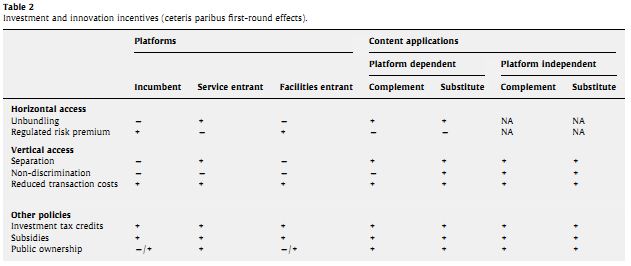
This paper deals with the different regulatory frameworks that relate to Next Generation Networks for telecommunication. There are two major implications for implication. First, looking at opening up the network to additional services will have a short term impact, but may hamper innovation in future networks. Second, investment and innovation at the market platform can lead to higher prices and in some cases slower penetration where there is minimal return on investment on the infrastructure (think middle of no where US).

This is important as in the US we hear about how prices are cheaper for services in Europe. This is very true and some countries have significantly better broadband infrastructures than the US. Such as the Scandinavian countries, South Korea and Japan. Many of these countries have had very active partnerships between public institutions and the private firms rolling out the new network.

We all can remember what it was like on dial up back in the mid to late 90s, and how after some time we started to see a huge increase in the number of service providers. This is because the regulators did something called “unbundling” which forced the telecoms to open up their network to any service providers. This caused a drop in price, but it reduced any sort of infrastructure investment at the dial-up level. With broad band we are starting to see this to some extent, but not nearly at the level we saw it with dial-up. This has to do with the fact that these networks are still being deployed. If these networks are opened up to just any old service provider the incentive to continue to invest drops off as a firm like Verizon will make less money off of their large investment to lay down fiber.

However, we should concern ourselves with the medium of the broadband. Cable services are much more prevalent than fiber networks, dynamic regulations are required to account for the differences in the network. Opening up the cable networks at this point may be desirable as the infrastructure for the network is well established with high prices for these services. Perhaps it is time to unbundle the network from the services.

In the picture above are the different types of regulations and the short term impacts on innovation and investment. From this table, it’s clear that depending on the situation of the network different regulations need to be in place.

So, my take on this: we need to have extremely flexible regulations that work to drive incentives for investment and innovation. In the US there needs to be different regulations than in Europe as there has been a different history of regulations. However, to drive down costs while pushing for innovation into the next generation of networks, I think a fair method would be to allow for something similar to patents for these networks. A given time period after a large portion of the network has been installed where the telcom that laid down the network has exclusive access. Then after a given period, 5 years or so, the network has to be opened up and no preference to the data can be allowed. This will allow the firm to recoup investment as well as plan for the next generation of networks. So possibly faster fiber switches, or all wireless or whatever.

I still think that the networks need to be data neutral because there can be consequences on unregulated markets if the networks aren’t open. For instance gaming and video streaming would be the first to take a hit. This would have repercussions in a network completely unrelated to the broadband company, yet still have potential for financial impact. In other words, gamers may get pissed and stop gaming.