Advances in Healthcare science will change our lives

We are at the very beginnings of a healthcare industrial revolution. Perhaps, we’re beyond just the beginnings, we’ve seen huge leaps and bounds in diagnosis and treatment in the last 20 years. In my life time Aids has gone from being a quickly terminal disease to a disease where people are able to live relatively healthy lives which also last nearly as long as the average person. This is all without needing to have the sums of money of Magic Johnson.

This alone is something to celebrate, but there’s a lot more work to be done in easing the pain of suffering patients. Many Americans suffer from dibilitating heart diseases, which in some cases require heart transplants. Transplants are extremely risky procedures because the body can and does reject the new hearth. So, even after receiving the new heart, many patients are on immune system suppressing drugs. This increases their risk of infection and contracting other diseases, which can of course reduce the quality of life and inreases the risk of premature death due complications of the transplant. Recently, there’s been a serious break through in building a heart scaffold.

What is a heart scaffold? This is essentially a structure that allows your own cells to re-build your heart. In the case of this breakthrough, another heart had all of the specific cells that would have been rejeted by the transplant patient. The underlying structure remains because it is generic tissue that is transferrable between species. This break through allows patients to use their own stemcells and heart cells to convert the scaffolding into a function heart that is the patient’s own heart, not a transplant heart. This reduces the likelihood of rejection by the patient, eliminates the need for the immune suppressing drugs, and improves the results.

In the paragraph above, I said transferrable between species. The heart that is being used isn’t even a human heart, it’s a pig heart. This greatly increases the supply of hearts, because the number of hearts that can be transplanted is based on the number of peole willing to donate a heart and that are in good enough condition to be transplanted into another patient. We can hope for future advances for other types of organs as well.

This isn’t the only type of advancement we’re seeing along this vein. There is a pen that can draw cells on bone, and there are 3D printers that are being developed to print organs, like livers.

We live in exciting times for sciene in healthcare. We just need to figure out how to have medicare and insurers pay for the next.

Healthcare is not a free market

From the obvious department, amIright? Yes, but not for the reasons you think. Healthcare cannot and never will be a free market. There are several reasons for this that I will elaborate on here.

Healthcare consists of micro-regulation in the form of the reimbursement structure. This is an artifact of two different systems combining to make things worse. First, because the Federal Government is big and has two different programs one for Federal Employees and one of those in need Medicare/Medicaid (I’m combining them here for simplicity), there’s also the VA, but that has much less influence on healthcare. These two programs set the terms on how the government will reimburse or even pay providers for care provided. These are based on Current Procedure Terminology (CPT Codes) and not based upon your diagnosis. Essentially the government sets a price they are willing to pay for a procedure. As one of the largest market players, this influences all of the other payers (IE insurance companies). Many insurance companies use Medicare payment rates to set their own, which drives down the cost of a procedure to the point, in many cases, where it’s below the cost of the actual care. This drive providers to select more expensive and more procedures in many cases to make up the short fall. This payment model also makes it hard for new procedure methodologies to be adopted as they may not be paid for.

Healthcare is a network economy – nearly all care happens close to home. This is why groups like the ACLU argue that driving more than an hour for an abortion is an unnecessary burden on women. Because of the proximity of the majority of care (10.2 miles) this creates a local network of care based on the original provider a patient sees. When you receive a referral, there are a few different routes this can go, best doctor the the referrer knows, another doctor in the same clinic, or in the same care network (such as UPMC in Pittsburgh or Kaiser Permanente in CA). This drives an incentive to send patients within the network leading to mutual referrals or money staying within that care network even if there are better doctors for that specific patient outside of that care network. In addition to the Doctor’s network there is, of course, your insurer’s network which may be in direct conflict with the professional network that your provider has.

Imbalances of knowledge – in typical free markets there’s an assumption that everyone has the same amount of knowledge. In Healthcare, it is abundantly clear that this isn’t true. Most patients have little to no understanding of their diseases when they are first diagnosed. On the other hand, both their insurer and provider has an extensive knowledge of the disease. This limits how well the patient is able to correctly make decisions about their healthcare. It also pushes reliance to the provider whenever there is a disagreement between insurer and provider. The member can’t effectively participate in those conversations about care. Furthermore, there maybe little penalty to the patient if they fail to follow the prescribed course of care until much later where neither the insurer or provider can enforce a change of behavior to reduce costs for the entire system now through treatment rather than later when there are more complications.

These are but three cases that highlight the lack of free market mechanisms in healthcare. Even in cases where a patient wants to seek the best care it’s typically the patient’s responsibility to pay for it if it’s not with in the insurer’s network. In many cases these clinics can reduce systemic costs through lower point of care and lower likelihood of readmission after care.

Over the course of the next few weeks I will discuss Exchanges and their potential, how healthcare can be made more affordable using process improvement tools and other mechanisms. I plan on writing weekly on healthcare. If you have any topics that interest you please comment and let me know!

Tools that will help disrupt Healthcare

I’ve been reading this really interesting book on healthcare – it focuses on the potential Hows that healthcare can be disrupted. If you aren’t sure what disruption and/or disruptive innovation is then check out my last blog about some of the industries where it’s occurring and you’re likely part of the disruption.

If you buy your own health insurance you may have noticed a new type of insurance. It was new to me whenever I joined my health insurance company in the North West. Neither AMD nor Samsung had similar plans so when I first signed up for it, I was extremely ignorant of what it was and just signed up for something that looked good. This type of insurance is called HDI w/ HSA.

HDI: High Deductible Insurance. This means that you’ll likely have a high deductible (obviously) and will have to pay out of pocket.
HSA: Healthcare Savings Account. This is an account that allows you and your employer to make pre-tax contributions. You will also be able to pay for healthcare tax-free and accrue interest tax free as well. This is great in terms of how much money you actually gain from this. When you pay for a healthcare service like a Doctor’s visit, you’ll have to pay all $150, however, since you didn’t pay taxes on that $150 you end up saving money. Further, your employer can contribute to this account in the same fashion as your 401(k) and your account will be invested in a similar fashion as a 401 (k).

Of course there are some draw backs to this type of health insurance. First, until you reach your deductible you’re going to end up paying out of pocket. You could potentially have a deductible as high as $5,000 which is highly undesirable. Your employer might not contribute to your account, which places more of the burden on you, which sucks.

How can this contribute to disrupting healthcare? Well, you’re going to start really shopping around for your day to day medical expenses. You’re not going to go to a specialist unless you really think you need to. You’re not going to go straight to the hospital for care. You’re going to try to find another place to get the care you need. This will open up the possibility for care givers to provide healthcare in other fashions. This will potentially change the way that insurers will begin to pay out to providers as well.

There is also a push for Accountable Care Organizations, look for those as well, which are paid based on outcomes rather than the type of service being provided. These organizations will help disrupt incumbent firms and will likely capture the attention of insurance agents. I believe that in many cases this is where a lot of Exchange insurance programs are going.

Personally, I’m excited about the potential to work within an insurance company to disrupt the industry. I believe that there are changes that can be made internally, through educating on what metrics are and how to improve based on these metrics. I also believe that we’ll be in a position to help enable providers to be more efficient and effective care.

Healthcare: the Value Stream of care

In Lean process improvement, one of the first steps you ever take is to walk the process. For manufacturing this means to go down to the floor where the product is made and walk with one piece from beginning to end. This provides the manufacturer insight into where there’s a great deal of waiting for product to come, leading to idle workers, where there’s a lot of inventory piled up – a bottle neck, if there’s a lot of rework – fixing defects like re-etching a person’s name on the back of an iPhone, and how the material flows around the floor. This works pretty well with doctor’s offices too. You can draw a map to all the different places the Dr. walks, the nurses walks, and where the patient walks. Any transportation in a Lean system is waste, so reducing that is important.

Mapping value streams essentially take this to the next level. You map all the major steps that the material that goes into your product step through before and after you. This allows a manufacturer to see all the waste before and after them, enabling them to partner with their suppliers and customers to reduce waste and unnecessary processing. For example, many of us have worked retail. Some times when you do stocking you’ll find shirts that are in bags that are in a box. This is non-value add because it’s highly unlikely that the bag would protect the shirt from getting wet in the case of a flood. So, it’s a waste of plastic for the bag, putting the bags on the shirts, and removing the bags from the shirts are all waste. Which increases the cost of a shirt. However, there’s a beginning and end of the value stream likely starting with cotton and ending with the final sale to the customer. In the case of a can of cola, it takes 319 days from the mining of bauxite to the consumption of the cola with only a total of 3 hours of actual processing of the material (Lean Thinking, Womack).

Value Stream for a can of cola through bottling (Womak Lean Thinking)

Why such a long introduction? Well, the value stream for healthcare is completely different. The beginning is when you’re born and the end is when you die. Otherwise, every activity you partake in impacts your health and the eventual cost of any episode of care. An episode of care is what happens when you directly interact with a provider, hospital, or health insurer. Arguably, these are the exception to your normal behavior and take you out of your normal routine.

Thinking about health in a value stream like this is non-intuitive for providers and insurers alike. As both have accounting practices and treatment plans that focus mainly on the episodes of care and minimize the remainder of the activities a member does. Thinking in this manner places more importance on preventative care, longer term plans for mental and physical rehabilitation, and care networks for long term diseases. This is a serious shift that is starting to occur in many insurance organizations, but aren’t very effective yet. The most effective portion of those three are the networks of patients that have a similar disease, such as Crohn’s Disease.

I believe that looking at care in this fashion will help redesign the manner that care is designed as it will focus on different portions. As my friend Rachel pointed out, behavioral health issues are typically undervalued in the value stream of healthcare. However, with this model long term care issues should be given priorities as they impact the highest percentage of the value stream. It would also force insurers and providers to look at addressing care holistically and providing the best care in the best way when they can. Sending patients to clinics that can quickly treat conditions as cheap as possible.

I’m extremely interested in how this will play out at my company as we think more holistically about value streams for health care. Checkout my last two blogs about health care:
http://scitechkapsar.blogspot.com/2013/11/heathcare-how-insurance-company-decides.html

http://scitechkapsar.blogspot.com/2013/11/healthcare-why-do-we-need-medical.html

Healthcare: Why do we need medical policies?

In my last blog post, I discussed how US health insurance companies decide what to pay for, what information they need to make decisions on paying for care, and some of the ways they go about making those decisions. I only briefly discussed why medical policies are required and why there’s a lot of complexity around health care. I hope to shed some light on this and help people understand the difficulty that both Providers and Insurers have in dealing with the cost of health care.

First, not all diseases are equal. This one is pretty obvious, but I’m not even talking about how severe the diseases. That’s vitally important of course, but even a “minor” disease can lead to long term impacts to quality of life because we don’t know how to treat the disease. In some of these cases it might just be embarrassing, such as if I eat Gluten and I’m out and about the next day. I’ll probably have some serious issues and won’t be able to enjoy myself while I’m out. There are two reasons for that. One, it’s not really obvious what condition I have. Two, there’s no treatment to allow me to eat gluten other than “avoid” wheat, barley, and gluten. Which in many cases is rather difficult.

This brings me to the second reason why there’s a lot of difficulty – it’s difficult to even diagnose what disease people have. So, for gluten issues you have only a few options, one is a blood test to looking for an immune response to a gluten or to have a colonoscopy to see what sort of damage has been done to your large intestines. Because of this lack of precision, in many cases it can lead to the matching the wrong treatment for the right disease, vice versa, or wrong treatment for the wrong disease in the most extreme cases.

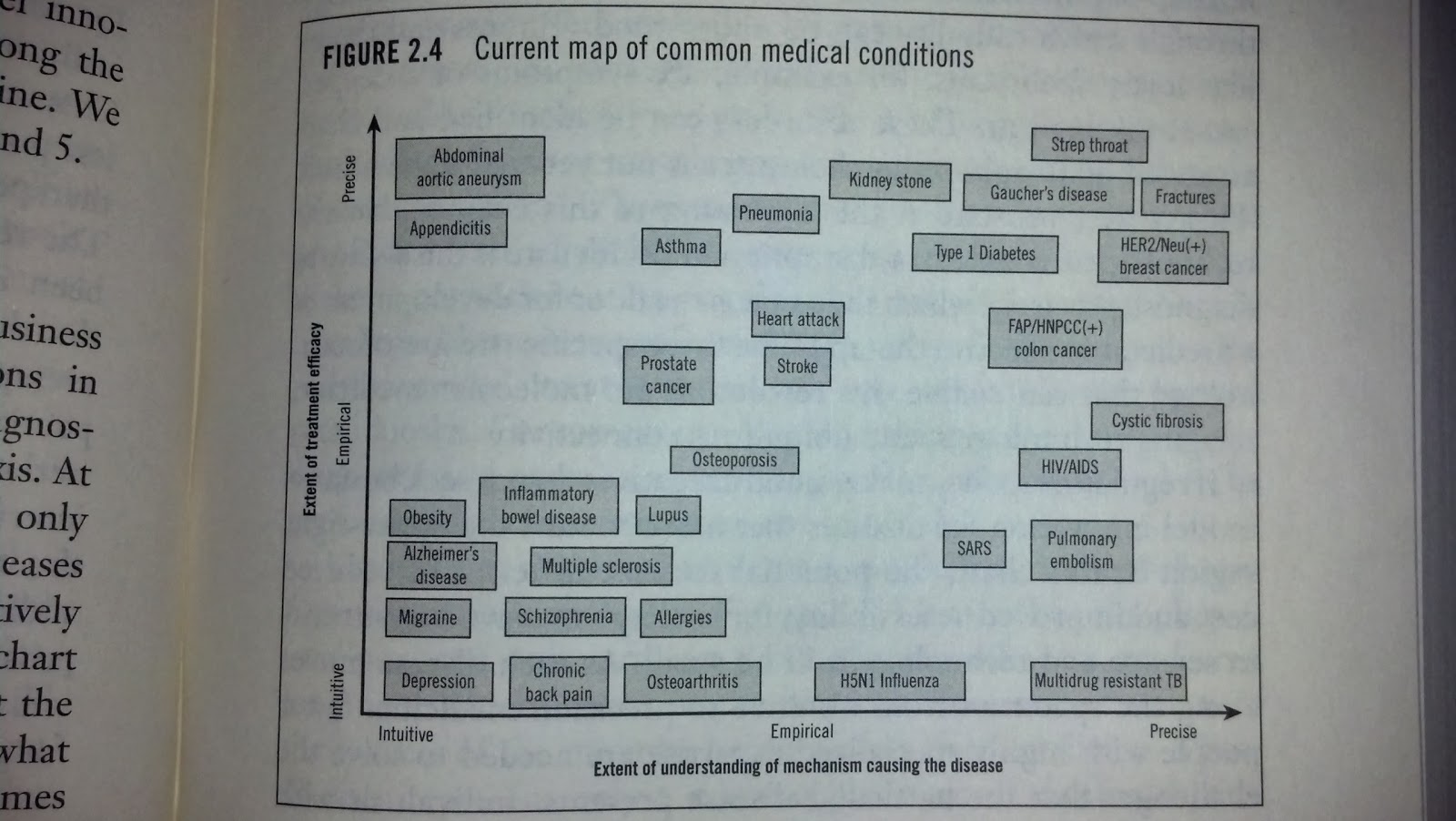
Precision of Diagnosis and Precision of Treatment matrix

In the above picture from “The Innovator’s Prescription” it’s clear which diseases are “better” to have, those in the upper right. While those in the lower left are much harder to treat and have less consistent outcomes. For anything in between the cost and quality of care is really dependent on the experiences of your provider. I believe that this is where insurance companies can add a lot of value. Using medical policies and partnering with providers they can artificially expand the experience of a provider through providing the latest scientific research and results for a treatment and disease interaction. This will help allow providers to focus on care while getting the latest medical news from their network of insurers.

This really puts the model on it’s head as the provider can take advantage of the diverse networks they are part of to learn different components of research based on the focus of those providers. I think that a true partnership between insurers and providers really will drive down health costs.

This complexity is unfortunate, but is truly part of our human condition. One way to reduce costs is to increase the amount of research that pushes care into the upper right from the bottom left. Otherwise, it’s difficult for an insurer to determine which providers are taking advantage of patients and which ones are honest. There’s imperfect information on both sides and the patients pay for it in the long run.