Innovation

Yesterday I said I was going to discuss how patents impacted innovation. However, I think the first thing we need to do is clarify what innovation is. Schumpeter, described innovation as bringing a product to the market. He claims that without innovation, invention is worthless. Indeed, patents play this out. There is no legal requirement to actually manufacture anything that you’ve patented. I will discuss that in more detail tomorrow though. Schumpeter also notes that these innovations are the source of creative destruction in the economy. He claims that through innovation we are able to keep growing. He called these the long waves. See the picture below for a representation of these waves and the innovations that drove the economy at the time.

Based on Schumpeterian principles we can see that we should expect growth slow down and potentially economic issues at these times. So, if an innovation is bringing a product to a market, in what ways can we innovate? There are four ways in which innovation can occur in a product; Incremental, Modular, Architectural and Radical. Please see the picture below:

Henderson and Clark ,1990

Most innovation occurs in the upper left hand corner, incremental innovations. These are fairly obvious and most people aren’t surprised to see these products. Products like iPhone 3G after the iPhone first came out. this was an incremental innovation on this product. While Apple did a fantastic job making it sound like it was a radical innovation, it simply wasn’t.

The next most likely is the modular. In this case it could be considered that an electric car might be a modular change. As you only have to change one part of a larger piece of equipment. In this case a combustion engine is replaced with an electric engine.

The architectural changes are less common than either of the previous. As these ones typically require a great deal of changes within a firm. An architectural change can be described as going from a ceiling fan into a box fan (Henderson and Clark 1990). Seems pretty simple right? Well, there are a lot of changes that go into this innovation. You have to think about how to keep the box from falling over. How to keep the noise down. How to protect the users. You also have to manufacture everything differently. So, in many cases there are two innovations within an architectural innovation. One at the product level and one at the firm level. Another example is the reintegration of the original developers of the Mac into Apple after the successful product launch.

The final type of innovation is the radical innovation. This is the stuff that “creative destruction” is made from. When these types of innovations occur most of the previous knowledge base is blown away and the innovators have to start all over again. I’d say the most common example of something like this would be with game consoles. Basically each time a new one comes out everything starts all over again. Other examples can include things like the Jet engine from the propeller. Not only did this require changes in the aircraft but it also required changes in the runway, it needed to be longer than before.

There are many cases of Radical innovations and in some cases they completely reworked our economy. IT/ICT is the most recent set of radical innovations that is shaping our economy. These technologies are heavily patented and impact our economy. Tomorrow I will look at how these patents interact with innovation to increase or decrease the rate of innovation.

Further reading/Citation:
Henderson, R., Clark, Kim. “Architectural Innovation: The Reconfiguration of Existing Product Technologies and the Failure of Established Firms” Administrative Science Quarterly, Vol. 35, No. 1.
http://dimetic.dime-eu.org/dimetic_files/HendersonClarkASQ1990.pdf
What is a Patent?

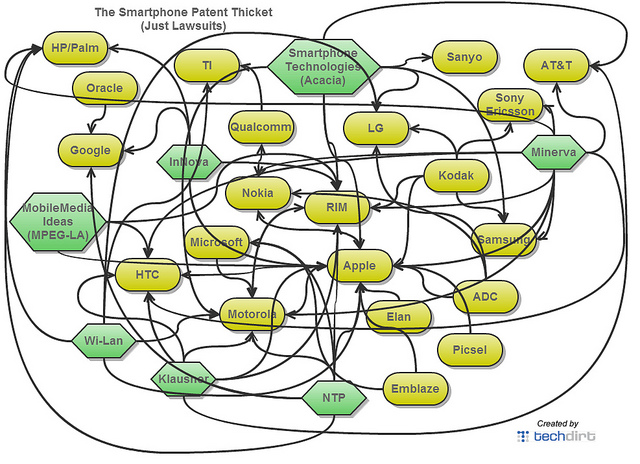
In the news we hear about various lawsuits from high tech companies over patents. Right now there is a tangled mess of patent lawsuits flying back and forth between firms like HTC, Microsoft, Apple, Google, Motorola, Nokia, and the list goes on. So what are they suing each other about? Why are they suing each other? What kind of impact does this have on innovation in general?  All of these are important questions. To answer these first we need to understand what a patent is. In the most basic form a patent is a contract between the government and an inventor. This contract bestows certain rights to the inventor and certain obligations that the inventor must fulfill for the government. However, not everyone can enter into this contract. There are requirements for earning a patent. Note I say earning a patent not obtaining one. This is important.

Smart Phone Patent Thicket
So, how does the inventor earn this patent? Well, there are three basic criteria. The invention has to be novel, non-obvious, and useful. To be novel means it has to be new, no one has come up with this idea before. To be non-obvious, it has to be something that a person couldn’t figure out by looking at the device. For example if there is a patent on nail clippers, you can’t get a patent on a larger nail clipper. It’s an obvious invention. To be useful means it has to be intended for some sort of use and isn’t just technical details of something that cannot be used. This are the general requirements of patents. However there are some other nuances. For example, in Europe you cannot patent software but you can in the US. In Europe and the US you cannot patent genes. Basically these nuances are part of the reason why patent lawyers exists.
This doesn’t explain the patent mess shown above though. How does this happen? Well, the patent bestows a temporary monopoly for the inventor. Typically this is about 20 years, in some cases it can be extended like for pharmaceuticals. Here’s a link to a patent, i just picked one at random from RFIDs. So looking at this, if you scroll down until you see the word “Claims” these are what actually are protected. These items are what the inventors actually have the monopoly on. These are typically worded very vaguely and broadly to ensure maximum coverage under the law. Which means it’s easy to step on people’s toes. Which they will sue you for. I’ll discuss this in more detail in another blog post.
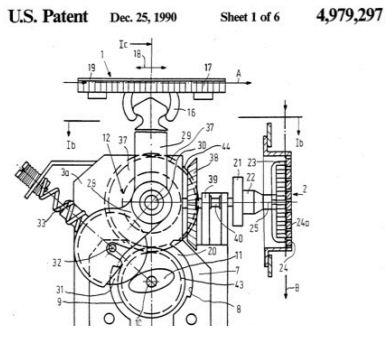
Since this is a contract, what does the government get in return? The inventor has to give full disclosure of how this invention works. Below you can see a picture from Philips’ electric razor. 
Philips electric razor USPTO
The release of this information should allow any competitor to recreate this technology in their lab. 
That is basically a patent. Rights to protect the invention with release of how the invention works. I will answer some of the other questions I posed in later blogs.

Regulation and Broadband investment

Just finished reading a rather interesting paper from Telecommunication Policy: Regulation, Public Policy, and investment in communications infrastructure: Johannes M. Bauer.

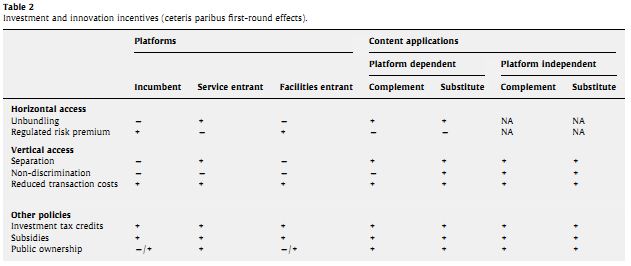
This paper deals with the different regulatory frameworks that relate to Next Generation Networks for telecommunication. There are two major implications for implication. First, looking at opening up the network to additional services will have a short term impact, but may hamper innovation in future networks. Second, investment and innovation at the market platform can lead to higher prices and in some cases slower penetration where there is minimal return on investment on the infrastructure (think middle of no where US).

This is important as in the US we hear about how prices are cheaper for services in Europe. This is very true and some countries have significantly better broadband infrastructures than the US. Such as the Scandinavian countries, South Korea and Japan. Many of these countries have had very active partnerships between public institutions and the private firms rolling out the new network.

We all can remember what it was like on dial up back in the mid to late 90s, and how after some time we started to see a huge increase in the number of service providers. This is because the regulators did something called “unbundling” which forced the telecoms to open up their network to any service providers. This caused a drop in price, but it reduced any sort of infrastructure investment at the dial-up level. With broad band we are starting to see this to some extent, but not nearly at the level we saw it with dial-up. This has to do with the fact that these networks are still being deployed. If these networks are opened up to just any old service provider the incentive to continue to invest drops off as a firm like Verizon will make less money off of their large investment to lay down fiber.

However, we should concern ourselves with the medium of the broadband. Cable services are much more prevalent than fiber networks, dynamic regulations are required to account for the differences in the network. Opening up the cable networks at this point may be desirable as the infrastructure for the network is well established with high prices for these services. Perhaps it is time to unbundle the network from the services.

In the picture above are the different types of regulations and the short term impacts on innovation and investment. From this table, it’s clear that depending on the situation of the network different regulations need to be in place.

So, my take on this: we need to have extremely flexible regulations that work to drive incentives for investment and innovation. In the US there needs to be different regulations than in Europe as there has been a different history of regulations. However, to drive down costs while pushing for innovation into the next generation of networks, I think a fair method would be to allow for something similar to patents for these networks. A given time period after a large portion of the network has been installed where the telcom that laid down the network has exclusive access. Then after a given period, 5 years or so, the network has to be opened up and no preference to the data can be allowed. This will allow the firm to recoup investment as well as plan for the next generation of networks. So possibly faster fiber switches, or all wireless or whatever.

I still think that the networks need to be data neutral because there can be consequences on unregulated markets if the networks aren’t open. For instance gaming and video streaming would be the first to take a hit. This would have repercussions in a network completely unrelated to the broadband company, yet still have potential for financial impact. In other words, gamers may get pissed and stop gaming.