YouTube Copright School

Since I’ve been posting recently about copyright and infringement and YouTube, I figured I should watch the video they have posted for “Copyright School.” Although I tried to embed the video into this post it appears it’s not working. So you can find the link here.

The video itself is moderately annoying. The song used through out the video kind of reminds me of this song.  It explains the bare bones basics of copyright works and how copyright can work on YouTube. It shows how copying a video is copyright infringement, and how potentially filming a live concert can be considered copyright infringement. Although they didn’t explain it was infringement because of the song not because of the video itself.

The fair use part is rather deplorable. However, this is to be expected. I’m sure whenever the writers got to this section the lawyers heavily edited it. I’d argue that it’s overly protective of YouTube. By stating that most remixes are likely to be outside of fair use, the video makes it very safe for YouTube itself. Youtube can point to this video and say, “See we told them those remixes weren’t allowed under fair use.” However, this is not entirely accurate. In fact the very video they use to explain this problem most likely is covered by fair use. Realistically, there’s no difference between the video Youtube uses and Numa Numa.

I’m not an expert at fair use, so I decided to post some commentary from one person who is. Here’s a pretty good discussion between Colbert and Lawrence Lessig. In this they discuss how remixing is and should be ok under fair use. It can benefit both parties. Here’s a blog post written by Lessig describing some of the failures of the fair use system as well.

So what can we gather from these two discussions and the YouTube video? First, YouTube is clearly putting itself in a position to not be liable for any work that may not actually fall under fair use. Second, it’s difficult to determine what is and what is not fair use. Lessig also points out that there is a dividing line between commercializing the work and keeping it for free. I’d suggest as much as possible to clearly understand these issues before attempting to commercialize any remixes.

In the terms of the internet commercialization isn’t the same as it used to be. Placing ads on your blogs or within your videos basically commercializes your work.

Btw here are two remixes from the Colbert Lessig Inteview.

Copyright’s History and what’s gone wrong

I’m not going to go into a super deep history of copyright here. What I plan to do is outline the general idea behind copyright and how it’s shifted over time. If you want an in depth discussion on this I suggest reading it from Lawrence Lessig’s book Free Culture which the link to a direct download isn’t working right now. I can email it to you if you’d like, I believe.

Basically, the idea of copyright came about around the same time as patent protection. The idea, which is rooted in the same theories as patent protection, is to give just reward to people who created creative works, without fear of someone stealing it, and selling it for their own gain. This worked extremely well in a time when to listen to a great piece of music you had to listen to it live. This is where the public performance aspect came into affect. Of course, books were much more difficult to copy en mass as it’s really expensive to print a run of books. Copyright was originally much shorter in length of time than it is currently. At the longest it was until the creator of the work died. Now, as we know, copyright can persist significantly longer. We have more interaction because the material is more accessible. In the early 1900’s there was a big congressional hearing about sheet music. If sheet music should be allowed at all. Today, I think our version of sheet music is the video or musical remix, al a GirlTalk. I feel like I’m really pimping Lessig today, but he also wrote a book specifically about this topic called simply enough Remix. In this book he interviews GirlTalk about this very topic.

So, how does this shift in copyright really impact us? Well, as we can tell from the O’Dwyer case, RIAA, MPAA, and their equivalents in other countries, we interact with copyright on a daily basis. Not enough of us have a clear understanding of how we’re actually interacting with it. It’s conceivable that the video commentary out on Youtube for video games is technically copyright infringement. However, it would be stupid for video game publishers to go after the Youtubers, like my friends at KBMod, because they are effectively giving free advertisement for these games.

I suggest people that are active in posting videos online on Youtube become aware of the copyright issues that you may be interacting with. Sadly, ignorance is not a defense. The books I’ve mentioned above are easy to read. Lessig writes in a very clear way that non lawyers can understand easily.

Copyright and the O’Dwyer case

So, I’m not sure how many of you out there have heard about this O’Dwyer case. Tech Dirt has a nice article about it today check it out here. If you don’t feel like reading it I’ll summarize it. An UK student is being extradited to the US over a website he set up which links to streaming content. The website had already been ICE’d, or seized by the US government. Apparently that wasn’t enough now the Southern District of New York wants to bring this kid over to the US and try him, for something. However there are some problems:  “a) perfectly legal in his home country and (b) probably legal in the US.” (tech Dirt article). So, this is a bit of a problem. O, and by what he means by legal in the US is that it’s not criminal, and you can only be extradited for a criminal offense.

So, this really brings into focus some of the activities of ICE in general. There are a lot of people that are concerned with the overly broad approach to seizing domain names as there is not much judicial oversight. What that means is that these actions could have a chilling affect on freedom of speech, destroy businesses, and in some cases lives. One of the seizures involved a false accusation of child pornography. That can completely destroy a person’s reputation. The other problem is that it’s not even clear that these actions are completely illegal.

The US copyright laws are getting progressively more difficult to understand. This comes at a time when users are interacting with copyright in their daily activities. To enjoy media people should not have to concern themselves with a byzantine set of laws. I plan in the upcoming weeks to write some posts about the history of copyright and how it has changed over time. I’ll also discuss some of the Creative Commons “Copyleft” movement that’s been founded by Lawrence Lessig.

Let’s bring in the lawyers (Patents)

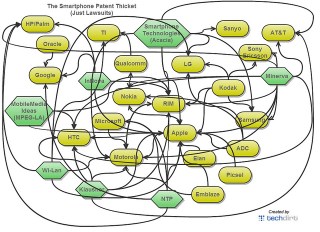
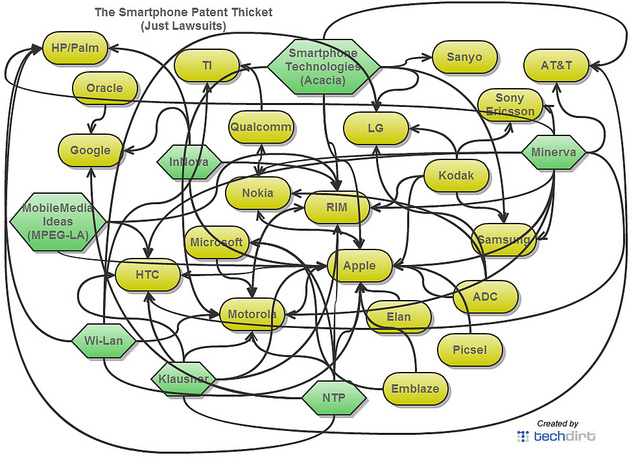
So, building on my previous post, What is a patent?, I’m going to discuss some of the reasons why lawsuits happen due to patents. Depending on how long this discussion is, I may or may not get to how this impacts technological innovation. If I don’t then I’ll cover it on Monday.  Starting again with this lovely drawing from Tech Dirt of all the law suits related to smart phones I’ll discuss how something like this can happen.
Patent Thicket Lawsuits

As I mentioned in the previous post patents are to be awarded for non-obvious, novel, useful ideas. This can be extremely difficult to actually judge. For instance, there is a patent owned my Smuckers that describes a method to crimp the edges of a peanut butter and jelly (PB&J) sandwich with the filling layered in a specific order. So, let’s say you’re a patent examiner. You’re a technical expert in some field, the one related to food processing perhaps. How would you look for examples of prior art? Where prior art is articles, technologies or anything that does the same process. For crimping a PB&J sandwich where would you start? Well, in this case the examiner wasn’t able to find anything and awarded the patent. However, there are two problems with this. This is a fairly obvious way of making a PB&J sandwich. I’m sure many people ate sandwiches like this in their youth. The other problem is that there was a company in Michigan that had been making these from the 1800s, which means it’s not novel. Once the patent was awarded Smuckers sued this little ma and pop restaurant over patent infringement. For more information on this exact story please read Jaffe and Lerner’s Innovation and Its Discontent (2006).

In the Smucker’s example presented in this way, it’s fairly obvious that this patent shouldn’t have been awarded in the first place. However, it was. So that means the only way to invalidate the patent is in court. However, this can be extremely expensive. According to Jaffe and Lerner (2006) these law suits account for roughly 25% of R&D expenditures and that many lawsuits cost hundreds of thousands of dollars regardless of the fine or impact to production. While this case was straight forward more advanced technologies are much more difficult to analyze in this fashion.

Here is a link to an Apple patent for Gestures for controlling, manipulating, and editing of media files using touch sensitive devices. Here is a claim that Apple is saying is unique to this specific invention:

1. A computing device, comprising: a touch-sensitive display; a processor; memory; and one or more programs, wherein the one or more programs are stored in the memory and configured to be executed by the processor, the one or more programs including instructions for: playing-back a video file on the touch-sensitive display; displaying a play progress bar on the touch-sensitive display, the play progress bar including a timeline indicating a time span of the video file being played; detecting two touch points making initial contact at respective initial positions on the play progress bar; detecting the two touch points moving away from each other on the play progress bar; and, in response to detecting the two touch points moving away from each other on the play progress bar: expanding a portion of the play progress bar in accordance with the movement of the two touch points, wherein the portion of the play progress bar that is expanded is determined by the respective initial positions of the two touch points; and contracting a part of the play progress bar outside the expanded portion.

This basically is how most people are interacting with their phone to zoom in for pictures or whatever. However Apple is claiming that this specific gesture is unique to this patent because of the specific application of the gesture. Fortunately, this patent has not been granted yet and I hope that this does not get granted.This is a software patent and it’s difficult to say if this will be granted or not.

Regardless of what I want, this patent may be granted. With the broadness of the first claim it is difficult to tell what sort of impact this patent would have on the smart phone industry and could introduce additional lawsuit from Apple towards firms like Google, HP, HTC, Microsoft, etc. Additionally, with the wording of this claim it is difficult to say if there aren’t other patents that have a similar claim to being unique.

As you can tell these claims leave a lot of wiggle room and can increase the likelihood of a lawsuit in a fast growing new technical area. These new technical areas are still being explored as firms are patenting technologies related to it. In many cases the Patent Office hasn’t fully decided if specific types of patents should be allowed.

Tomorrow I will look at some of the potential impacts on innovation of this type of patenting.

Additional readings:

A.B. Jaffe & J. Lerner (2006). Innovation and Its Discontent.  NJ: Princeton
University Press.

USPTO http://patft.uspto.gov/netacgi/nph-Parser?Sect1=PTO2&Sect2=HITOFF&p=1&u=%2Fnetahtml%2FPTO%2Fsearch-bool.html&r=14&f=G&l=50&co1=AND&d=PTXT&s1=Apple.ASNM.&OS=AN/Apple&RS=AN/Apple

GDP a Tragedy of the Commons

In my Novel Technology and Human Behavior course we have an assignment related to a specific novel technology and how it interacts with philosophical ideas and psychological reasoning. So, of course my group member Timmy and I decide to do work on something that is mostly unrelated to actual technology. We decided to look into different metrics for growth. GDP is the current standard for everything. High GDP and GDP growth is currently construed to mean that you have high well being in a given country. However, this is not what the metric was originally designed to measure. So what does GDP measure? It measure most major economic activity. It measures production, hospital bills, and end good sales for example. However, it excludes factors like education, house hold activities and the black market. These are serious gaps. As most people will tell you that have been employed we tend to focus on the activity that is measured. So if you’re at work and you need to get defect counts down or shorten call time for tech support you will do everything you can to make that happen. Even if it’s actually bad for the company you work for. So, if you have high defects you can reduce your measuring frequency to make it look like your defects are better. Or if you’re on a phone call you can be rude and just give the minimum help you can. These are negative results from a measurement.

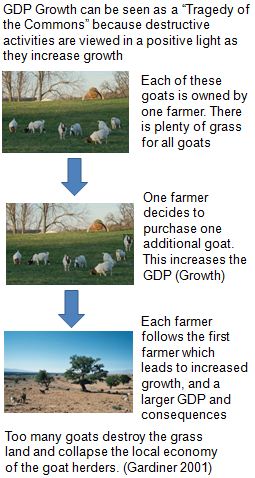
In our poster we argue that something similar happens with GDP. So a tragedy of the common happens all the time. It can be something as inconsequential as replacing the water from a community water cooler. Most people won’t do it because you assume that some one else will. Below is an example of what I mean by how GDP is a tragedy of the commons.

Even the collapse of the local economy may be seen as increasing the GDP. As the goat herders are trying to save the land they may slaughter additional goats, buy fertilizer, get some seeds, buy fencing to block off an area so it can regenerate from the goats. All of these things are seen as beneficial to the economy when it is actually very destructive to this aspect of the economy.
So what can we do about it? Well there are some different metrics that can be used to measure well being while taking into account sustainability, such as Green GDP. China actually attempted to implement this, but decided against it as it lead them to have smaller growth numbers and may have put them at a competitive disadvantage. Timmy and I believe that some good ways to deal with this, is to focusing on what is preventing people from adopting more sustainable technologies, and then trying to create incentives to drive further adoption. We’re finding that this problem is a bit of a catch-22, you can’t get people to adopt the different measurements without people adopting green technologies, but you can’t get huge investment in green technologies without incentives from a new indicator.
Further reading/Video watching:
Bergh, C.J.M. van den (2009), The GDP paradox, Journal of Economic Psychology 
20 (2009) 117-135
Gardiner. 2001, “The real tragedy of the commons” Philosophy and Public Policy Vol 30, No. 4
Tim Jackson, writer of the book “Prosperity without growth” for instance http://www.youtube.com/watch?v=_Jq8WUp1x8k (7:19)
David Korten, writer of the book “Agenda for e new economy” for instance: http://www.dailymotion.com/video/xgeykn_david-korten-on-ways-to-create-an-economy-that-values-life_lifestyle (13:42)
Hans Rosling: New insights on poverty and life around the world http://www.youtube.com/watch?v=YpKbO6O3O3M (20:55)