Book Review: Algorithms of Oppression: How Search Engines Reinforce Racism by Safiya Umoja Noble

Algorithms of Oppression: How Search Engines Reinforce RacismAlgorithms of Oppression: How Search Engines Reinforce Racism by Safiya Umoja Noble
My rating: 5 of 5 stars

I found out about this book through a series of events. A woman I follow on Twitter tweeted about a talk one of her peers gave and in that talk she referenced this book. I plan to share this book any time that I see someone saying that coding is “color blind” and that it past experience and history doesn’t matter.

One of the things that I’ve learned from doing Agile software development, is that outcomes are more important than the specifics of the coding. This book focuses on the outcomes of search engine algorithms and explains how search engine algorithms drive racist results.

The author Safiya Umoja Noble, does a fantastic job explaining the basis of her research, querying Google for “black girls” and getting a huge list of porn. She verifies monthly for almost 6 years. She meticulously explains that these results are racist, sexist and the responsibility of Google.

Noble explains why Google believes that these results are not biased, because they are objectively using an algorithm to determine what links appear where on their search results. These results, they argue, are based on what is popular and therefore that makes the content “true.” The basis for Google search is Library Sciences, which uses citations to determine relatedness between content and how important (regardless of context or if the import is a negative or positive attribution) specific pieces of work are. This is called Bibliometrics (I did some of this work while I was earning my Masters).

To my surprise, Noble explained to me that the Dewey Decimal System was racist, sexist, and Eurocentric. I was taught, this was just the way libraries were organized. That this was the best way to organize books. Noble explains, briefly, that this system still used Racist categories like “Black Question” and similar type of classification. Similarly, the US Library of Congress uses similar classification headings. This is problematic, because other major library systems follow a similar system and take their lead from the US.

Google claims that they cannot control their outcomes, however, Noble points out, repeatedly, that they will modify their searches based on criticism or serious problems. Furthermore, Noble explains that after she wrote an article in Bitch Magazine, within 5 months the search results significantly shifted when she queried “black girls.”

I believe that outcomes are the responsibility of engineers, testers, and product owners. Algorithms are not neutral technologies. Hell, even Bridges can be non-neutral technologies, as they can be shaped to prevent buses from using them (which happened in NYC https://en.wikipedia.org/wiki/Robert_…). So, engineers and leaders that believe that software projects are always neutral is flawed.

The best solution is to hire Black Women, Black people, Latinas, and other minorities. Furthermore, it’s important to allow those developers to significantly impact the outcomes of the product. Otherwise, having them as employees will not be effective.

View all my reviews

Book Review: White Rage by Carol Anderson

White Rage: The Unspoken Truth of Our Racial DivideWhite Rage: The Unspoken Truth of Our Racial Divide by Carol Anderson
My rating: 5 of 5 stars

If you, like me, recently read “Between the World and Me” by Ta-Nehisi Coates, you’ll have found that book to be incredibly moving. I felt it really helped explain the environment that many Black men now in their 30’s and 40’s grew up in and that young Black men are growing up in now. However, the book only glimpses at touches of context. Obviously there are references, plenty of them, to great Black thinkers and political activists. That book is primarily an emotional book. To help a reader, targeted towards Black men but very much helps white people, empathize with a young Black man. It humanizes.

This book, this book, though, is a clinical look at our history. It starts out with context around the history of the Civil War, that it WAS a war fought over slavery and not state rights. Anderson highlights the failings of President Lincoln and eviscerates President Johnson (which if you read An Indigenous History of the United States you’ll be unsurprised he’s as horrific towards former enslaved people as Indigenous people).

This book outline the systematic tools white leaders have used to continually keep Black Americans down. How tactics shifted from outright racism to much more subtle approaches of racism. How immediately after freeing enslaved people, they were basically forced into labor and where their labor could be sold if they were caught being “vagrant”, the so-called Black-Code. I’d never heard of these.

The Black-Code morphed into Jim Crow, which stuck around for an absurdly long time. In fact, the book essentially argues we only had a few years without Jim Crow dominating and we’re back into a quasi-Jim Crow state with all the current “Voter Fraud” initiatives – which are really just carefully worded Racists preventing non-whites from voting.

The book is a history book, so it’s dry. That doesn’t mean it’s not an emotional book. There are points where your blood will boil. Where you will be infuriated that we, Americans, have treated through law a group of Americans this way.

I learned how much effort the NAACP put into getting education into southern states. They were the catalyst for Brown. I have to admit, I didn’t know a lot about what they did. I vaguely had a negative impression of them when I was younger, because my parents would both get angry any time they were brought up. Like they were a bad group that were only trying to help bad people. Other than that I was pretty ignorant of what they did. Now, I can only look at how my parents reacted to the NAACP as two white people experiencing White Rage at what the NAACP was doing. That my parents and many other people in my home town, practice the subtler form of racism that is dangerous. It can turn into a darker type of racism, like Dylan Roof (which Anderson specifically mentions in her book).

This book is incredibly well researched. The paperback version, with an afterward reflecting on Trump’s election, is only 180 pages long with 83 pages of end notes. For some chapters there are well over a hundred end notes. I learned a lot from this book and honestly, it was an overwhelming amount of facts that spanned from the 1850s-2016. Overall, the book is one of amazing perseverance by the Black community. I’m in awe of what they’ve been able to do despite intentional roadblocks along the way. These roadblocks, it’s important to note, didn’t just hurt Black Americans, they hurt all Americans and are STILL hurting America today.

We could have many more Black scientists than we do, but because of policies enacted in the 50’s to STOP Brown v. Education, we destroyed educational opportunities for multiple generations of Black Americans and poor white people. White Americans should be embarrassed, but instead, many are pushing laws to continue disenfranchising and holding back Black America.

View all my reviews

Algorithms are Intentionally Designed

During an NPR segment on my morning flash briefing, I heard an alarming, unchallenged, comment, “No one intended this to happen.” This is utter bull. The context doesn’t even matter, but in this case it’s about, what amounts to, interest rates based on what university you attended. Specifically, how alumni of Historically Black Colleges and Universities (along with Hispanic leaning institutions) receive higher interest rates than people that went to other universities.

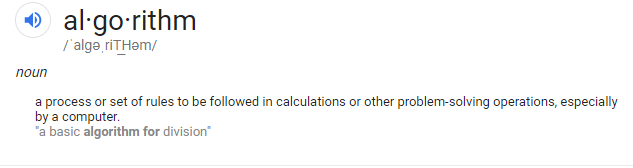
Let’s start at the most basic point, what is an algorithm? A quick Google search returns this:

It calls out specifically that an algorithm can be as basic as for division. So, I think it’s fair that many people use the word algorithm over “computer program” because it sounds magical and difficult to understand. Now, there are plenty of algorithms that are very complicated, like the original algorithm for page rank.

However, the most common algorithm used is the basic regression model. This looks something like ax + c = y. You should recognize this as the most basic equation for a line. Each ‘x’ is a conscious decision of what to include. For example, let’s say you want to calculate fuel economy for the vehicle. In this case, x could be your speed at steady state, such as driving down the highway. If you want to make it more accurate, you need to include other factors, like temperature, your acceleration habits, the time between accelerations, how much weight you have in the vehicle, time between oil changes, you get the idea. This would look like a*speed + b*temp + c*acc+d*freqAcc + e*weight + f*oil + g = y.

Each factor that you include is a choice of the person making the algorithm. In fact, there are tools, like sum of least squares which helps you identify factors that are actually significant (important) to properly estimating y. Furthermore, how you gather the data in your underlying set is also a choice. This is called sampling. There are statistical tools to allow a person to get closer to matching the actual population, but given how large the population is, it’s unreasonable to collect data on the entire population. So you’ll necessarily be estimating for a large portion of the people in your data set.

So, if your goal is to calculate interest on a loan using a regression model (algorithm) you have to pick which factors to include in your regression model. You have to pick how you sample the population. You have to pick the values you’re trying to get. You have to pick if you think something could be a proxy for race. You have to decide if you are going to do something about that.

Any bank will know all the factors that represent race. Zip code, high school, university, names, etc… In this case, they made the choice to ignore how these factors could be skewing the credit score and therefore the interest rate.

Anyone telling you that they had no way of knowing an algorithm is racist, is lying to you, thinks you’re stupid, or shouldn’t be trusted with your money. Probably all three. Reporters need to be more critical about accepting “iT wAs ThE AlGoRiThM” from any company.

Book Review: What You Do Is Who You Are

What You Do Is Who You Are: How to Create Your Business CultureWhat You Do Is Who You Are: How to Create Your Business Culture by Ben Horowitz
My rating: 5 of 5 stars

As someone hired at a small company to implement change, determine how and where to change the culture has been a big challenge. “What you do Is Who You Are” really helps with clarifying limitations I am operating under as someone that cannot change our CEO’s vision of our culture. I’ve felt for a long time that culture is something a CEO owns and that any bad behavior should be pinned to the CEO and that CEO should be fired if they cause something like a financial crash. It is their culture that allowed and pushed someone to make a multi-billion dollar bet.

This book demands that the CEO takes ownership of the culture. It also elevates culture to one of the most important thing a CEO must consider. It is something that, Horowitz argues, must be continually reinforced in little action. He argues that to earn the trust of your employees, you have to do things that show you trust them. That you need to make sure they understand the ultimate goal for the company and to see WHY you’re saying this thing is part of your culture.

Horowitz uses some rather extreme examples to show how you can change the culture of an organization as a leader. He uses the slave revolt in Haiti and a prison gang leader. Both show that if you explain why to the people that report to you, that you can get them to radically change their behavior. For example, you’d expect former slaves to butcher and pillage the lands of their former slave masters. Louvatore refused to allow his troops to do this, because he wanted to create a healthy free state. If the land was razed there’d be no economy for all the freedmen in the country.

Similarly, Shaka Seghnor believed that for any gang to be successful, they must live by the code of ethics they claimed. It would lead to hard decisions and often forced contradictory behavior. Such as forcing one of his gang members to apologize rather than attacking someone that the gang member had robbed.

There were some real gems in this book and I strongly recommend every CEO or aspiring CEO read this book. it provides great ideas of what your culture could be and how to get there. It also includes great recommendations for how to have a healthy inclusive culture.

View all my reviews

Book Review: An Indigenous Peoples’ History of The United States

An Indigenous Peoples' History of the United States (ReVisioning American History, #3)An Indigenous Peoples’ History of the United States by Roxanne Dunbar-Ortiz
My rating: 5 of 5 stars

I read a portion of the Project 1619 publication in the New York Times Magazine. Which was really eye opening. I hadn’t realized the economy legacy of Slavery (or the cotton price crash related to slavery). I didn’t know about the immediate resurgence of the former slaves during the Reconstruction of the south with the swift and sudden destruction of that community. So, I was talking with my wife about how we needed a similar project for Native Americans. I happened to see a tweet from a writer I follower on Twitter, Eve E. Ewing about differences in coverage of Indigenous Peoples in other countries and the U.S. I tweeted how there needed to be a 1619 Project and she suggested I read this book. I really appreciated that, because I understand it’s not the responsibility of advocates to educate me on these topics. It’s my own.

So, on to the book. This book was a lot to read. It was a slow read for me. It’s not a very long book, coming in at around 250 pages. However, there’s a huge amount of information packed in to this book. As a reader, you get the impression that this is a survey of the histories of Indigenous Peoples. It has to be.

The book starts by setting the record straight on the science and cultures of the Peoples ranging from South America, Central America, and then into North America, before the first contact between Spanish and Portuguese conquerors and the Indigenous Peoples of the Americas. After explaining how the Indigenous Peoples cultivated the land, including farming and creating deer parks (which were managed forests where it was easy to raise deer and hunt deer), Dunbar-Ortiz moves onto migratory patterns of people over the course of centuries and various trade routes. This set the stage that this was a very inhabited place whereupon colonizers usurped the land from the peoples living here.

Dunbar-Ortiz then moves on to the first contact with the Spanish, Portuguese and other Europeans. From then on, it is an unblinking look at the hard truths of the slaughter of Indigenous Americans. As most of you know, historians use lenses to explain specific events. To me, it felt like the lens used here was the interaction between Settlers/Colonizers/US citizens and various native nations. For example, the Sioux were introduced at two points, once to explain their migratory history (which shows migration from South and Central America to North America has been happening for centuries) and when there was land theft and aggression by illegal settlers and/or the US Government.

I think this is the appropriate context for an accurate understanding of the relationship between the US and Indigenous Nations. So much of the US’s history is predicated on exterminating the Indigenous Nations preventing Manifest Destiny. George Washington called for the elimination of Native Americans. Andrew Jackson built his personal brand on the slaughter and flaying of Muskokee (Creek) villagers. If you’re a Game of Thrones fan and you like Ramsay Bolton, Andrew Jackson was your President. He literally flayed villagers and turn their skin into tack for his horse. He was proud of doing this.

Throughout history classes that were taught at my conservative high school, we glossed over much of the interaction between the US Government and Indigenous Nations. Things like the Trail of Tears (perpetrated by Jackson) were sad things that happened, but weren’t the norm, according to my 10th grade history class. However, reading this book, it’s clear to me, that was the norm not the exception.

Even in cases where the forced migration wasn’t as obvious as that, there was forced migration to avoid war with illegal settlers or the US Army. Going back to the Sioux, that Nation was forced away from it’s holy land, The Black Hills. You might know that as where Mt. Rushmore resides. I cannot imagine what it would be like for something so foundational to me as a people being destroyed with the faces of your oppressors.

You might say, “But Lincoln is on there! He was a good guy!” Well guess what, DURING the Civil War the US Army was attacking the Navajo in New Mexico and Arizona. Every person on that monument is someone that made it their goal to destroy native peoples while they were President.

This book was brutal to read. I’m sitting here drinking my tea enjoying the legacy of these atrocities. While reading this book, I would oscillate between disgust and a desire to help the Indigenous Peoples of the various Nations in North America. Fortunately, the author gave some recommendations at the end of the book.

First and foremost, encourage the US Government to honor the treaties (that are still in effect) they made with the Indigenous Nations. That includes repatriating portions of land back to those Nations. Treat them as true Sovereign Nations with all the rights that gives.

For US Voters, that also means supporting candidates that don’t pretend they are Native Americans of any kind, unless they are literally recognized by that Nation as a citizen.

This book should be required reading for all seniors in high school. It’s important that we have honest discussions about where the US came from. Because, as the last chapter explains, all our wars with other foreign nations use the same Total War tactics as we did against the Indigenous Nations of America.

View all my reviews