Google’s Motorola Future

According to Eric Schmidt of Google the purchase of Motorola Mobile is also it’s own foray into physical products. This is promising but it’s also dangerous for Google. While 98% of Google’s revenue comes from ads as of 2008, the majority of its revenue stream is free of a great deal of risk from patent infringements.  This is double true because the majority of Google’s patents are related to search and locating data. The products that it produces that people use on a regular basis have been designed around open standards which enables them to get around patenting and use licensing instead. If any of these technologies are accused of patent infringement Google can pull up the original source code, the version and the date. While this may be more expensive than the patent examiner finding this during the patent examining procedure, it still can save Google millions of dollars in patent suits. However, it hasn’t prevented them from having to pay a good deal in licensing fees despite this as I mentioned in my previous post.

Why is this a risk for Google? Well, every one of those patent lawsuits that were targeted at Motorola is now directly targeted at Google. Google is sitting on a huge pile of cash. Enough cash to outright buy Motorola. Additionally, any lawsuit that is directed towards an application of Android on a Motorola phone that Google will eventually be selling, is going to be directed towards Google now. Previously, when there was something infringing in an application on Android most of the risk was shifted towards the manufactures of the phones and away from Google. Google does have to pay Lodsys/Intellectual Ventrues for one of their patents which allows things to be purchased through apps. Like using the Android Market place. Google also has one other lawsuit related to Android at this point, which is related to a Java Patent. This is kind of an ongoing lawsuit, which Oracle has had to remove a blog post from a former Sun employee praising the use of Java in Android.

There’s got to be some sort of potential for payout for Google to take this risk though. Yes, I do think there is. Despite the fact that Google is going opening itself to direct lawsuit battles with Apple, it also allows its engineers another outlet for creativity now that Google has shuttered Google Labs. Engineers from the Motorola Mobile side will be able to have more freedom and the engineers that work in Google will be able to play more with Android to make a more superior product. Google will have direct control over their handset opposed to farming it out to HTC like they did with the Nexus One.

Are there any other risks besides the ones you’ve mentioned already? I think there’s one big one. Anti-trust case. Google is already in the cross eyes for an investigation. In my next blog I’ll discuss the case against Microsoft which the US and EU handled and then how the precedence could impact Google.
Google’s misstep with Patents

Google has been in the news a lot recently related patents. Why? Well, I think they’ve managed their intellectual property in a naive way. Not an incorrect way. Just one that wasn’t keeping up with the behavior of competitors and trolls in the market place. To date Google has 782 patents, for a company that has produced as many innovative products as it has, this is not very many. Google has been around for 13 years now, founding in 1998. Comparing Google to Apple, looking at patents filed after 1998, is not a good comparison. Apple has filed and received 2600 patents. Sure they’ve been busy working on products and had an established market already. The iPod had already come out by then. Regardless, this indicates that Google has made a major misstep in regard to patents.

I fully applaud Google’s efforts to minimize the number of patents they own. It’s clear from a glance at the patents, they have focused their patents on the ability to search for data as well as data management. They are sorely lacking when it comes to most software. This is most likely why Google has licensing agreements with companies like Intellectual Ventures. To combat the growing web of lawsuits surrounding it’s handset manufacturers and developers Google has been on a spree of both purchasing patents (1,000 from IBM and 12,000 with the purchase of Motorola Mobile) and propaganda against software patents.

Motorola will give Google the patent expertise and experience at defending its patent claims as well as a huge number of patents it will need to defend. I believe this will create a great change in the way that Google deals with intellectual property in general. I’m not entirely sure this is a good thing either. Google may take the route of IBM which both patents things specifically so that other companies can’t patent them and publishes technologies in obscure journals which can be later used to invalidate patents as a form of prior art. However, Google could easily take the route of Apple. This would be extremely bad in my opinion. The route where Google continues to invest in new technologies but patents everything and then makes it difficult for other companies to use that technology. Google has the innovative capabilities to become a huge patent troll.

I think the only good that would come out of that is if Google went after patent trolls.With open source technologies some of the problems with software patenting does go away. As anything with an open source license is technically released into the public and becomes part of the prior art. Unfortunately, that’s also a huge problem with open source. It would be impossible for a patent examiner, who typically has 3 days to approve a patent, to actually find a given software technology which is already being used as open source.

Overall, I think Google is currently attempting to address its misstep with patents. I think that Google will push for patent reform for software patents. I think that with a large enough group of people, including billionaires like Mark Cuban, there could be a significant change in the manner in which software patents are issued. Gaming companies, search engines, and software developers need to work together to address this issue though.

Adoption of a new technology

Based on my previous series we can see how disruptive technologies can impact the economy. What we don’t know is how these technologies are selected by the users. This in fact is a matter of great debate. In some cases looking back it’s obvious as to why a specific technology won over the other. However, during the standards war, or beginning of a new market, it’s unclear which technology will win. We’ve seen this play out repeatedly over the past few decades. The VHS victory over Betamax is an important case. I also believe that this example can play an important role for any new platform developer.

What happened with VHS and Betamax? They both were created in the 70’s (VHS 1976 and Betamax 1975), as a method to record video. Each had a different method and were competing standards. By a standard, i mean a products that achieve a specific result using a type of technology. In this example there are two technologies that achieve almost the exact same end result using incompatible technologies. Which is why we have a standards war. Both products are attempting to capture the same market segment.

About the technologies: Both products were produced by huge companies, JVC for VHS and Sony for Betamax. Betamax had the higher quality, however you had to pay for this quality. The Betamax was smaller than VHS. Betamax was sued by the MPAA in an attempt to prevent people from recording TV programs to watch without buying them. Betamax won.

So why did VHS win over Betamax? Well, in this case it’s well known that pornography producers selected VHS over Betamax because of the price difference. It was easier to produce a product at a high enough quality that they could sell.

What does this tell us? As a platform locking in content is extremely important. Since this was the first technology porn could play a huge role, now with several legacy video recording methods and the internet porn’s sway on the future standards for video storage is much diminished. In fact during most standards wars they would most likely sit out until the standards are decided.

I believe that Google actually learned from this example. They saw the benefits of content on the platform from the success of the Apple App store and worked to create a viable app store before the release of their initial product. They held contests and ensured that there was a vibrant app development community before the release of anything. While this did nothing to close the gap initially between iOS and Android app stores, it helped give people reason to adopt their product.

Disruptive technologies and long term impacts IV

In yesterdays post (click here for the first in my series) I discussed some of the long term implications mostly related to the software industry. However, these ideas relate to some of my previous blog posts about innovation in that post I talk about long waves and these paradigmatic type technologies. Where we need to be aware that these disruptive technologies can interact with society on a number of different levels. In the case of video game consoles, while a pretty big industry, it’s not a big chunk of our overall economic output. Even with in video games, you could argue that different types of coding methods have revolutionized how writing video games occur, so you can make these steps as small as possible, or as large as you can think of like the semiconductor based transistor. The transistor has lead to a huge shift in how our economy works.

The problem with new technologies is that we never know ahead of time what the impact of a disruptive technology will be. For instance, of the renewable energy sources we can’t tell which one will have the most long term impact. However, these are all disruptive technologies. If enough solar, wind, wave, and geothermal energy were produced we wouldn’t have a need for coal fired plants. This would create a massive shift in our economy. It would destroy a lot of mining companies, would shutter many power plants and put people out of jobs from the mining companies and the power plants. Of course changing from a poisonous energy source that we are rapidly depleting to a fully renewable resource is completely desirable. However, these disruptive technologies will have farther longer term impacts that we think of initially.

These new energy sources may eventually have lower energy costs than we currently experience under the coal/oil/gas regime. However, this extra money is typically spent on other goods. Which should be cheaper as energy costs are reduced. In many industries, the biggest expense is on energy. Reducing that will significantly shift the cost of these products. Unless, of course, the companies keep the higher prices to keep up profits. These lower costs should make it easier for new companies to enter with a lower price point which will keep innovation moving forward.

There difficulties with adopting new technologies. There are a lot of socio economic reasons to minimize the adoption of a disruptive technology. In my next blog I’ll discuss some different theories of how new technologies are adopted.

Disruptive technologies and long term impacts III

As I discussed yesterday, disruptive technology’s impact can be mitigated by extensive networks. So how do these networks form? Well, they can be formed by movement of employees, which can lead to an exchange of tacit knowledge as well as increasing the likelihood for a collaboration. For instance, my roommate’s employer has asked if his former professor would like to collaborate with them. This would lead to a direct knowledge flow from a large university in the US to a public-private research organization in the NL which would then diffuse to that organization’s partners. These networks can help reduce uncertainty through an ability to acquire additional skills sets which are not currently possessed within an organization.

The networks can be built through previous collaborations, suggests of a previous intermediary organization, such as a publisher in the video game sense. Or there could be other forms of collaboration such as licensing technologies like the Quake/Unreal engines in video games. This allows for a full knowledge transfer of technology from one organization to another through formal methods. However, the reason for adopting one technology over the other could come down to a single employee which used to use one or the other technology at a previous job.

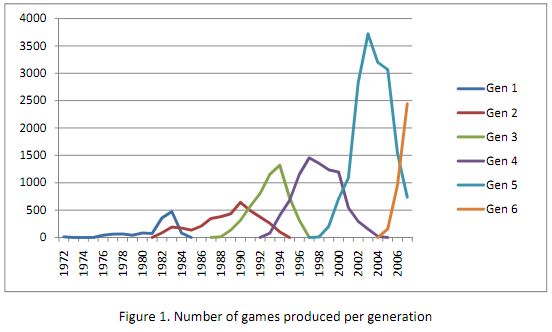
Now, how do these impact long term innovations and economic growth? I haven’t talked about that at all. It’s not exactly straight forward. In some ways, as you can see from the network diagrams yesterday, these disruptive technologies have clearly lead to an explosion of growth within the video game industry. This is most likely why it’s over a multi-billion dollar a year industry. Extensive networking and collaboration at the beginning of a new generation of technology is good for the console maker and the consumer as it leads to a faster ramp of video games. See the graph below:

So, these networks help expand the options for consumers and lead to growth in the industry. Disruptive technologies are really good for the economy. Otherwise, we’d see a steady decline in prices and demand for products as people will already have them. In the example of video games, there are other drivers forcing the continued evolution of console technology, such as competition with the PC gaming platform, as well as continued expectations of better graphics and better game play. While there are a lot of people that scoff at the consoles, they do drive expectations for better graphics. People get tired of the same visual representation of their football teams. They want to see the graphics improve, the physics engines improve. Basically they need a continued improvement of technology to meet these expectations. These in turn help push the boundaries of PC games as well.

This is a fairly rosy picture of this march forward. There’s no concern for intellectual property, any licensing that is being done is obvious. I don’t expect this to continue. Which brings us back to the software patenting issue. We all know it’s a horrible thing.

References:
Vaan, Mathijs de, “Interfirm Networks and firm performance in the face of technological discontinuities” 2010 Druid conference