The different meanings of internet freedom

This week we have seen some incredible riots in London. Interestingly, some of these riots were actually predicted by some of the youths a few weeks back, at the end of the video one of the youths mentions that there will be riots. David Cameron had some choice points about the use of social media, Ars Technica has a good discussion about the different sides of social media. However, it is mostly discussing it in terms of causing the riots as well as leading to the clean up of the cit of London.

I find the reaction that we’re seeing on the internet to the usage of Black Berry Messenger and Twitter interesting. These are the same forces that while in affect in countries like Tunisia and Egypt, social media were forces to be praised. However, now that they are being used in England instead they are being vilified. Also, we are seeing pressure from the government to use social media to arrest the members of these gangs.

First, I think what these groups did was horrible. If I was able to I’d try to help the victims of these crimes. However, we need to be aware of the precedence we are setting in the response to this. While there are some differences in the actions, there was looting in Egypt and Tunisia, there are also differences in the situation. The major difference comes from the leaders being elected compared to being despots.

Based on the interviews the Guardian conducted we can see that the youths are unemployed and marginalized. This is similar to what was going on within Tunisia and Egypt. High unemployment and lack things for the kids to do. It’s something of a structural issues. Which Cameron acknowledged yesterday in a speech. So some of the reasons are similar between the rioters in London and with the Arab spring.

However, since it is England asking for data from Twitter and BlackBerry, they are much more will to cooperate with the police. I’m not entirely sure this would have happened in any of the countries involved in the Arab Spring. Leverage over Twitter during the Arab Spring could have killed it. Do we pick and choose which riots we support? I think it’s clear that we do.

We just need to be aware of the precedence we are setting and that all countries around the world are going to emulate the response of the US and England in this riot. There’s no reason why China, Iran, North Korea, or any other country shouldn’t expect Twitter to comply with them if Twitter complies with England.

The actions that our governments take in this case could have long term implications in regards to internet freedom. It also will indicate if there are two different classes of countries when it comes to the allowable types of internet freedom.

I don’t condone what happened, but we need to really understand the repercussions of the actions in wake of these riots.
Ethics in Science III

I’ve been doing a series on Ethics in science, part one, part two, because there’s been a lot of public issues in the UK about the behavior of scientists. Any suggestions, or laws put into affect would have far reaching impacts. As any scientist in the UK would be required to follow them and any scientist that wishes to publish in a journal headquartered there. I believe Nature is. Nature is THE journal to get published in.

There are some different suggestions on what should be done, including ethics review boards and independent verification of results. The UK’s investigation of fraud led to this result:

In the same way that there is an external regulator overseeing health and safety, we consider that there should be an external regulator overseeing research integrity,” says the committee’s report. “We recommend that the government set out proposals on the scope and powers of such a regulator and consult with the research community and other relevant parties to develop them.

I understand what they are going for here. They want to prevent another vaccine debacle or prevent another cold fusion lie. I think they also plan to prevent another “Climate gate.” While these are noble causes, I can’t help but fear that politics will get involved in this process. If a scientist is found of committing true fraud their career is over. There just isn’t the right incentives to commit fraud in MOST sciences. Yes, it happens, but it’s more likely to be a mistake than true fraud. Which is something that peer review might catch. However, even this is difficult without the initial data set, or recordings of how the experiment was carried out. Scientists are pretty brutal when going through the peer review process. They question everything and you have to have a satisfactory answer to all their questions if you want the results to be published. The true best way to improve scientific debate is to provide incentives to publish articles that have debunked previous research. This will fix more problems than a regulatory board for most of the sciences.

However, then we come to medical sciences. Here there are much greater incentives to commit fraud or intentionally mislead. Why? Well, for a blockbuster drug they can sell Billions in revenue a year. If a drug company thinks that they have a blockbuster on their hands they will try to get it to market sooner. In most cases they have patent protection for at most 10 to 15 years. But you’ve said patents are for 20 years. That’s true, however, it typically takes drug companies 10 years to get a drug to market. After the last ten years they are able to request a 5 year extension.

Why is the system set up like this? Well, the drug companies test a lot of different drugs and not all of them can be blockbuster drugs. A lot of them don’t make it through the rigorous testing process either. The drug companies have to pay for all of that as well as make a profit. So, they charge a lot for these blockbuster drugs. They actually do have some different prices to try to help the poor out as well though.

So, in clinical trails there is more incentive to commit fraud or with hold important results. What can be done about it? Well Bernie Sanders (US Senator) has proposed a prize competition for developing different kinds of drugs, which as a stipulation of getting the prize the US government would own the patent. The government would license the patent out so drugs could be cheaper. However, this prize would have to be huge which would again provide more incentives to defraud the government. It would have to be in the billions to allow for the drug companies to recoup their expenses. It could force much stronger restrictions and oversight on the drug trials though. Which could reduce the ability to commit fraud. The prize committee could potentially be made up of scientists that are part of the NIH (National Institute of Health) which would do the data analysis for each of the “Blockbuster” trials thus forcing impartiality into clinical trials.

This could work. Additionally there could be sanctions put on the fraudulent authors, where they are unable to publish for a year, at any level. Where they lose their grants, or are unable to hire new graduate students until they show they have been reformed. This would certainly kill their career. However, this should happen.

Finally, I think that scientists should be required to add any conflicts of interest in the publications as well as sources of funding. In many cases this already happens as the funding agencies require it, however making it an explicit part of the publication process will make it more transparent. Transparency is vital to science.

Science isn’t perfect, but it’s our best tool for understanding the world around it. Committing fraud on the scientific community and the world as a whole is a horrible crime and should be treated as such.

NASA

I’ve gotta say, it’s hard to be a lover of space, NASA and scientific exploration right now. With the end of the shuttle program around the corner, and a new bill to cut a huge amount of funding from NASA (article) things are looking rather down right now. Basically this would kill the James Webb telescope. I think this would be a terrible thing.

Why should we invest? Well, the US prides itself on being number one in everything, even if we aren’t actually number one. Without continuing to push the frontier of research we will fall behind eventually. The article above, or another article mentioned congress killing the Super Collider in Texas, it would have been able to produce the novel results that the Large Hadroc Collider is producing now. The US would be the world leader in particle physics. We are starting to fall behind. Europe is going to be the world leader, and in the future we will be reading articles written by Europeans. We could be excellent teaching centers for particle physics for years to come, but the best of the best will not be in the US.

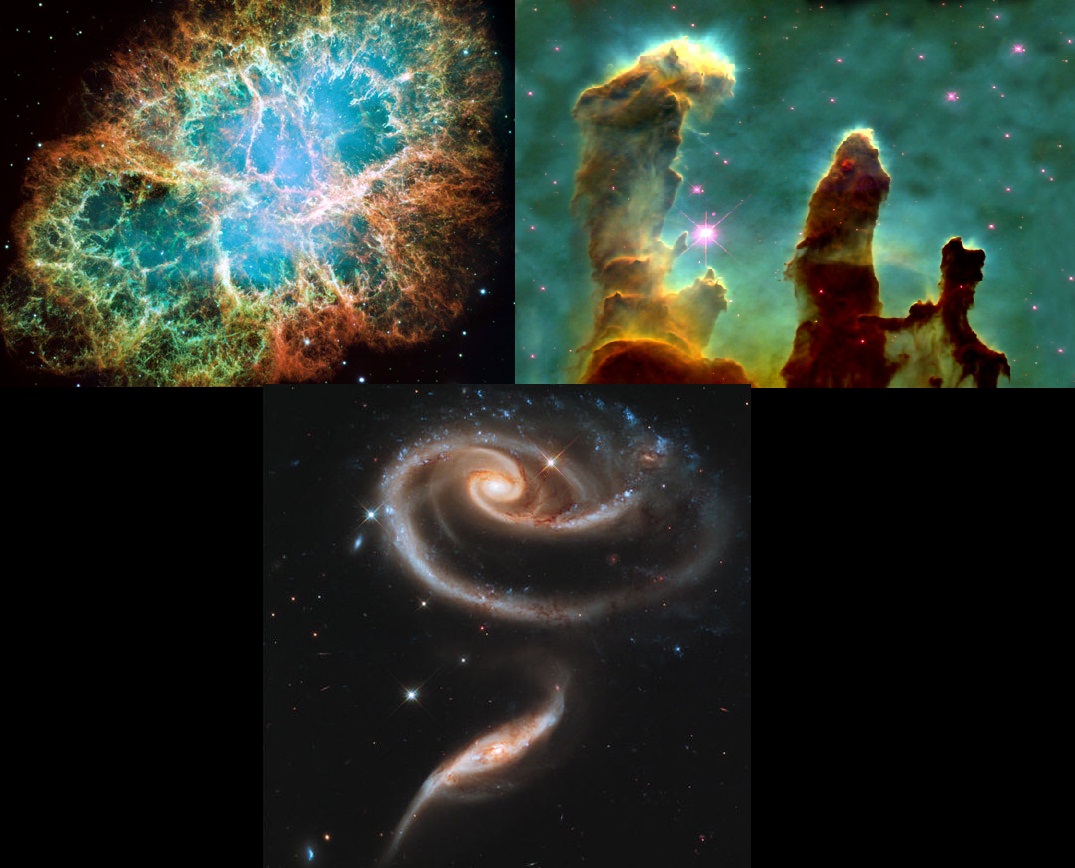
The same could happen with astronomy. The Hubble Telescope led to over 9,000 scientific papers being published. Yes, that may seem like we were probably spending more money on research than just the money that we spent on Hubble, but remember we were also producing jobs to support those scientists that were writing the papers. The Webb Telescope is going to be significantly more powerful than Hubble. We have had some amazing picture of space and the universe around us because of Hubble. Pictures of the Crab Nebula, Pillars of Creation and the Rose Galaxy. See below.

Top Left Crab Nebula, Right Pillars of Creation Bottom Rose Galaxy

For me, these images instill a feeling of awe and wonder. Through the Hubble we’ve expanded our understanding of how the universe works and how dangerous of a place we live. The rose galaxy, or galaxies, are two galaxies colliding with each other. Our galaxy is actually predicted to collide with the andromeda galaxy in a few million years. We know this because of Hubble.

We are also starting to realize that what we’re learning at the particle level may interact with the origins of the universe. For example, string/M theory also is a theory about how the universe was started. We need to be able to keep seeing back in time to understand how these theories interact with each other.

Controversies IV – Vaccines

Today I learned something interesting. A guy who does Judo with me told me that in France there are concerns over Hep B shots and Multiple Sclerosis. Apparently, this is based on a discredited publication and health authorities have not been able to convince the French to begin taking the vaccines again. This is of serious concern for me, because he also mentioned that the vaccination rate was something like 30% or so.

In some ways France is lucky, because the vaccine isn’t as serious as the vaccine people are rejecting in the US. They are rejecting MMR (Measles Mumps and Rubella), which are highly contagious. What can we learn from these two cases?

First, it is extremely difficult to overcome personal beliefs on scientific evidence. In both cases many different studies have been conducted to verify the safety of the vaccines. In the US, the connection was completely debunked. The Journal the Lancet it is the UK medical journal, actually went so far to retract the article. It was a flawed study where there were only 12 patients, they were unwilling included and the author was also being paid. There were many cases of ethical violations and the guy isn’t even allowed to practice medicine in the UK any more. He now works in the US. So, despite mountains of evidence to the contrary people still believe these findings.

Second, we learned that it’s not only conservatives, or a segment of the population that is uneducated that hold these anti-science beliefs. The topics I’ve talked about have focused primarily on that group. This controversy is with the liberal well educated group of people living in California. They have celebrity spokespeople and many of these people are engineers or some other scientifically based  profession. These people should know better.

What are the risks if we don’t vaccinate though? Well, vaccination works through protection of the herd. Everyone needs to be protected in the “herd” otherwise everyone is at risk. Well, that just sounds like a scare tactic. Ok, yes a bit, however vaccines don’t always work. You could have gotten vaccinated for MMR and it didn’t actually give you the anti-bodies you needed. It’s difficult to test for these things and expensive. Not something you’d want to subject a small child to. So, lets say that unknown to you, your child’s vaccine didn’t work, and another kid in class was intentionally unvaccinated. He some how comes across measles and comes to school with it. Your child could become ill, as well as any other person in the school that the vaccination didn’t work for or intentionally wasn’t vaccinated.

Ok, let’s say you’re right, why is Autism increasing? Well, partially we’ve changed the standards for what fits autism over time. In the past only people like Rainman would have been considered autistic, now there’s a well defined spectrum that includes a lot more types of behaviors. Other reasons may be from who are having children together. A recent study (WSJ summary) showed that Eindhoven has a significantly higher rate of autism than two other areas where there are many less technology jobs, thus less engineers and scientists. This also would indicate a possible reason why Silicon Valley might also have a higher rate than other places in the US. This does need additional research to compare regions in the US to regions like this and others around the world.

In conclusion, just because you believe non-scientific things does not mean you are stupid. There are a lot of changes in scientific literature. However, we need to develop techniques to educate people and convince them that the new data is right and that there is not some grand plot to make some one money (anti-vac think its the pharmaceutical companies lying) or destroy our economy (anti-climate change thing it’s a conspiracy to destroy the US economy). These groups are increasing risk to everyone. We need to as a general public, figure out a way to address these problems.

Further Reading:
http://www.wired.com/wiredscience/2008/01/california-stud/
http://www.wired.com/magazine/2009/10/ff_waronscience/

Controversies III – Evolution

So, we have some ideas for how to deal with climate change. Will they work? I don’t know. I hope my friends that read my last post will discuss will educate themselves on climate change and work to talk with their friends about it. Also, let me know if you do and how it goes!

How do we deal with evolution though? This one is a lot trickier, not that dealing with climate change is easy (but I think my idea is a step in the right direction). People who are much smarter than I am have been attempting to tackle this one for some time, including Richard Dawkins who is extremely knowledgeable about the topic. He wrote a fantastic book about evolution called “The greatest show on Earth” where he discusses each of the “counter” claims of ID (Intelligent design) advocates.

However, in some ways this is even besides the point. The major issue is that people are trying to remove evolution from the classroom. This is the biggest problem. This would destroy our capabilities to compete in the future in biomedical applications.

Why are people trying to fight evolution? Well, they feel that it will drive people to atheism. This isn’t true. There are many people that have figured out ways to reconcile their religious beliefs with evolution. The biggest problem is that it directly contradicts the bible. Which in the US there is a growing minority that take the bible literally. The next issue is the growing minority that falsely claim the US is a “Christian Nation” which this CNN contributor debunks.

It appears that we need to not just worry about scientific accuracy but also historical. For it is impossible to really understand the “controversy” without understanding the context that it is being framed within. Without this claimed backdrop there would be no basis under which to fight having evolution in school classes. Evolution is not a religion. With the pope accepting it, it’s as much of a part of catholicism as it is part of secular humanism or part of the accepted scientific facts of an atheist. Since the supporters of ID place the argument within this framework though we must first refute the framework of a christian nation and from there we can show that it is impossible to teach ID in school while evolution must be taught in school.

Additional ponderable thoughts:
Nothing in Biology Makes Sense Except in the Light of Evolution” is a 1973 essay by the evolutionary biologist and Russian Orthodox Christian Theodosius Dobzhansky, criticising anti-evolution creationism and espousing theistic evolution. The essay was first published in the American Biology Teacher, volume 35, pages 125-129. (Wikipedia)


We teach our vets, doctors, nurses and pharmacists biology. Without a clear understanding of biology from a young age the quality of our healthcare can only go down. As a country we will not be able to stay on top of the life sciences research and pharmaceutical production.


If we fail to education our students on biology how do we keep up, and how to we keep our economy running?