Patents and Innovations

So, I think that the news that Apple and Nokia decided to drop lawsuits against each other is a good starting point for this discussion. Here’s the BBC article discussing the decision. Basically, Apple decided to license several patents from Nokia. Which in itself has some implication for innovation within the Smart Phone market.

I plan to do several of these types of posts. However, in this one I will focus specifically on smart phones. This will extend to many other product spaces, but not to software or business models.

So first what are some implications of this agreement by Nokia and Apple? Well, the most obvious is that they aren’t suing each other any more. The less obvious is that neither of these cases was heard by a judge or a jury. This doesn’t allow us, the observer, to actually know if these patents were valid or not (see my post on patents to see what a valid patent is). In some cases the patent office, whichever office, may approve a patent that is invalid. This could be due to prior art, like the PB&J sandwich described in my patent post, or that it’s an obvious invention. The only way that a patent’s validity can be overturned is by a jury or a judge. Let’s say that Nokia is also suing HTC over the exact same infringement. HTC doesn’t believe that the Nokia patent is valid so they were also counter suing saying that it’s an invalid patent and HTC has the reasons why. So, this case goes to trial and Nokia is now able to say that Apple is currently licensing this patent from them. This claim will give a great deal of credibility to Nokia’s claim. At this point HTC may have to decide to license with Nokia to avoid the potential of a huge fine.

In this case Nokia has a tract record of being an innovative firm. What happens when the firm isn’t an innovative firm or has no products though? Well, these cases happen all the time. For instance a few years ago RIM, the maker of BlackBerry was hit with a lawsuit that would have effectively shut down the Blackberry network, or prevent emails. Here’s a link to when it started. While at the time it was a $60million fine, it eventually got up to $612.5 million. The firm suing BlackBerry NTP, doesn’t actually produce anything. They are a patent management firm. In other words, a patent troll.

So what does this do to our economy when it’s based upon innovation. Patenting is supposed to protect innovative firms from competition so they can exploit their invention. It’s supposed to grow the economy, as these firms can license out the patent and allow other people to manufacture the product. Well, in this case it took $612.5 million from the pocket of a firm that was innovating and creating a product and put it into the pocket of a firm that doesn’t produce anything. That’s not the best for innovation.

There are some good things about the patents though. For instance, once the Xerox patent expired for the copier, there was an explosion of innovation in the field and Xerox nearly lost all market share. It had to sprint to catch back up. How did this happen? Well, you are allowed to work on a patented technology for research and development. Xerox’s competitors didn’t sit idle while Xerox was dominating the market. They were waiting until they were able to sell a product and then unleashed pent up innovation onto the market. This was an excellent thing for consumers. We can thank the fact that this patent ran out for our 3 in 1 printers.

Innovation

Yesterday I said I was going to discuss how patents impacted innovation. However, I think the first thing we need to do is clarify what innovation is. Schumpeter, described innovation as bringing a product to the market. He claims that without innovation, invention is worthless. Indeed, patents play this out. There is no legal requirement to actually manufacture anything that you’ve patented. I will discuss that in more detail tomorrow though. Schumpeter also notes that these innovations are the source of creative destruction in the economy. He claims that through innovation we are able to keep growing. He called these the long waves. See the picture below for a representation of these waves and the innovations that drove the economy at the time.

Based on Schumpeterian principles we can see that we should expect growth slow down and potentially economic issues at these times. So, if an innovation is bringing a product to a market, in what ways can we innovate? There are four ways in which innovation can occur in a product; Incremental, Modular, Architectural and Radical. Please see the picture below:

Henderson and Clark ,1990

Most innovation occurs in the upper left hand corner, incremental innovations. These are fairly obvious and most people aren’t surprised to see these products. Products like iPhone 3G after the iPhone first came out. this was an incremental innovation on this product. While Apple did a fantastic job making it sound like it was a radical innovation, it simply wasn’t.

The next most likely is the modular. In this case it could be considered that an electric car might be a modular change. As you only have to change one part of a larger piece of equipment. In this case a combustion engine is replaced with an electric engine.

The architectural changes are less common than either of the previous. As these ones typically require a great deal of changes within a firm. An architectural change can be described as going from a ceiling fan into a box fan (Henderson and Clark 1990). Seems pretty simple right? Well, there are a lot of changes that go into this innovation. You have to think about how to keep the box from falling over. How to keep the noise down. How to protect the users. You also have to manufacture everything differently. So, in many cases there are two innovations within an architectural innovation. One at the product level and one at the firm level. Another example is the reintegration of the original developers of the Mac into Apple after the successful product launch.

The final type of innovation is the radical innovation. This is the stuff that “creative destruction” is made from. When these types of innovations occur most of the previous knowledge base is blown away and the innovators have to start all over again. I’d say the most common example of something like this would be with game consoles. Basically each time a new one comes out everything starts all over again. Other examples can include things like the Jet engine from the propeller. Not only did this require changes in the aircraft but it also required changes in the runway, it needed to be longer than before.

There are many cases of Radical innovations and in some cases they completely reworked our economy. IT/ICT is the most recent set of radical innovations that is shaping our economy. These technologies are heavily patented and impact our economy. Tomorrow I will look at how these patents interact with innovation to increase or decrease the rate of innovation.

Further reading/Citation:
Henderson, R., Clark, Kim. “Architectural Innovation: The Reconfiguration of Existing Product Technologies and the Failure of Established Firms” Administrative Science Quarterly, Vol. 35, No. 1.
http://dimetic.dime-eu.org/dimetic_files/HendersonClarkASQ1990.pdf

GDP a Tragedy of the Commons

In my Novel Technology and Human Behavior course we have an assignment related to a specific novel technology and how it interacts with philosophical ideas and psychological reasoning. So, of course my group member Timmy and I decide to do work on something that is mostly unrelated to actual technology. We decided to look into different metrics for growth. GDP is the current standard for everything. High GDP and GDP growth is currently construed to mean that you have high well being in a given country. However, this is not what the metric was originally designed to measure. So what does GDP measure? It measure most major economic activity. It measures production, hospital bills, and end good sales for example. However, it excludes factors like education, house hold activities and the black market. These are serious gaps. As most people will tell you that have been employed we tend to focus on the activity that is measured. So if you’re at work and you need to get defect counts down or shorten call time for tech support you will do everything you can to make that happen. Even if it’s actually bad for the company you work for. So, if you have high defects you can reduce your measuring frequency to make it look like your defects are better. Or if you’re on a phone call you can be rude and just give the minimum help you can. These are negative results from a measurement.

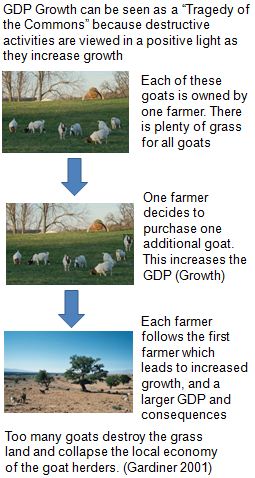
In our poster we argue that something similar happens with GDP. So a tragedy of the common happens all the time. It can be something as inconsequential as replacing the water from a community water cooler. Most people won’t do it because you assume that some one else will. Below is an example of what I mean by how GDP is a tragedy of the commons.

Even the collapse of the local economy may be seen as increasing the GDP. As the goat herders are trying to save the land they may slaughter additional goats, buy fertilizer, get some seeds, buy fencing to block off an area so it can regenerate from the goats. All of these things are seen as beneficial to the economy when it is actually very destructive to this aspect of the economy.
So what can we do about it? Well there are some different metrics that can be used to measure well being while taking into account sustainability, such as Green GDP. China actually attempted to implement this, but decided against it as it lead them to have smaller growth numbers and may have put them at a competitive disadvantage. Timmy and I believe that some good ways to deal with this, is to focusing on what is preventing people from adopting more sustainable technologies, and then trying to create incentives to drive further adoption. We’re finding that this problem is a bit of a catch-22, you can’t get people to adopt the different measurements without people adopting green technologies, but you can’t get huge investment in green technologies without incentives from a new indicator.
Further reading/Video watching:
Bergh, C.J.M. van den (2009), The GDP paradox, Journal of Economic Psychology 
20 (2009) 117-135
Gardiner. 2001, “The real tragedy of the commons” Philosophy and Public Policy Vol 30, No. 4
Tim Jackson, writer of the book “Prosperity without growth” for instance http://www.youtube.com/watch?v=_Jq8WUp1x8k (7:19)
David Korten, writer of the book “Agenda for e new economy” for instance: http://www.dailymotion.com/video/xgeykn_david-korten-on-ways-to-create-an-economy-that-values-life_lifestyle (13:42)
Hans Rosling: New insights on poverty and life around the world http://www.youtube.com/watch?v=YpKbO6O3O3M (20:55)