Software Patents are the new Copyright

In one of my previous posts I commented that I was seeing a convergence withing copyright activities. I believe that something just as horrible is starting to happen within the software patent world. I think that it will threaten the free software movement as well. We’ve had patent trolls around for a long time now. Almost since the first patent was created, however, this didn’t interact with our daily lives. It was similar to the way that copyright didn’t affect you and me on a daily basis. Sure, changes in prices or the removal of a product could affect us, but typically we were able to find a replacement or dealt with the price change. However, I think that this new type of patent troll is more dangerous. Yesterday I saw a post on Ars Technica discussing how Lodsys is going after Apple app developers. Apple isn’t happy about this at all, because it threatens to ruin the base they have developed.

I think there are some other problems with this as well. Historically, if a company, that produces software, was looking to go for an IPO or bought by another company there’s a thing called due dilligence, where the products are checked for stolen code. This is a big deal, because if I stole the code from Linux or some other open source software, my entire project falls under the GPL, and forces my source code to become open as well. This can create massive headaches for companies.

There is a key difference between what used to happen in the past and what is happening now. Before it was the method of making something happened that mattered. For example if I took a really fast way to sort something from open source how it was sorted was what mattered, not that it sorted. Why does this matter? Well the code is also technically copyrighted and owned by the writer. Now the outcome matters as well. What if some one had a patent on sorting. I’ve mentioned how crazy this would have been in the past and how this would impact innovation.

Let’s say some one decided to put in for a patent on shooting animals at some sort of target through a controlled interface. Once the animal hit the target the animal interacted with the target which changed the user interface to indicate that the change had occurred. I have two games on my phone right now, Angry Birds and Monkey Blaster that would both be impacted by this patent. Both of them have very different goals and methods for shooting an animal at a target and different results once it hits the target. Indeed, the definition of target is different between these two games. However, neither of these developers are going to be looking for patents when they have an idea about what’s the next game they want to make.

The patent that is mentioned in the Ars article is absurd. It should never have been approved. There’s nothing novel in the development of the in app purchase. That is something that should be obvious from any one in the computer industry. You could easily see the relationship between a website and an application. In fact, I’m sure that there have been cases of this in the past. Another question that remains to be seen is this going to impact services like Steam? The article notes that Lodsys has already gone after EA.

This change in behavior towards apps and software patents is a very bad change. We need to work to address these types of problems. Returning to the requirement of producing a product to have on the market within a certain number of years could help address these problems. However for software this will likely just lead to a crappy product put on the market that no one buys and no one knows about.

The value of a Copyright

Just to make it clear, I’m going to say that there is some merit behind some copyright. A way to ensure a return on effort spent to produce the piece of work. That being said, it should not be the same right for every piece produced.

I don’t really need any sort of scientific survey to look into part of this. Most copyrighted material is absolutely worthless. However, is it afforded the same protection as a major blockbuster movie, for free. Depending on how I structure the copyright of this blog, it has the same protection as Transformers 3. Why? To me this doesn’t make any sense. Which is why I’ve decided to license my blog with a creative commons license. You can see it down at the bottom. However, I still got that copyright with no effort for myself. I have to do nothing to keep that copyright. 
The arts, sciences and technologies have had a strong interaction on each other throughout human history. We can see this with how our arts are pushing our technological limits. Video games push the limits of personal computers, recording studios push the limits of audio equipment and flawless video push the limits of TV and cameras. However, for any piece of art that was created on any of these technologies, they are afforded much more protection than the technology. The art also gains this protection for free, without any effort, whereas the technology has to go through a great deal of work to prove its worthy of the protection. 
As much as I would like to remove the auto guarantee of state protection on a work, I don’t think that’s feasible. However, I do think what is feasible and realistic is implementing a registration requirement for works older than a year old. This minimum level of effort demonstrates, at least to the owner, there is value in the copyright. If the content creator fails in this, the work should fall into the public domain. Thus freeing the vast majority of our culture from copyright. 
In the patent system there is a minimum cost for renewing the protection each year, which is considered the minimum value of a patent. This scale is graduated so that the the longer you want the protection the more expensive it is. For most firms this isn’t really that much money. I think we need to add something like this for copyright. However, our current copyright length is extremely long. Which brings us to another point, after 20 years, which is the maximum allowable protection length for a technical discovery, the yearly rates should be exorbitant. In the last 10 years the copyright should cost more than $1,000,000 per year to manage. There will be firms that are willing to pay it, but it will be a difficult choice. Because it would be for every single copyright. This would quickly reduce the numbers of items within copyright protection.
I also think that there should be a payment difference for levels of protection. So this goes a bit to the different types of creative commons licenses out there. However, I think the most basic cheapest level of protection is required source acknowledgement if remixed, and the right to license out the work. Anything more than that would be extra money. So, if you didn’t want it remixed for profit you would have to pay a significant amount of money more. Again, this is per copyright. There wouldn’t be any blocks for works on a CD as each song can be sold separately, which would require a separate registration. 
I think with a system such as this we would quickly understand what the true value of a copyright actually is. At this point we have an artificially high valuation of copyrighted material based upon an extremely small subset of copyrighted material. From my previous post on the value of patents, we saw that most patents were barely able to cover the value of owning the patent. Additionally, most wouldn’t cover the cost of litigation. 
We need to come to accept that most of our art at some point becomes economically worthless, if it ever was. That’s not to say it’s not emotionally full of worth, however, we can only truly understand that value when we have easy open access to it.
Further Reading:
Free Culture Lawrence Lessig: http://www.manybooks.net/titles/lessiglother04free_culture.html (Free ebook)

What is the value of a patent?

The truth of the matter is that most patents are worthless. What? How can that be with so many people suing over these patents? Why has there been a HUGE increase in patent activity in the past few years? Just because something is worthless doesn’t mean it can’t be useful. However, that being said, most patents are still useless. A patent on how to swing some one in a swing, is in fact, worthless and useless (real patent) (Jaffe and Lerner, 2006). In fact, I would argue it has negative value as it cost substantial money to have it patented. Granted the father was the patent attorney, however, there are still expenses that has to do with the procedures to get it patented.

In 2008 a study was published on the values of patents based on a survey asking both inventors and managers what they felt the value of a patent would be. As can be see in the figure below it’s a greatly skewed graph with the vast majority of the patents being worth less than €1 Million ($1.5 Million). This value is related to how much an inventor or manager would have sold the patent for as soon as it was issued.

Gambardella et al, 2008

But wait! That’s not worthless. In fact that’s worth a lot of money! Is it? For a person yes. For a company maybe not. R&D is not cheap. Let’s say it took three years to develop the technology and a staff of 5 people making €50,000, that alone is a cost of €750,000. You’d barely recoup the expenses of that let alone the materials. However, most economists would argue that those costs are sunk and shouldn’t be factored into the cost of the patent. I do agree with this assessment, however there are other costs to consider as well. One of the biggest costs is risk of lawsuits. Which as you can see below are growing at an alarming rate.

In a lot of ways, patents are worthless until you sue someone. There are arguments that a patent has no value until you try to actually use it, or prevent some one from using it. Thus, the fact you’re suing means it has inherent worth. Additionally, as there are requirements to pay for patents, a certain fee each year, there is a certain bottom level threshold to indicate the value of a patent. Shifts in this value will impact different patent holders differently. Increasing it towards the end could drive up litigation, while decreasing it, means that no patents will lapse.

So what can we take from this? With the rising numbers of patents, and the rising numbers of law suits, it could be argued that there is a sense of an increased value of patents. However, I think we need to be very careful with this sort of argument. As, we could just be letting bad patents get approved because of changes in the USPTO (there has been more of an increase in the USPTO than at the European Patent Office). In the end, the value of a patent is truly decided in the market when people purchase a product. Unfortunately, the person that gains value out of the patent may not be a true innovator. They could be a troll like Intellectual Ventures http://www.thisamericanlife.org/radio-archives/episode/441/when-patents-attack

References/Further Reading:

A.B. Jaffe & J. Lerner (2006). Innovation and Its Discontent.  NJ: Princeton
University Press.

Alfonso Gambardella, Dietmar Harhoff, Bart Verspagen (2008). The value of
European patents. European Management Review (2008) 5, 69–84.

Innovation and Software Patents

Whenever a new type of product is released there are a lot of difficulties with intellectual property. This is being played out in biotechnology and software. As recently as last year it was possible to patent human genes in the US. See this link for the recent verdict against it. The ACLU also had a write up from 2009 when this case was still ongoing about the history of genetic patenting. Software is another case of this. Many people argue that since software is an algorithm or series of statements that leads to a result it should not be patentable. This makes sense as mathematical proofs are unable to be patented. The argument is that for proofs these are discoveries and more natural processes than creating technology.

In the EU it is not possible to obtain a software patent at all. They claim that with software there are multiple different methods to obtain the same output. Software patenting is a very recent trend. The most famous example is the Amazon.com one-click to buy button. Which, if you don’t know what it is, basically allows you to store an address and a credit card and automatically buy whatever product you’re looking at. Fairly simple right? Well there was a lawsuit against a major competitor, Barnes and Noble about this in ’99. Some how this patent managed to survive the re-review, even though it’s a fairly obvious idea and could be implemented in about a billion different ways. On the billions, I’m not even exaggerating. There would be so many different interactions that could make the actual implementation totally different. These range from database types, information request, how the data is actually stored in the data base. There could be nothing similar between the implementation at all, yet Amazon ones all the methods to do this. In terms of patents this is effectively an amazing patent.

Let’s put this more simply. If software patents had been allowable in the 70’s when software first started to take off we would be living in a different world. BIOS have been owned by IBM until 1990 or so, which would have made manufacturing computers a two horse race between Apple and IBM. Microsoft or Apple could have patented the Operating system, and then the graphic user interface. IT innovation would have been non-existent. Think of this, some one could have patented data sorting. There are a many different ways to sort data in the CS world and all of them would have been covered by a single patent. Then some one could have decided to patented sorting on a multi-core computer (by then sorting as a patent would have expired).

Software is more like a mathematical proof than it’s like inventing the computer.

Innovation in the software world has been amazing because it has been something of a free for all. However, there are drawbacks to this lack of IP protection. In the most recent version of iOS, iOS5, Apple has been accused of lifting many of it’s new “innovations” from apps that have been rejected from the app store, or that have been selling in the jailbroke iPhone app store. Here’s the link for the article. How do we deal with cases like this, either Goliath stealing from David or David stealing from Goliath? There needs to be some sort of protection.

Potentially copyright should cover this, or a registered design. Perhaps in the case of the app stores a non-compete agreement should be signed if the app is rejected by Apple. Meaning Apple won’t steal it. However, there is no easy solution. Software design thefts are going to be very difficult to manage and deal with.

What is a Patent?

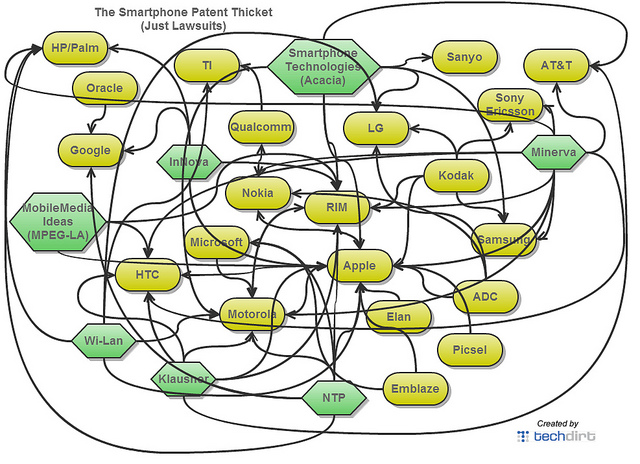
In the news we hear about various lawsuits from high tech companies over patents. Right now there is a tangled mess of patent lawsuits flying back and forth between firms like HTC, Microsoft, Apple, Google, Motorola, Nokia, and the list goes on. So what are they suing each other about? Why are they suing each other? What kind of impact does this have on innovation in general?  All of these are important questions. To answer these first we need to understand what a patent is. In the most basic form a patent is a contract between the government and an inventor. This contract bestows certain rights to the inventor and certain obligations that the inventor must fulfill for the government. However, not everyone can enter into this contract. There are requirements for earning a patent. Note I say earning a patent not obtaining one. This is important.

Smart Phone Patent Thicket
So, how does the inventor earn this patent? Well, there are three basic criteria. The invention has to be novel, non-obvious, and useful. To be novel means it has to be new, no one has come up with this idea before. To be non-obvious, it has to be something that a person couldn’t figure out by looking at the device. For example if there is a patent on nail clippers, you can’t get a patent on a larger nail clipper. It’s an obvious invention. To be useful means it has to be intended for some sort of use and isn’t just technical details of something that cannot be used. This are the general requirements of patents. However there are some other nuances. For example, in Europe you cannot patent software but you can in the US. In Europe and the US you cannot patent genes. Basically these nuances are part of the reason why patent lawyers exists.
This doesn’t explain the patent mess shown above though. How does this happen? Well, the patent bestows a temporary monopoly for the inventor. Typically this is about 20 years, in some cases it can be extended like for pharmaceuticals. Here’s a link to a patent, i just picked one at random from RFIDs. So looking at this, if you scroll down until you see the word “Claims” these are what actually are protected. These items are what the inventors actually have the monopoly on. These are typically worded very vaguely and broadly to ensure maximum coverage under the law. Which means it’s easy to step on people’s toes. Which they will sue you for. I’ll discuss this in more detail in another blog post.
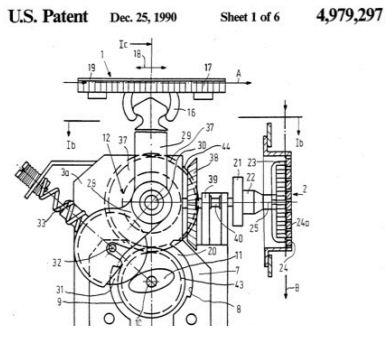
Since this is a contract, what does the government get in return? The inventor has to give full disclosure of how this invention works. Below you can see a picture from Philips’ electric razor. 
Philips electric razor USPTO
The release of this information should allow any competitor to recreate this technology in their lab. 
That is basically a patent. Rights to protect the invention with release of how the invention works. I will answer some of the other questions I posed in later blogs.