Scientific Standards

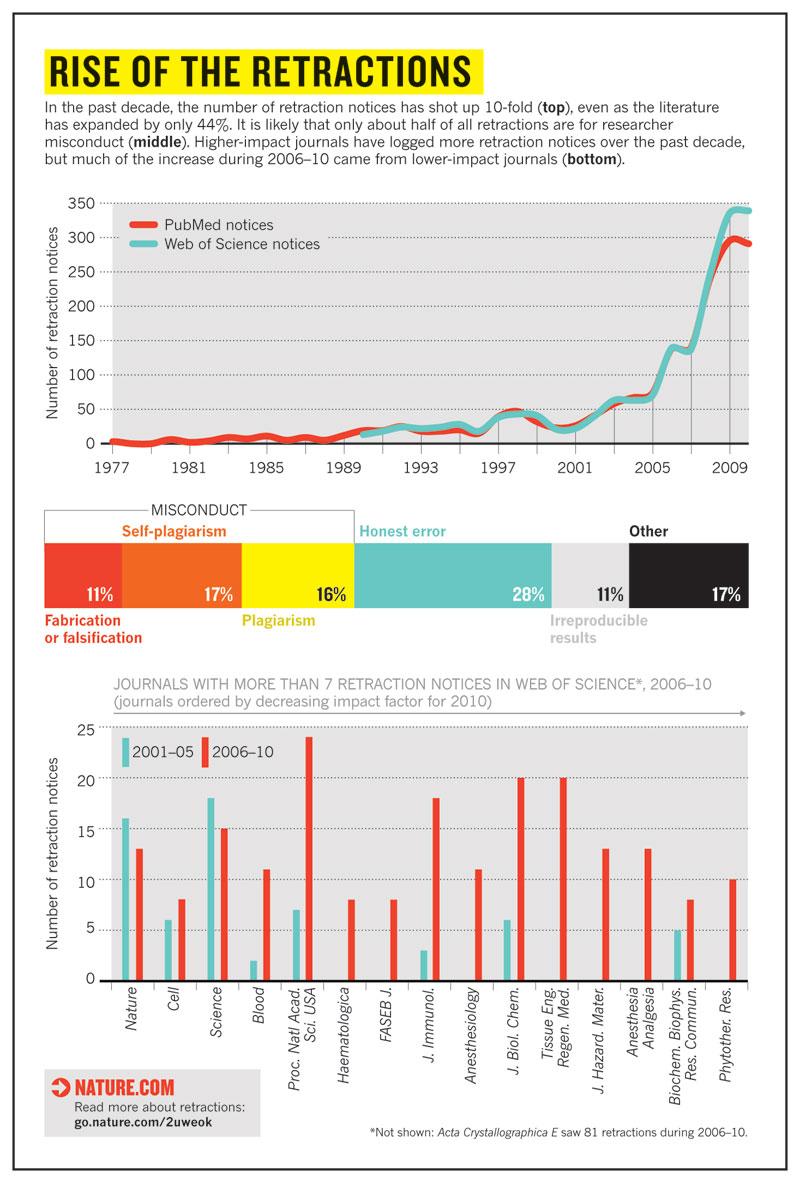
One of the problems with scientific research is the fact that retractions happen. They have been on the rise recently as well. There have been some high profile instances which have had some serious ramifications. one of these cases was in the prestigious Lancet from the UK and it involved a sample of 12 children and has caused the vaccine autism connection.  In the graph below is a break down of the reasons for retractions. We need to be aware that mistakes do happen, but real fraud is completely unacceptable.

Rise of Retratctions
Despite the fact that no science is frivolous, not all research is worthy of being published. There need to be scientific standards for quality work to be published. Without this standard, the respectability of science will go out the window. The only solution right now is peer review. Which involves a pair of credible scientists independently reviewing the same article.  Between the two scientists they are expected to find fraud, mistakes, biases and ensure that the research really contributes in the manner the researcher(s) claims. 
These standards have additional impact. The number of papers published by a scientist can impact the location they work, the amount of money they get from grant organizations and credibility within the scientific community. These standards are the only thing that keeps science from turning into pseudo science like the anti-vac movement. 

Innovation, Science and Money II

In my last blog I discussed some of the budgetary cuts occurring in the US and how these cuts are going to impact the future of science. I want to spend some time explaining why this is the case. I mentioned something called Path Dependency, what do I mean by this? Well it’s a pretty simple concept, once you start down a policy path your choices are constrained by your previous choices and the results based on those choices.

This type of path dependency can be seen in scientific and technological changes. For example, if a piece of technology has three parts each one can be improved independently. If each one can be changed in one direction, from a 0 to a 1 each change could impact how likely a specific technology would be selected by consumers. Each change could lead to a local optimal, and could prevent the technology from becoming a global optimal. Additionally, these changes over time, with further research, could lead to radical different technologies. This happening from changing a single feature from on or off. Basically, it’s an evolutionary process.

Policy works the same way. There’s a paper written by Mustar et al (2008) that discusses the policy choices in France and the UK. The objective of the paper was to investigate the impact of policy choices on the creating of academic spin-offs. Some of the results lead to additional technology incubators in the UK and in France. However, the number of academic spin-offs in France actually decreased, however in the UK they increased significantly.

These differences came about because of previous policy choices. For example, France has laws related to civil servants and starting a new company. In France all professors are considered civil servants, so there is a history of professors not starting companies. There’s a lack of culture for entrepreneurship in France for increasing the number of academic spin-offs.

This is what I meant by path dependencies. Decreasing the amount of money going into meaningful academic research will have an impact in other ways. In the US there has been an increased push for increasing the number of companies being started. Scientific research can be turned into new companies through academic spin-offs. Decreasing the funding at two of the biggest funding agencies will decrease the number of academic spin-offs.

References:
Mustar et al 2008 http://www.springerlink.com/content/68282r1460889062/

Innovation, Science and Money

The death of Steve Jobs has really shaken the technology community. It has really made people do a lot of thinking about innovation and the impact of technology based companies on the economy. The Economist notes that the American work force is on the decline and the high tech companies aren’t making up enough jobs. That now companies like Apple and Google employ less than a third of what companies like GM used to employ. These high tech companies don’t need as many employees. Additionally, it’s a different type of work force that are required in the US. Apple outsources manufacturing because they are really concerned with driving down the cost of manufacturing and maximize profits. This is good business.

In a long article by Peter Thiel, co-founder of Pay Pal and a venture capitalist, he discusses what he calls the end of the future. Where he claims that we’ve been in an innovation slow down since the 70’s. He also argues that scientists and technologists aren’t living up to the claims they are making. He argues that in a lot of ways we’ve been technologically stagnant. Politicians have been making the same promises on energy since the 70’s and that we’ve been slowing down are rate of increase of production for food barely keeping up with population growth. I think that he does make some good points, but he definitely goes a bit over the top with his statements. He’s looking at things only within the national and regional context and is ignoring the fact that there have been cultural changes that have driven a change in how companies innovate.

Historically, companies don’t find value in doing basic research. If you look at the history of research labs within industry, they hire researchers to do incremental and radical innovation. However, this research is carried out within a scientific paradigm which was created in basic research.

In fact we’ve seen a decrease in the amount of R&D being spent by companies. This has lead to some of the stagnation in innovation that Thiel mentions. To combat this and to reduce the risk borne by the company they have been doing more and more contract research with universities and have increase the amount of money they spend with universities.

Thiel also mentions that the government might be able to help but doesn’t see it ever going to happen when you have to justify the expense by cutting something else. Since he’s a libertarian he feels that the budget must be balanced. However, our politicians are cutting budgets to the largest scientific funding agencies in the US. My wife sent me an email with some of the funding cuts, National Science Foundation is getting cut by 2.3%, in fact it’s 14% below the budget requested by the administration. The National Institute for Standards and Technology’s budget is getting cut by 9.3%. Both of these agencies create a large number of jobs. It’s been shown that one research job creates several other jobs. Cutting these budgets will reduce the amount of research which can be conducted. This will impact the number of researchers, impact the quality of education at universities and slow down the ability for universities and firms to exploit new research.

It typically takes 10 years for research to be monetizable. Cutting funding now impacts employment now and future employment. In fact, these changes will have a long term lasting impact. These choices create a path dependency within our society. Without proper funding we’ll be passed by some one that feels research is paramount.

Frivolous Science? Pfft

Today I saw this post on Reddit. Long story short this guy was asking the r/askscience subreddit why we do research like the CERN experiments, as it has no practical use. There are several reasons. I’ve mentioned some of these on here before, but they can always be mentioned again. First, research that we conduct now that is interesting only to a small subset of people may be applied for other things later. Second,  furthering our understanding of the world isn’t frivolous. Third, in many cases basic research must be completed at universities because industry will not pay for it.

Some examples, bird migration research that told us a lot about birds historically probably wasn’t very interesting to much of the scientific community. However, it’s become more important of late. One of my friends commented to me about how in Europe during the Avian flu, migration patterns became extremely important for predicting where the next could be. There are further uses, those migration patterns are being used to determine where to place wind mills, because we don’t want to put a wind farm in the middle of a bird migration path. The slaughter would be horrifying. Finally, changes in migration patterns may represent a shift in local climates. If birds take longer to migrate south, it indicates that the weather isn’t changing as fast as it used to. Over time this data could indicate a trend and we should look for further evidence of climate change.

In 2009 there was a rash of articles that questioned the importance of scientific research in some cases. This isn’t really new, even at that point there’d been the infamous McCain bear comments. Even scientists make fun of some of the more obscure types of research with the Ig Noble Awards (One award was given to a research that only cracked the knuckles on one hand to test for arthritis differences (there wasn’t any)). Despite this, some of this research is interesting and could be useful in the future. Take the recent finding that fish are angry in boring fish tanks. This research is pretty much useless unless you’re a fish fan. However, it also shows us that we clearly don’t understand animals as well as we think we do. Even popular stories about the memory span of gold fish was shown to be wrong by the MythBusters. These examples indicate that many people don’t understand the importance of research and that even scientists don’t. However, even seemingly pointless research can illuminate our understanding of the world. People love to know nearly pointless facts. This also ties back to the my first point above, we never know when something seemingly useless can suddenly have an importance beyond the scope of the original study. It may save lives. That finding about fishes could help build better large scale aquariums where it is safer to interact with dangerous fish, like killer whales and sharks.

My final point is that some basic research will not be conducted by industry players. There’s no guarantee on any return on some scientific investigation. However, it can be incredibly important for the advancement of industry. Quantum computing could be the next big thing for computing, however it’s being researched by a combination of industry and universities. Most of the money and risk is on the university side though. Our understanding of particle physics helps us understand how quantum computing can help. Eventually we may be able to use this neutrino finding, if it pans out, in communication systems. There’s no reason why we wouldn’t be able to use the spin of a neutrino to transmit information.

Seemingly frivolous research is an important part of the scientific process. Enjoy it.

They’ve gone PLAID!! or CERN finds faster than light particle.

Yes, CERN has claimed that the speed of light has been broken by Neutrinos. What is exactly does that mean and why is it a big deal? First why is breaking the speed of light a big deal? According to the theory of special relativity, the speed of light is the maximum speed that something can accelerate to. Because of the famous equation E=mc2 it would require an infinite amount of energy to accelerate an object beyond the speed of light.

What is a Neutrino? A neutrino is one of the particles that make up other particles. It’s part of the building blocks of atomic theory. Neutrinos carry no charge, so they are different than the electron. Since they have no charge they are able to pass through matter. Neutrinos also require very special detection mechanisms. Neutrinos also have mass. 
This is why it is a big deal to have detected the speed of a neutrino at greater than the speed of light. Either the neutrino always has traveled faster than the speed of light or they were somehow able to accelerate to a speed greater than that of light, which requires infinite energy under our current model of physics. Since we’re talking about a particle accelerator here it can be assumed that the collision created the neutrino, thus we know that it is impossible for infinite energy to have be entered into the system.
Now that we understand what is going on, what is at stake here? A particle that is able to accelerate to a speed faster than the speed of light completely shifts our understanding of subatomic particles. Actually, it obliterates it. We will have no clear understand of what is going on at these particle sizes. 
Could this be the greatest finding in the 21st century? Yes. All physicists believe it would be. Are people just accepting these findings? No. There is a great deal of skepticism, and it’s not just from the broader community. The scientists that are presenting the results are basically issuing a challenge to the scientific community to show that they are wrong! Based on their findings these results are in fact statistically significant. 
Are other scientists going to test these results to verify it? Well, there are only two other places in the world that could have the capabilities to test it. Fermilab in Chicago and a Japanese lab that was damaged by the earth quake and tsunami. However, Fermilab’s equipment isn’t sensitive enough to detect the difference in the speeds. Basically, the speed difference is so small it is within the margin of error for the detection equipment.
What’s this all mean to me though? Well, for us non-physicists life goes on as normal. We can’t suddenly travel faster than light. However, this is a case of good science at work. We should seriously pay attention to what happens here. This type of science happens all the time at a smaller scale. For evolution this type of science is happening. Some extraordinary claim is made, which requires extraordinary data to support it, then is tested by other people. IF the claim withstands additional scrutiny the claim is accepted. In some cases where the claim is so extraordinary that the people making the claims don’t really buy it, then it is the duty of the scientific community and the larger community to give them the support they need to determine the validity of the results.
Here’s some comments from British CERN physicists Brian Cox.