Ubiquitous free high speed wireless

One of the people I follow on twitter posed an interesting question. What would happen if there was free broadband wireless all over Europe. I sent them my 140 character answer but felt really unsatisfied by that. I’m going to devote some blog space to it over the next few days because I think that there would be a lot of changes. I’m going to break this into a few section. I haven’t worked out all of them but there will be government, business, computing and social changes. This structure loosely follows some of the structure within Lawrence Lessig’s Code 2.0. He also argued there were four structures that impact community building on the internet. It is written in the US context, but can be applied in other countries.

I’m going to start with Governmental changes.

One of the first things that will happen will be further encroachments on the ability for users to be anonymous and use pseudonyms online. Initially the requirement to login will be used to track which areas have the highest user rates and things like that, but this could be an incredibly powerful tool to prevent copyright abuse from users of the network. IP addresses would go out the window as an enforcement tool of nearly any online abuses. For instance, the safest place to download a movie from the internet would be on the train. You’d be changing IP addresses frequently and it would be very difficult to track a single user from one IP address to the next.

To deal with these problems there would have to be strict oversight to protect users of the network from invasions of privacy from the government and third party users of the network. Currently, the US government has a significantly heavy hand in collecting data from ISPs, Cloud data and social networking data. This includes both European and US data. This would need to be prevented.

Paying for and managing this network would need to be determined as well. One route could be to put a tax on advertisements that are displayed in a IP address range. Since IPs are distributed through regions this would be technically possible. Google just announced they made $9.7 Billion and nearly all of that is from ads (99% was from ad revenue in 2008). Putting a modest tax on this revenue will help pay for this network. Assuming that this infrastructure would need to be rolled out and continually upgraded I would expect at least $2-3 billion annual investment is required. I’m basing this on how much Verizon Wireless and AT&T invest in their network annually. This of course would change based on the amount of capacity required (a lot) and what technology used (WIFI, Wi-Max, LTE) for the network.

Since, this will effectively kill the business model of the telecoms, like T-mobile and KPN, they could be used to help manage the network. Governments and the like aren’t the best at managing these networks these old companies would be the best suited to manage it. That or create an organization that is based on former employees.

Finally, the network would have to be net neutral. Otherwise, it would effectively be government censorship if there was a reduction in access to any portion of the web. This means that the internet would be free as in free beer and free as in free speech. This would ensure the most positive results from the free internet on the business side and improve ability of users to participate in democracy.

Biggest changes? Management of the network, increased privacy concerns, paying for the network and copyright owners influence on data controls.

In my next blog I’ll discuss how this would change the business environment.
Technological Adjacency

Two days ago I talked about Technological convergences, yesterday I discussed how firms can enable technological convergences. Today I’m going to talk about technological adjacencies. First though, why do we care about these? There’s a couple reasons. One at the micro level, specifically you, understanding how technological adjacencies work can help you determine different industries that your skill set applies. Does understanding ceramics only help in making durable dishwares or can they be used in the semiconductor industry too? It turns out they can be. Ceramics are great insulators and are used on many different types of tools for manufacturing semiconductors. A step above, at the firm level, being able to produce ceramics can allow a company that used to only make dishware to move into creating other types of technologies, like for semiconductors. This shift can eventually open up an entire new market to allow for continued growth. However, as I mentioned yesterday, this doesn’t always work and can leave a company weaker than it was before the shift into the new industry. Finally, technological adjacencies can help spur regional and national growth.

Companies aren’t the only thing that can be viewed to have specific capabilities. Regions and countries typically have specialties Pittsburgh used to be the major hub in the world for steel. However, steel collapsed in the 70’s and 80’s there. Now Pittsburgh has turned itself into a medical and biomedical hub. Because of the steel industry Pittsburgh already had two world class universities and a number of great universities. After the crash of steel these became the main drivers of the economy. The firms that were created helped to rebuild the area.

As I mentioned above technological adjacencies are fairly simple to find after the fact. They are difficult to see ahead of time. It’s difficult to know what is a good bet and what is not a good bet for a company. This is why it’s important to have an R&D branch that is allowed to explore the adjacent technology spaces around your major technologies. If you don’t do this then there could be some great markets your missing out on.

Enabling Technological Convergences

In my last post I discussed technological convergences. I didn’t really discuss anything ground breaking or earth shattering. We all know these things happen. Even if we never really make a note of it. What’s a more interesting question though is why do some companies, like Apple and Blackberry, succeed and others like Microsoft and Rio (early MP3 maker) fail, either in creating technologies that converge or create technologies that then fail.

One of the first reasons is the culture of the company. To create a totally different product that will shake the core business firms may have to do something called “corporate venturing.” This is where a company decides they are going to take people that normally work on the major product and put them into a different area and seclude them and allow them to create a new product. Whatever sort of leadership structure develops, develops. It really doesn’t matter if this matches the rest of the firm. Essentially, these people are put into a position where they are starting a new company. Apple famously did this with the original Macintosh program. It was called a skunk works area. Of course recombining the two portions of a company creates huge problems, but good management can figure out how to deal with this.

Another piece required for a firm to successfully move into a new product space is the ability to identify the market need. This one is pretty obvious, but it still needs mentioning. In many cases it’s really obvious that there’s a product space and that some one should fill it. When companies don’t move into it there must be some sort of reason.

One of those reasons comes down to firm capabilities. Every firm has something at its core that it’s best at. I would argue that Microsoft is best at taking advantage of a virtual monopoly of a platform and moving into new directions within that platform. Internet Explorer and the Office Suite are the best example of this. Microsoft has also tried to do this with servers and other peripheries. Which is why Microsoft has had difficulty moving into other platform positions. They have failed (or mixed results at best) over and over again with phone OSes because it doesn’t rely on their dominate platform.

Another company that is an R&D powerhouse in energy but has failed at anything outside of their major focus is Shell. As a major energy company you’d expect Shell to be moving into other types of energy production to make massive amounts of money in the transition from fossil fuels to renewables. You’d actually be right. They have tired and failed. Aside from having a failed solar industry Shell has a moderately successful Wind program. Between the two it actually makes sense why solar failed and wind is doing well.

First, wind is closer to extracting material from the ground than making energy from the sun is. Now hang on, I know, but Shell has to maintain offshore oil rigs in tough conditions. Understanding how to build a wind farm out in the ocean has some similarities. Shell doesn’t actually make the windmills themselves, they buy the windmills and put them together to harvest energy. Shell was trying to make solar panels. Intel would be a significantly better solar panel producer than Shell. Why? Because solar panels are semiconductors. You make them with similar machines the technologies are adjacent to each other.

What’s technological adjacency? It’s whenever you are able to use your current skills and apply them with some research to a related technological field. I’ll discuss this more in my next blog.

Technological Convergences

Convergences happen in all different ways. They happen in books or book series, where a good author can plan to have plotlines converge in a specific time and place. In the case of the series I just finished, the Malazan Book of the Fallen, the author was able to get two totally unrelated characters meet in really unexpected ways. It happens in films too, Crash and 21 Grams are two great examples of this. This happens in technology as well. Most of the time, we as consumers never even see it happening. When we look back though we realize it was incredibly obvious that it would happen. Two great examples of this happened with cell phones.

MP3 players have been wildly popular since they came out in the late 90’s. Napster and easy to rip CD’s made them incredibly useful and provided hours of great listening. Around the same time cell phones were becoming smaller and more popular. No unexpectedly, phone manufacturers decided that it would be useful to put a music player onto the phone. These were clunky and really only used when people didn’t have a better MP3 player. Apple had created a great MP3 player and realized, like the phone manufacturers that users only wanted to carry one of these devices. This is one of the reasons that drove them to make the iPhone. Great interface and good music experience. At this point they already had the music infrastructure and the loyal fan base to be sure of a high number of sales.

Around the same time as the MP3 boom businessmen were starting to use Portable Digital Assistants (PDA). This was a replacement to the calendar and phone book. It also provided a few applications that allowed some work on documents. It could also be used to schedule emails when the PDA was synced with the computer. It was obvious that this would be a great device to connect to some sort of network aside from plugging it in. Blackberry used to make two way pagers and figured out a way to send emails and other useful data over the pager network. This was one of the earliest smart phones. Eventually Microsoft and Palm got into the phone manufacturing game for the same reason. People didn’t want to carry two device a PDA and a phone. If you put them both together you’d have a better product and would sell more.

These two technologies converged on a similar product, smart phones. Both types of phones had a very different set of users initially. However, since the iPhone there has been a further convergence of these phones into general purpose phones. Blackberry, while still catering to the business side, is shifting to compete directly with the iPhone because business users want the apps that the iPhone has. Palm has vanished from the market being unable to compete and Android has appeared as the first PC based OS. Android is a distribution of Linux, it doesn’t run well on PCs but MS and Apple are moving in a direction of merging mobile OSes and PC OSes (sure it’s a Mac, but it uses Intel so there’s no different besides the OS).

If we look back at these convergences, aside from new competitors and firm failure, they appear to be pretty obvious. Why wouldn’t these companies move into these market spaces? I’ll discuss some of that in my next blog.

Scientific Standards

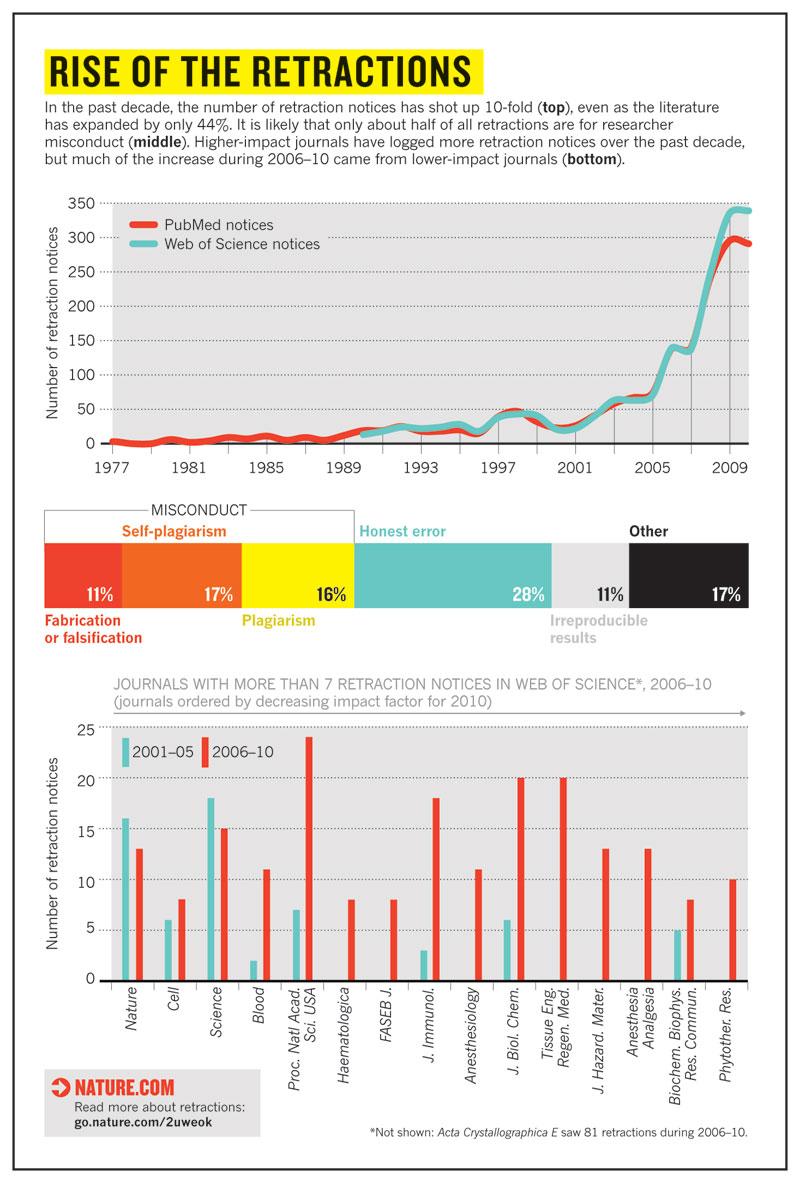
One of the problems with scientific research is the fact that retractions happen. They have been on the rise recently as well. There have been some high profile instances which have had some serious ramifications. one of these cases was in the prestigious Lancet from the UK and it involved a sample of 12 children and has caused the vaccine autism connection.  In the graph below is a break down of the reasons for retractions. We need to be aware that mistakes do happen, but real fraud is completely unacceptable.

Rise of Retratctions
Despite the fact that no science is frivolous, not all research is worthy of being published. There need to be scientific standards for quality work to be published. Without this standard, the respectability of science will go out the window. The only solution right now is peer review. Which involves a pair of credible scientists independently reviewing the same article.  Between the two scientists they are expected to find fraud, mistakes, biases and ensure that the research really contributes in the manner the researcher(s) claims. 
These standards have additional impact. The number of papers published by a scientist can impact the location they work, the amount of money they get from grant organizations and credibility within the scientific community. These standards are the only thing that keeps science from turning into pseudo science like the anti-vac movement.