Companies forget that they pay wages; don’t understand complexity of economy

Apparently 68 out of the top 100 retailers are concerned about flat or falling wages. Huffington Post did some poking around their 10-K forms and aggregated the top risks for the top 100 retailers. Huffpo found that low spending, unemployment, and falling or flat wages were the top 3 items. To me this is really interesting. Apple was recently identified as part of a wage fixing scheme that looks like it could have cost employees something on the order of $3.2 Billion, Wal-Mart has cut hours of their employees as to prevent themselves from paying for ObamaCare for those employees, which means that those employees have to pay for their insurance out of pocket, as they have to insurance now.

All of these things together impact the web of our economy. What we’re seeing is local optimization which leads to sub-optimization of the entire system. Companies that are cutting wages or benefits to maximize their profits are likely taking a cut out of their own revenue stream. It’s likely that many Wal-Mart employees shop there because it’s the lowest priced place in most areas for most goods. The fact that WinCo is Wal-Mart’s largest threat now, is pretty indicative that wages are falling.

When Henry Ford raised the wages of his employees to a real living wage, it wasn’t out of kindness or some perceived social good. It was so that his employees could buy his car. If a large mass of people are unable to buy a good you produce because of your own wage policies you’re creating a problem for yourself. Furthermore, economies are networks, they interact with each other. Each and everyone of those employees would then become representatives for the Ford brand and be able to show off the good they were manufacturing. With every new employee hired, Ford knew that there would eventually be one more sale.

Companies today have clearly forgotten this. Retail is one of the largest segment of our economy, with a huge number of employees. If this entire swath of our population cannot afford to buy consumer goods, then it’s likely that we’re going to be continually be at risk for another recession. People buying stuff is what keeps our economy going. If the companies that staff the most people do not pay them well enough to keep buying stuff beyond food, then we’re at a great risk.

Wages are a very difficult thing. There’s a Socialist party in Seattle that’s trying to get minimum wage up to $15, but offered a job starting at $13/hour. Employees have gone on strike to get higher wages. I’ve written about it several times, however, whenever companies are indicating that low wages are a risk to their business, it’s time for them to start looking in the mirror. There are large retail industry groups, these groups should start to investigate the root cause of these risks and propose recommendations to address these concerns.

Should the Fed look to take action to protect the companies from themselves in order to protect the economy? Should the minimum wage be increased to address the problem? Should the government take action at all, it’s the businesses fault if they fail because they didn’t pay their employees enough. What do you think?
FBI double downing on encryption horrors

Last week I wrote about how the Washington Post was being irresponsible by arguing that phone encryption was a greater risk than a benefit for citizens. Because the BAD GUYS or evil people would take advantage of it. Only a few days ago the director of the FBI doubled down on these statements saying that “phone encryption will take us to a very dark place.” Furthermore, the scare mongering examples he provides, cell phone data provided no help nor would have encryption been any sort of hindrance in the investigation.

Phone encryption will more likely force governments and the police to actually get warrants to search phones. As with Passwords courts can order a suspect to hand over encryption keys, in cases where the police don’t have enough evidence to earn a court order they are expected to crack it on their own with their own computer experts. This will likely lead to something of an arms race between police and encryption writers, but that’s already been happening for years.

I think that this is about something bigger than phones though. Once your average computer user has been educated in encryption for phones and loses their fear of encryption, they will likely look into encrypting or expecting their computers to come encrypted. Since phones are fairly easy to hack it makes sense to start with those spaces. However, with the massive amounts of computer leaks at companies lately, it’s likely that Microsoft will begin to encrypt their operating system, eventually consumers will expect it on their personal computers. Laptops and tablets are extremely easy to steal. With encryption it makes the theft a lot less valuable as they have to completely wipe the computer and will be unable to extract any data that might be used for identity theft.

The final end effect might be that users will have true end to end encryption. Which will make it much more difficult for the FBI, CIA, and NSA to spy on ordinary Americans. The end result of phone encryption might actually be that overall Americans have dramatically improved privacy from other Americans, businesses, and governments (not just the American government).

This is why the FBI is terrified.

Phone Encryption

It’s been announced that both iOS and Android are going to have fully encryptable phones which will be a huge boon for our 4th amendment rights. As well as to protect us from more mundane things like theft or simply losing your phone. Our phones these days contain as much or more personal information as our computers do these days. The average person doesn’t have any sort of two step authentication on their personal accounts on their phones. In most case people do have some sort of password protection to get into the phone, but once in it’s fairly easy to get into many applications.

For end users there’s nothing better than having a stronger security measures as in many cases companies poorly manage their security. This can be highlighted from the past week of exploits and those celebrity pictures. Encrypting phones might not prevented the celebrity leak, but in many cases it could. It’s believed that some of the hacks of Paris Hilton years ago came from hacking her phone through a BlueTooth connection, so a fully encrypted phone may have protected her from that hack.

All these things are good, however, the Washington Post has decided that this encryption is a risk to public safety because it will help criminals. This is the exact same argument that people make against BitCoin and full disk encryption. BitCoin ended up spawning SilkRoad, which has been shut down and it’s more likely that more crime is committed with dollars rather than Bitcoin. Full Disk Encryption has been used by both criminals and the more technical savvy. With the recent changes where the government can simply take your laptop at boarder crossings without any sort of warrant. Which means anyone at anytime that could have been flagged by the NSA could have their computer searched at will.

It’s more likely that encryption will protect an average person from an arbitrary search than protect a criminal. It’s likely that without everyone being encrypted, having your computer or phone encrypted would have been a huge red flag, however, with these recent changes that can’t happen. Meaning the average person will be safer as well as the fully legal with nothing to hide security conscious individuals.

The Washington Post, FBI, and other agencies are wrong. Fully encryption on our phones protects our privacy, improves our fourth amendment, and give us more control over our own devices. If the FBI and the US government is successful in creating a backdoor the encryption will be worthless and the put us more at risk as we’ll have a false sense of security.

Bombing ISIS/ISIL

As a country we’ve been at war for the past 13 years. Despite that fact we’ve begun bombing yet another terrorist organization. Based on what we’ve heard, seen, and read, it truly is a horrific organization. They’ve beheaded journalists, innocent civilians, and their own people. These are truly horrific acts that snuff out any potential that person had to impact other’s lives. The great things they could or would have done has been destroyed because of a fanatic religious belief. To me, there’s nothing more abhorrent than this.

However, our country has little leverage to enact change in the Middle East. We’ve continually upset our Arab allies and have had contradictory policies depending on the country around intervening in any given civil war or revolution. This has caused some serious issues in the US’s considered reliability in any given conflict. Furthermore, it’s unclear who will win a given conflict and if they will possibly be an ally of ours once the conflict is over. ISIS likely has elements of some of those Syrian rebels that we helped.

Engaging with ISIS is basically confirmation that we will bomb any country that has any elements of an organization that has been deemed a terrorist organization by the executive branch. This is an expansion of what Bush claimed and was able to gain Congressional support through the Authorization of Military Force, however, it’s not entirely clear that it’s applicable in this situation.

The bombing further revealed, that while in this case we do have support of our Arab allies, our alliance with Israel has prevented them from acting in the manner that they would have to protect the Gaza strip. The US shouldn’t be involved in these land wars. We will only continue to lose our credibility in these parts of the world and will likely to continue creating new extremists, as according to the blow back theory. I don’t believe we should be bombing another country. We need to end this war and work through other means to address these issues. We’ve been at work for 13 years, without a true declaration of war.

Grants to build out networks rules change

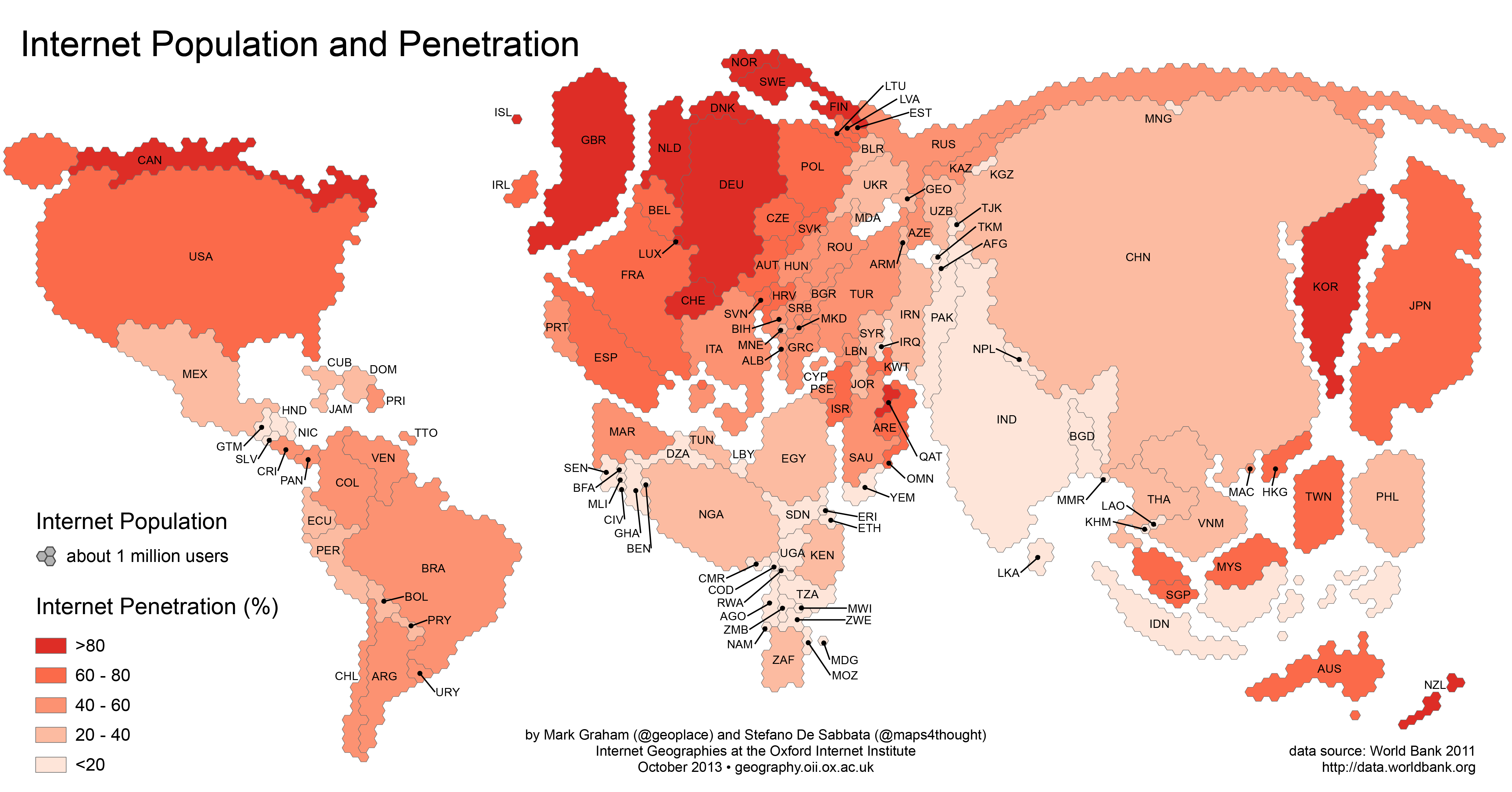
Recently there have been a serious debate between the FCC and major telecoms about the minimum rate for broadband. It’s pretty obvious that there’s a strong disagreement between most customers and their ISPs. For the most part rural ISPs are pretty terrible. If you live outside of a major city it’s unlikely that you’ll have a very fast internet service. For a country of our size and population, we have an extremely large portion of our population that does have access to the internet, however we don’t have the deepest penetration of the internet in the world. Which for a country of our wealth that is something of a shame. We’ve been investing, through governmental grants since the middle of the 90’s and we haven’t seen the expected return on investment that we’d expected as investors. We paid for companies like Verizon and Comcast to invest in our network, and I mean we, as in the tax payers. We’re paying for them to get rich off of grants.

Internet Population and Penetration

Smaller countries like the Netherlands and the UK have significantly greater penetration. Sure they have smaller populations than we do, but they also have significantly faster internet speeds than we do across the board including rural areas. Korea has speeds an order of magnitude higher than we do, despite the fact that we’re a significantly richer country than South Korea.

One of the first moves in a long time that the FCC has done that is a positive move in a really long time. As of today, the FCC has decided that the minimum speed for broadband must be 10mbps which is a huge step in the right direction. This will change the minimum threshold for any investment by a company to earn a grant to increase from 4mbps to 10mbps. This is the right direction for our country and I’m really excited about the possibilities. It means that the FCC is starting to really understand that the telecoms don’t fully have our best interests in mind when they make their arguments. We’ll see what happens in the upcoming months.