Networking and knowledge flows

We hear on a daily basis about how important social networks are, either social or professional. I have to agree, they are extremely important, however, not all of us are actually good at actively engaging in expanding their personal networks. I’m personally terrible at it, although I think this may be a problem for me going forward the next few years. I plan on getting into science and technology policy, if it wasn’t pretty clear based on my writings here. So, having a broad network is important. I will need to keep up with technological, scientific and political advances (although in the US regressions may be more apt).

I just finished reading The New Argonauts by AnnaLee Saxenian, which really pointed out the power of networks. It’s a pretty rosy interpretation of the benefits of networking for Taiwanese, Chinese and Indian entrepreneurs that had decided to move back home after working in Silicon Valley. It’s a much better representation than Thomas Freedman’s World is flat, which is just ridiculously overly the top optimistic.

There are a lot of theories about how networks operate and what type of network you want to have. What do you mean type of network? Well, I’m sure you can think of different types of networks that you have. You have close friends that you are around all the time, and then you have co-workers that you interact with in a different manner. Some of them you let into your social network, others you keep within you professional network. Now within those networks they could be structured very differently. At work you could have a lot of contacts in many departments and interact with them to get the best information about how to get a job done or that person is your go to for getting stuff done for you. This was how my network was at when I worked at SAS. I had to have many contacts in different departments. This was different from some of my colleagues  who only worked within a department and didn’t have much external exposure. You would have to make an effort to change your network type.

As I mentioned above networking is good for information. This is also the case in the scientific community. Saxenian focuses on technological knowledge flows in her book. She looks at the locations of firms and how they interact with both halves of their network. Two halves? Yep, one in Taiwan and one in Silicon Valley. These Argonauts were bridges between the two regions. This has allowed Taiwan to become a leader in computing because of this.

You are also able to use social networks to identify people. This was an assignment for one of my classes, which had three different class codes. We were given our class network data, from a survey, and we had to attempt to reconstruct our class networks. As you can see below there was some clustering going on, with some people acting as bridges from one part of the network to the next.  The points that bridge the networks are good points for knowledge to flow from one part to the next. These are the people that are always good to have contact with.

Three major clusters roughly correspond to different courses

Further Reading:
Saxenian, A. (2006) The New Argonauts Harvard University Press, Cambridge Massachusetts
Evidence of Higgs boson

I’ve been a bit remiss with my blogging of late and managed to miss discussing this pretty big story. CERN, the European particle physics group, has evidence that there might be Higgs particles. What are Higgs? Well, they are theorized to provide mass to all other particles. Not only has CERN reported this, but Tevatron in Chicago at Fermilab has reported seeing similar, but smaller results. This is very good news. In fact, despite the fact that Tevatron (6.3km) is no where near the size of Large Hadron Colider (LHC) of CERN (27km), which means that it can produce less power, can detect it means that there’s a lot of room for further investigation at LHC. This is exciting.

What if Higgs doesn’t exist? Well, basically it means that the Standard Model of particle physics is partially scrapped. Only partially, because a lot of the theory has been supported through the research at institutions like CERN and Fermilab. However, the evidence is pretty good, however, the scientists are being extremely cautious. They are currently at 2.8 sigma on a normal curve (bell curve for grading). For most research this error rate is more than enough for it to be considered a significant finding, 99.9% likelihood, however in particle physics significantly higher results are required. They require 5 sigma, which is about 1 in a million.

Does this impact my daily life? No not really, however I’m very sure whenever some of the original atomic theories were put forward and verified, most people didn’t see much use in them. It might take us a large amount of time to figure out how to actually use this. For all we know some of these developments may lead to a better understanding of fission in some way. I’m speculating of course, but there’s no reason to assume that this research is good for just doing more research.

In the United States cutting edge particle research is drawing to a close I’m afraid. In October of 2011 Tevatron will shut down for good, and there are only a few other large accelerators in the US, none as large as Tevatron.This will likely have long term impacts on both theoretical physics and particle physics in the US. The expertise will leave Universities like University of Chicago and move over to Europe to work with CERN. This didn’t have to be the case, but in 1993 Congress scrapped the Super Collider in Dallas, the US gave up the desire to lead in particle physics.

Congrats to both Fermilab and CERN for coming so close to detecting the Higgs boson!

Hypocrisy of science deniers

This is something that has been bothering me for a while. People pick and choose the types of science they are willing to accept the validity of the scientific method. This relates to my controversies series where I explained several major controversies in the US. As I said then, people have decided for whatever reason to suspend their acceptance of scientific principles and believe something that is unfounded, been proven to be untrue, or untestable or have simply chosen not to accept the scientific data.

So what am I upset about? Well, each group of these people accept the scientific method in fullness in other situations. The general heuristic used in scientific research is the same in all types of science. The specific methodologies used are typically sources of creativity. Scientists are able to connect strings concepts, and data to create a testable theory to a problem. These theories are then rejected or accepted for more testing. That’s all well and good, but the problem is that people wholeheartedly accept less rigorous testing for other products. You hear the organic crowd talking about how this organic food is so much better for you than that processed apple sprayed with chemical. The reason, because it’s more natural. They also argue that fish oil and vitamins make you feel better. Well, the problem is that there is no actual evidence to support these claims. In many cases, as Michael Specter put it, it just turns into really expensive pee. However, many of them will reject health food science that disputes these claims.

Ok, so I’ve rambled a bit without a good story in this one. People will always be this way. However, this science, layperson disputed science, has lead to amazing breakthroughs that have made our lives better. For instance, because we know evolution to be true, we’re able to test on animals because we are genetically similar to them. We test specific animals in specific ways because of their genetic similarity to us. We are able to non-human organ transplants because of this as well. We have made huge strides in our technologies because of the same methods that developed the theory of evolution, climate change and vaccines. People have no problems, for the most part, using technologies. Adopting these new technologies that in some cases we don’t even really know why or how these technologies work the way they do.

People put more trust in these technologies than they do in well proven science that have lead to life saving inventions, and practices. We cannot pick and chose which sciences we support. We need to support all of them with the understanding that from any of these branches of investigation that something major can be discovered that will make our lives better.

We may not really understand or see how this will happen at first, but looking back we can see the wonders that have arisen because of our voyage into the endless frontier of science.

NASA

I’ve gotta say, it’s hard to be a lover of space, NASA and scientific exploration right now. With the end of the shuttle program around the corner, and a new bill to cut a huge amount of funding from NASA (article) things are looking rather down right now. Basically this would kill the James Webb telescope. I think this would be a terrible thing.

Why should we invest? Well, the US prides itself on being number one in everything, even if we aren’t actually number one. Without continuing to push the frontier of research we will fall behind eventually. The article above, or another article mentioned congress killing the Super Collider in Texas, it would have been able to produce the novel results that the Large Hadroc Collider is producing now. The US would be the world leader in particle physics. We are starting to fall behind. Europe is going to be the world leader, and in the future we will be reading articles written by Europeans. We could be excellent teaching centers for particle physics for years to come, but the best of the best will not be in the US.

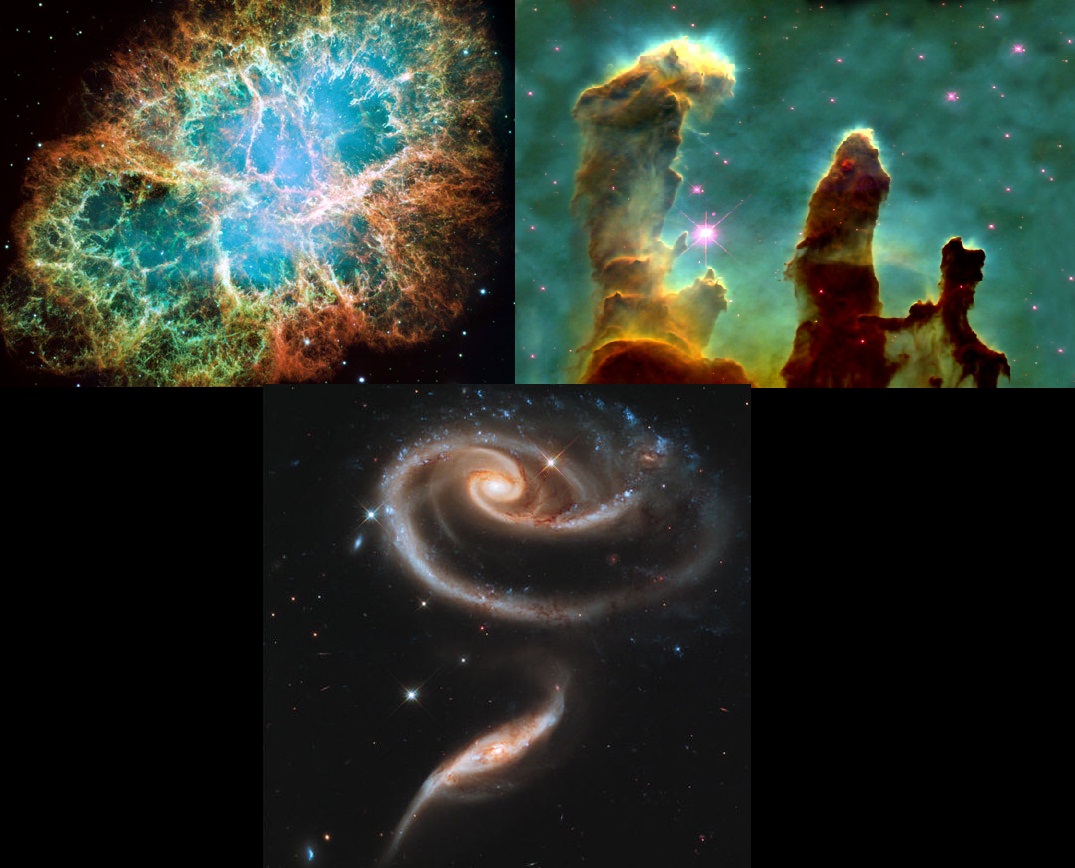
The same could happen with astronomy. The Hubble Telescope led to over 9,000 scientific papers being published. Yes, that may seem like we were probably spending more money on research than just the money that we spent on Hubble, but remember we were also producing jobs to support those scientists that were writing the papers. The Webb Telescope is going to be significantly more powerful than Hubble. We have had some amazing picture of space and the universe around us because of Hubble. Pictures of the Crab Nebula, Pillars of Creation and the Rose Galaxy. See below.

Top Left Crab Nebula, Right Pillars of Creation Bottom Rose Galaxy

For me, these images instill a feeling of awe and wonder. Through the Hubble we’ve expanded our understanding of how the universe works and how dangerous of a place we live. The rose galaxy, or galaxies, are two galaxies colliding with each other. Our galaxy is actually predicted to collide with the andromeda galaxy in a few million years. We know this because of Hubble.

We are also starting to realize that what we’re learning at the particle level may interact with the origins of the universe. For example, string/M theory also is a theory about how the universe was started. We need to be able to keep seeing back in time to understand how these theories interact with each other.

Controversies IV – Vaccines

Today I learned something interesting. A guy who does Judo with me told me that in France there are concerns over Hep B shots and Multiple Sclerosis. Apparently, this is based on a discredited publication and health authorities have not been able to convince the French to begin taking the vaccines again. This is of serious concern for me, because he also mentioned that the vaccination rate was something like 30% or so.

In some ways France is lucky, because the vaccine isn’t as serious as the vaccine people are rejecting in the US. They are rejecting MMR (Measles Mumps and Rubella), which are highly contagious. What can we learn from these two cases?

First, it is extremely difficult to overcome personal beliefs on scientific evidence. In both cases many different studies have been conducted to verify the safety of the vaccines. In the US, the connection was completely debunked. The Journal the Lancet it is the UK medical journal, actually went so far to retract the article. It was a flawed study where there were only 12 patients, they were unwilling included and the author was also being paid. There were many cases of ethical violations and the guy isn’t even allowed to practice medicine in the UK any more. He now works in the US. So, despite mountains of evidence to the contrary people still believe these findings.

Second, we learned that it’s not only conservatives, or a segment of the population that is uneducated that hold these anti-science beliefs. The topics I’ve talked about have focused primarily on that group. This controversy is with the liberal well educated group of people living in California. They have celebrity spokespeople and many of these people are engineers or some other scientifically based  profession. These people should know better.

What are the risks if we don’t vaccinate though? Well, vaccination works through protection of the herd. Everyone needs to be protected in the “herd” otherwise everyone is at risk. Well, that just sounds like a scare tactic. Ok, yes a bit, however vaccines don’t always work. You could have gotten vaccinated for MMR and it didn’t actually give you the anti-bodies you needed. It’s difficult to test for these things and expensive. Not something you’d want to subject a small child to. So, lets say that unknown to you, your child’s vaccine didn’t work, and another kid in class was intentionally unvaccinated. He some how comes across measles and comes to school with it. Your child could become ill, as well as any other person in the school that the vaccination didn’t work for or intentionally wasn’t vaccinated.

Ok, let’s say you’re right, why is Autism increasing? Well, partially we’ve changed the standards for what fits autism over time. In the past only people like Rainman would have been considered autistic, now there’s a well defined spectrum that includes a lot more types of behaviors. Other reasons may be from who are having children together. A recent study (WSJ summary) showed that Eindhoven has a significantly higher rate of autism than two other areas where there are many less technology jobs, thus less engineers and scientists. This also would indicate a possible reason why Silicon Valley might also have a higher rate than other places in the US. This does need additional research to compare regions in the US to regions like this and others around the world.

In conclusion, just because you believe non-scientific things does not mean you are stupid. There are a lot of changes in scientific literature. However, we need to develop techniques to educate people and convince them that the new data is right and that there is not some grand plot to make some one money (anti-vac think its the pharmaceutical companies lying) or destroy our economy (anti-climate change thing it’s a conspiracy to destroy the US economy). These groups are increasing risk to everyone. We need to as a general public, figure out a way to address these problems.

Further Reading:
http://www.wired.com/wiredscience/2008/01/california-stud/
http://www.wired.com/magazine/2009/10/ff_waronscience/