Values in an Agile/Lean/Innovative company

This is part of my Lean Disruption Series where I’m looking at Lean, Agile, Innovation, and Lean Startup.

None of these methodologies can be adopted for free. They require a great deal of firm introspection. Understanding how processes interaction with people and values is vital to adopting any of these approaches let alone a combination of these approaches.

Metrics are one of the best examples of how there can be conflicts between stated values, values in making decisions, how resources are handled and how processes are structured. The famous saying “You manage what you measure” is right in a lot of ways. Many companies claim that they value customer satisfaction, however many of these companies do not actually do anything with the satisfaction surveys they do get. Comcast is the most obvious example of this. Comcast doesn’t really value customer satisfaction because they measure their customer support on how much they can upsell to the customer anytime they are on the phone. This changes the processes their customer support must use, rather than designing processes to enable single call resolution, their processes are designed to enable selling more products. Their employees, the resources, are rated based on this and if they don’t meet those goals they are unlikely to do well. Considering the Verge’s Comcast Confessions series most of the resources at Comcast do not feel valued. This all points to the true values for Comcast being retention at all costs and more revenue per user measured in Churn and ARPU (Average Revenue per User) respectfully.
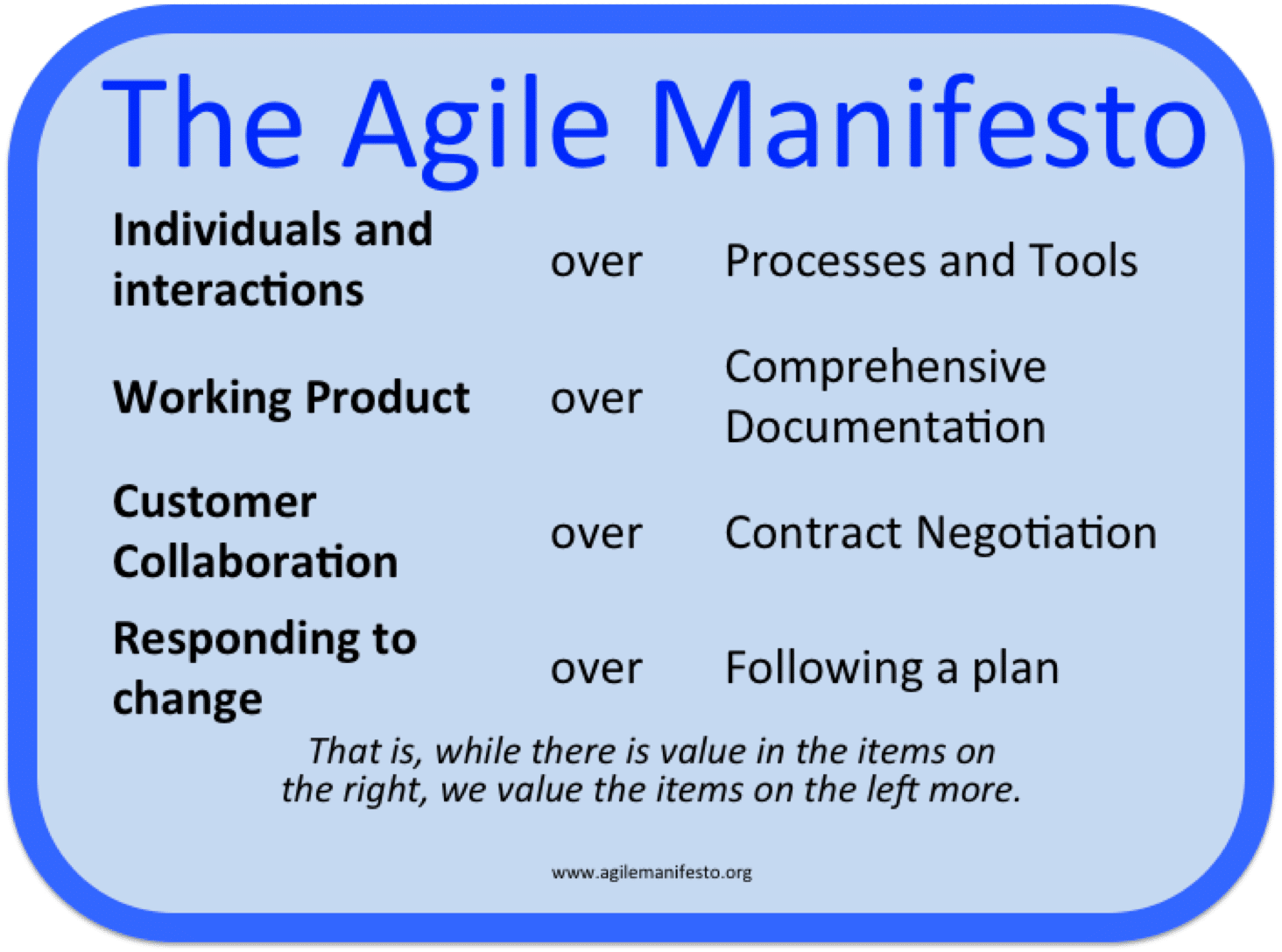
Agile Manifesto from ITIL’s blog

For a company to adopt an Agile approach to developing software, the paradigm of what the organization values must radically change to align to the Agile Manifesto. In most software development the concepts on the right are what are valued through a Project Management Office. The concepts on the left are typically considered only at the beginning or the end of the project or not at all. Working product is the goal of a project, while customer collaboration inclusive only in the beginning getting requirements.

Switching from the right to the left creates massive cultural upheaval at an organization, where power is shifted down and out. It is shifted down to the team level, where managers in the past made all the important decisions Product Owners, Scrum Masters, and developers make the decision now with the customers. Power is shifted out through increased collaboration with the customer. Customer centricity forces the company to understand what the customer really wants and more quickly respond to changes in their understanding of their needs. This does mean that the “requirements” change, however, in many cases due to the uncertainty in a technology, interface, or some other aspect it was impossible to properly articulate the actual need until there was an example in front of the customer.

With these value changes there must be process changes to that properly reflect the change in the way the values require work to be completed. In the case where Single Call resolution is the most important metric reflecting the value of true customer satisfaction, processes must be built to enable that – such as training, information repositories, and authority to truly address customer needs at a single point of contact. In software development rapid iteration with continual feedback is a process that must be built to enable that.

This changes are not free and require true commitment from leaders across the organization. Without their commitment any adoption of these frameworks is doomed to failure.

Diversity, Vital but Difficult

Increasing diversity at work is extremely difficult. There are all sorts of unconscious biases in the work place, including the words we use to describe jobs. Language that appeals to mostly guys could be a serious turn off to females. Calling people “Hackers” like in the Fast Company linked above, not only turns off females, it turns of men too. It has a connotation of a specific type of work ethos that doesn’t necessarily mesh with the type of environment a lot of people want to work in. While it’s awesome for fresh out of college graduates, for many experienced employees it sends the wrong message.

Diversity is a worthy goal, but it also needs to be tied to performance improvements in the organization. Not because you want to make a decision to turn it off or not, but because you need to know how successful it is and how it’s impacting the organization. If you’re hiring more women, how do you think that’s going to impact your company? Is it going to increase the number of releases, the number of novel features, make the product more appealing to women in general? The answers to these questions are incredibly important because the results should shape where your organization is going over time. Diversity isn’t going to just impact the team, it’s going to move the company. As a leader you should expect a similar result from the African-American and Latino communities as well.

Sociology research has indicated that diversity in backgrounds, even something like living abroad or knowing another language, dramatically increases the number of good ideas that come out of a group. Developing a clear plan with metrics will help leaders, that may not have bought into the plan, to understand the true value.

Unfortunately, this means that there is a group of workers that are going to either actually be negatively impacted or will feel like they are being unfairly called out. Scott Adams of Dilbert wrote about this just a few days ago as it has actually impacted his career. He had to leave two careers over diversity pushes, but he knew as a white male engineer that he’d be able to find work in other industries because he was a white male engineer. Other groups do not have that luxury. The Scott Adams of this world aren’t the problem, it is the people that feel that this is the wrong thing to do are being attacked by these initiatives. This is something that needs to be addressed immediately as it can seriously poison the culture of the company. It will make the diversity hires feel like they were only hired because they were a diversity candidates not because they bring something to the table. My wife has told me she has directly been told that before, which is unfair to her because she’s an amazingly brilliant woman.

There are a few ways to deal with recalcitrant people. One is the help them leave through a comfortable severance package. Obviously this would need to be handled carefully to avoid any potential lawsuits. Secondly, it needs to be clear that there is a place in the organization for white males in some fashion. Help them help with the diversification of the organization. For the highly experienced have them mentor some of the candidates so they can support those new employee’s career growth, they know the organization best and know where it needs help the most. Enable talent to move to the best places for them in the organization through mentoring. Provide mentoring to this cohort of employee by both minorities and others that have already bought into increasing diversity.

Increasing diversity is difficult because it’s painful. It means a great deal of change for everyone involved. The incumbent employees will have to adapt to a new work culture, while the diversity candidates might feel aggression towards them. It’s important for leaders to create the right type of environment where everyone can succeed and grow.

Legacies and Self Reflection

Last night while listening to Pandora, Fall Out Boy’s “Centuries” came on, not a huge fan of the song, but it got me thinking about how difficult it is to be remembered for “Centuries.” Even 100 years after a person’s death is impressive. Considering the fact that most people if asked who the richest person ever is, they wouldn’t come up with John D. Rockefeller even though his legacy is likely to last more than 100 years.

This made me think about my legacy at the companies I’ve worked. Once you leave a company having a positive legacy for years to come is difficult unless you implemented a major project or new product. This is important to me considering I’m going through a “Career Transition” according to my previous company. My last day is on Friday the 13th, because I’m being laid off. At my previous company my only real lasting legacy will be the impact of the process improvement training program and my help on the new medical management system. The latter will likely not be a long lasting legacy, while the former might last as long as the people I trained.

I am being let go because my organization didn’t prioritize process improvement, so my position was eliminated to make room for higher priority employees. It happens, i’m disappointed because we were just getting our program off the ground. We had several completed Kaizen events and one of them is up for a Blues Innovation award. I’m excited to have made that much of an impact so quickly with my student’s work and jobs. I believe that my students will continue to thrive and make significant changes to the organization using the skills I taught them.

I hope that my previous job’s legacy for me is to have learned from what I did well and did poorly at the organization. I know I was far from perfect and have room for improvement. I believe I can and will improve and that I will end up in a better position because of my experience at this job.

Retrospectives and Resolutions

This has been an interesting year to say the least. I’ve been in Portland for a close to a year and a half. Things have changed a lot in the past year. My wife and I bought a house, which I didn’t really see myself doing any time soon, but it just kind of happened – it was stressful as hell, but I’m glad that we bought the house. We got a new puppy, she’s a ton of work, but most of the time she’s well worth it. I’ve written a ton of articles, read a wide variety of books, and I’m looking for more to read (if you have suggestions feel free to comment, my Good reads is on here too).

Work has been a roller coaster though after starting out so positively things have continued to change for the worse. This year I saw the departure of my boss’s boss, our team being pushed under a new leader. My boss leaving with and then reporting to this new leader. Massive changes to a very complicated and uncertain project all throughout and now most recently the departure of two Business Analysts – one of them I really enjoy working with, so that’s a serious blow. I think the next step is that a contractor is going to be let go and that’s going to make things even crappier. I’m not sure where my career is going to be going in the next year because in my current role I don’t feel like I have any control whatsoever.

So, what am I going to do about it? Well in the up coming year I plan to do a few things. First, get better control of my health. I’m going to work out on a consistent basis, eat healthier and drink less. My goal is to drop 30 lbs within 4 months and to keep it off for the remainder of the year. I hope to do this by working out 4 or 5 times per week right after work. I plan to eat healthier by eating a better breakfast, selecting healthy snacks while at the office while avoiding candy my co-workers have on their desks, and eating healthy lunches and dinners.

Second, I plan to do a few things with my manager. I will directly tell my manager that I’m unhappy with the current situation and that we need to change our working relationship because it’s not working for me. We need to come up with a plan together to figure out what “my next steps in my career” means to her as much as to me. If that doesn’t work, well it might be time for me to move on as I won’t grow in my current role. Finally, I plan to spend my free time split a few ways, first with my wife, second working on my app that my friends and I are working on, and third writing. After talking with Rocko today I kind of got excited to start writing my fiction book more – possibly figuring out a non-fiction book to write too. Last but not least, I want to start brewing again, so I plan to buy some equipment and start within the next few weeks!

Hopefully I can stick to these goals over the next few months. I plan to write some blog posts here and on my other blog, look to find my gluten free brewing there. Keep me honest readers!

Passions

During Thanksgiving it’s a time for food, family, and watching copious amounts of TV and movies. This year those movies included “Somm” which is a movie about 4 guys trying to take the Master Sommelier test. Which apparently only about 12% pass each year. Not a super low amount, but also not an easy exam in any way shape or form. It got me thinking about if I could become a Somm (as they are called in the business according to the movie). I think that I do have the right kind of mind for the job, remember flavors of wines the history of region of wine and all of that is right up my alley. I know that, because that’s what I used to do with beer. I used to be able to rattle of several types of beers that if you liked one kind or style that might push your boundaries and give some of the reasoning behind it. I was able to explain why a beer tasted the way it did, etc… That was something I loved and was really passionate about. However, wine just doesn’t hold the same level of interest to me. I don’t know if it’s because beer feels much more close to home, my friends drank beer and avoided wine or what it is. Even now that I cannot drink beer I still haven’t really replaced it with a beverage I’m passionate about. I drink both wine and cider, but I don’t feel a deep down passion for them. Likewise I don’t think I could do that with whiskey, even though I really enjoy drinking whiskey, it just hasn’t captured my imagination as a GREAT drink that I want to learn everything about.

More broadly, the movie has had me thinking about what I’m truly passionate about. I know that a great deal of my interests are reflections of what my friends are interested in. If I’m surrounded by people that love watching football, I’ll watch a lot more football, similarly for college basketball or hockey. I enjoy the games when I watch them, but I rarely will seek them out on my own. I think this is something that is driving my wife crazy, I simply don’t have a lot of things that I’m passionate about that I’ll invest a huge amount of time into. It’s frustrating for me too. I think that is probably the hardest thing about me being Gluten Free I’ve really lost a great passion of mine.

I think many people will agree that I’m passionate about certain things in our political system. I’m all about free speech, investing in science and technology to grow and enable our economy. But I’m also not 100% all in. I’ve been thinking about how to get involved and in what way I’d do this. Ideally, I’d work at a think tank, but there aren’t many around Portland and many of them are either left wing or right wing. I think on many topics I’m a moderate, so neither party truly inspires much confidence.

I’m also passionate about making people’s lives better at work, but I’m not really getting much support at my organization and I’m getting beaten down. It’s one of the most frustrating things you can deal with on a daily basis, knowing there’s a better way to do things, walking your leaders to the kool-aid, but seeing them spit it out and start drinking from the mud instead.

So this leaves in an odd position. The things I’m passionate for I can’t really follow through, which makes me ask What do I have passion for, what should I try to be doing to find things I could become passionate about, how should I act on the topics I do have passion for? I know that there’s something more out there that I could or should be doing, but i have no idea how to get there.