Is Uber really worth $40 Billion? What is value?

Today it was discovered that Uber raised about $1.2 Billion in its latest round of VC funding. This puts Uber at the stratospheric valuation of $40 billion. This valuation makes Uber worth more than companies like Haliburton, CBS, Yum! Brand (Pepsi, Pizza Hut, Taco Bell, KFC), Northrup Grumman Corp, Kraft Foods, and basically 72% of the Fortune 500, according to this Fortune article, that means there are only 140 companies in the world valued more than Uber. On the other hand, its revenue is only $400 million which is one fifth the revenue of the smallest company on the Fortune 500.

Clearly this means that investors expect a massive IPO and that the company will continue to double revenue every 6 months. This is one of the major reasons for this round of funding as well – Uber needs to be able to expand in Asia and this money will allow them to do so. They’ll have to hire staff, fight law suits, bribe people, and who knows what else. It begs the question, are we going to see Uber Rickshaws?

With this astronomical valuation of the company, it makes you ask what is value, who is receiving this value, and how long can this valuation truly be valid? There are only two stakeholders that are truly receiving $40 billion in value, that’s the startup founders and the early investors. With the bad press that the company has been receiving, it’s clear that it’s not Uber’s customers, whom expect privacy and discretion on the part of Uber, whenever they are not receiving it. Ok, maybe that’s not completely fair, as a large number of people use Uber today, it’s clearly filling a void that aging regulations wasn’t really filling. However, it’s clear that this benefit is coming at great cost to the “employees” of Uber where aribitrary rate cuts in some areas prevents it from being possible to make a true living wage. Furthermore, this valuation will only last as long as Uber is able to continually grow, as soon as the company fails to show that they are continuing to grow, their stock prices (as they will be public by then) will eventually fall back to much more realistic prices. This is similar to what initially happened with Facebook and more recently with prices falling for Twitter. The major difference being that Uber has a much clearer revenue model than either of those companies that does not rely on ads, simply drivers and riders. Furthermore, we only know what the revenue for Uber is, we do not know what the profit margins on that revenue are, clearly they are looking good, because for a given city the overhead for Uber can’t be more than half a million dollars, which means they are likely doing rather well.

Compare this to companies that actually make things that drive the economy through providing many jobs, like Kraft, it makes you wonder where these valuations come from and what it is that investors truly see in companies like Uber. To me, it’s an interesting company that has an aggressive approach to business, but that isn’t worth that kind of money. Maybe I’ll see things differently if it comes to Portland.
Is AI going to kill or us bore us to death?

The interwebs are split over the question of if AI is going to evolve into brutal killing machines or if AI will simply be just another tool we use. This isn’t a debate being asked by average Joes like you and me, it’s being asked by some pretty big intellectuals. Elon Musk thinks that dealing with AI is like summoning demons, while techno-optimist Kevin Kelly thinks that AI is only ever going to be a tool and never anything more than that, and finally you have Erik Brynjolfsson an MIT Professor that believes that AI will supplant humanity in many activities but the best results will come with a hybrid approach (Kevin Kelly does use this argument at length in his article).

Personally I think a lot of Kevin Kelly’s position is extremely naive. Believing that AI will ONLY be something that’s boring and never something that can put us at risk is frankly short sighted. Considering that Samsung, yes the company that makes your cell phone, developed a machine gun sentry that could tell the difference between a man and a tree back in 2006. In the intervening 8 years, it’s likely that Samsung has continued to advance this capability. It’s in their national interest as they deployed these sentries at the demilitarized zone between North and South Korea. Furthermore, with drones it’s only a matter of time that we will deploy an AI that will make many of the decisions between bombing and not bombing a given target. Current we have a heuristic, there’s no reason why that couldn’t be developed into a learning heuristic for a piece of software. This software doesn’t have to even be in the driver’s seat at first. It could provide recommendations to the drone pilot and learn from the choices when it is overridden and when it is not. Actually, the pilot doesn’t even have to know what the AI is recommending and the AI could still learn from the pilot’s choices.

AI isn’t going to be some isolated tool, it’s going to be developed in many different circumstances concurrently by many organizations with many different goals. Sure Google’s might be to find better search, but they also acquired Boston Dynamics which has done some interesting work in robotics. They are also working on developing driverless cars, which will need an AI. What’s to say that the driverless AI couldn’t be co-opted by the government and combined with the AI of the drone pilot to drop bombs or to “suicide” whenever it reaches a specific location. These AIs could be completely isolated from each other but still have the capabilities to be totally devastating. What happens when they are combined? They could at some point through a programmer decision or through an intentional attack on Google’s systems. These are the risks of fully autonomous units.

We don’t fully understand how AI will evolve as it learns more. Machine learning is a bit of a Pandora’s box. It is likely that there will be many unintended consequences, similarly to almost any sort of new technology that’s introduced. However, the ramifications could be significantly worse as the AI could have control over many different systems.

It’s likely that both Kevin Kelly and Elon Musk are wrong. However, we should assume that Musk is right while Kelly is wrong. Not because I want Kelly to be wrong and Musk to be right, but because we don’t understand complex systems very well. They very quickly get beyond our capability to understand what’s going on. Think of the stock market. We don’t really know how it will respond to a given quarterly earnings from a company or even across a sector. There are flash crashes and will continue to be as we do not have a strong set of controls over the high frequency traders. If this is extended across a system that has the capability to kill or intentionally damage our economy, we simply couldn’t manage it before it causes catastrophic damage. Therefore, we must intentionally design in fail safes and other control mechanisms to ensure these things do not happen.

We must assume the worst, but rather than hope for the best, we should develop a set of design rules for AI that all programmers must adhere to, to ensure we do not summon those demons.

What can Interstellar Teach us about the tragedy of the Commons? (spoilers)

This post will contains some minor spoilers for the movie Interstellar. If you don’t want to read any spoilers, then stop reading now.

The tragedy of the commons represents a common good that without proper communication and planning can be destroyed through maximizing an individual’s utility. What does that mean? Well, a group of ranchers are sharing a field. One of them decides to make some additional money by buying, just ONE more head of cattle. He lets it eat in the grass that everyone else is sharing. No negative impact happens, the farmers discuss the number of cattle, which they had all agreed upon beforehand to be a set number. Since he increased his, everyone else does the same, eventually the land will not be able to sustain all the extra head of cattle, and the next year cattle start to die of starvation. Creating a crash in the economy.

According to Stephen Gardiner climate change represents a tragedy of the commons. However, instead of the ranchers, we have our great grand parent’s decision impacting our climate today. Climate change effectively started during the Industrial Revolution and our actions will be impacting future generations. Since the future generation does not have a voice in the conversation, it’s hard for us to put off current needs for future needs. This is further exasperated by the fact that we cannot even work to improve conditions for our own children, let alone some faceless grand child or great grandchild down the road.

Interstellar offers a glimpse into why this is so difficult. First, there’s clearly gaps in education, Interstellar points this out through exaggerating what a lot of school boards are currently doing, they go to the extreme to say that the Apollo missions are faked as a propaganda tool to destroy the Soviet Union. Second, Matthew McConaughey is one of the few forward thinking individuals, but he knows that we are continually leaving worse and worse conditions for our children, as a farmer he can see how poorly we’re fighting the blight that is killing our crops. Third, the time dilation he experiences being close to a blackhole allows him, while he’s still young, to see the full effects of his generations decisions on his children. He’s fully impotent to do anything about it, but he knows that the choices they made have fully doomed his children. Finally and I think most impactful, is the scene where Murph dies. He sees his grand children and great grand children and doesn’t even acknowledge them. He did everything he could for Murph but had no interest in seeing how all of this impacted his’s child’s children. Furthermore, Murph didn’t seem to want him to try to bridge that divide. Rather than try to build a relationship with the world as it was she pushed him to reunite with a crewmate that came from the same “world” as him.

All of these indicate that we have a serious tragedy of the commons problem. That education is required to even have a hope to combat the tragedy of the commons for climate change. That we must figure out a way to see past the here and now and create a seriously forward looking plan. That we cannot simply rely on a few forward thinking people because even they are limited in how much they can look to the future.

This is a serious concern because we now have a leader on the environmental committee in the US congress that doesn’t accept the evidence presented by scientists. Furthermore, the fact that lawmakers aren’t scientists seems to excuse them from understanding what people are saying about climate change.

We cannot expect some “they” to come and allow us to rescue ourselves with “their” help. We have to figure this out on our own. We’re failing miserably right now.

Another book that does a good job outlining these intergernational problems is the Forever War.

Phone Encryption

It’s been announced that both iOS and Android are going to have fully encryptable phones which will be a huge boon for our 4th amendment rights. As well as to protect us from more mundane things like theft or simply losing your phone. Our phones these days contain as much or more personal information as our computers do these days. The average person doesn’t have any sort of two step authentication on their personal accounts on their phones. In most case people do have some sort of password protection to get into the phone, but once in it’s fairly easy to get into many applications.

For end users there’s nothing better than having a stronger security measures as in many cases companies poorly manage their security. This can be highlighted from the past week of exploits and those celebrity pictures. Encrypting phones might not prevented the celebrity leak, but in many cases it could. It’s believed that some of the hacks of Paris Hilton years ago came from hacking her phone through a BlueTooth connection, so a fully encrypted phone may have protected her from that hack.

All these things are good, however, the Washington Post has decided that this encryption is a risk to public safety because it will help criminals. This is the exact same argument that people make against BitCoin and full disk encryption. BitCoin ended up spawning SilkRoad, which has been shut down and it’s more likely that more crime is committed with dollars rather than Bitcoin. Full Disk Encryption has been used by both criminals and the more technical savvy. With the recent changes where the government can simply take your laptop at boarder crossings without any sort of warrant. Which means anyone at anytime that could have been flagged by the NSA could have their computer searched at will.

It’s more likely that encryption will protect an average person from an arbitrary search than protect a criminal. It’s likely that without everyone being encrypted, having your computer or phone encrypted would have been a huge red flag, however, with these recent changes that can’t happen. Meaning the average person will be safer as well as the fully legal with nothing to hide security conscious individuals.

The Washington Post, FBI, and other agencies are wrong. Fully encryption on our phones protects our privacy, improves our fourth amendment, and give us more control over our own devices. If the FBI and the US government is successful in creating a backdoor the encryption will be worthless and the put us more at risk as we’ll have a false sense of security.

Time Travel could it work?

Apparently some folks thinks they figured out how you could go back in time kill your dear old grampappy and everything would work out alright. It’s a highly convoluted thing and I’m not really sure I understand any of it. But that’s ok, because it’s quantum physics. Quantum physics is one of the complicated types of physics we have discovered (discovered because it was always there, but never applied or understood).

The general idea is that because of gravity, something called a “Closed Time-like Curve” can exist. From what I understand these represent a likelihood of something occurring in like and/or particles. These are the likely ways that light might split into multiple particles (only to recombine later in most cases) or be consumed and re-emitted by another particle. Effectively, it creates a probability distribution that says one of these options might happen. In the case about your granddad surviving, you have to have a 50% chance of survival for everything to work as expected. If the likelihood of an event falls below that, then it wouldn’t happen. Essentially, you would need to create a scenario where your grandfather would survive as often as he died. That sounds like you’d have to do some pretty elaborate planning to be sure he might survive or he might die.

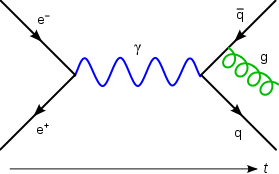
Feynman Diagram

This would work because of that recombination effect that I mentioned earlier. When light moves from point A to B it doesn’t have to go directly there. Richard Feynman created his famous (for math people) diagrams that were able to explain how these particles moved and emitted particles.

In some cases the light would move around and eventually recombine, but it would always end up at the point it was expected to based on the other attributes of that light. Because of these features, the physicist was able to do some experiments with light to actually create a “killing your own grand dad” situation. This allowed them to offer empirical evidence not just theoretical.

That being said, it’s really unclear if anything at that size would ever work in actuality at sizes we can actually interact with on a daily basis. We can stop light and we can teleport light too. That doesn’t mean we’ll be having Scotty beaming us up soon though. Likely this discovery will find it’s way into quantum computing or cryptography as mentioned in the article. Unfortunately it’s not really practical and will probably be discredited in a few years like the whole faster than light fiasco from a few years ago.