On Leadership

I love to read about innovation, but there aren’t a lot of books specifically about innovation, so I also read about management theories and best practices. Any book on management and most books on innovation will inevitably talk about leadership. As good management doesn’t really mean leadership. However, bad management always mean bad leadership or a lack of leadership.

A few things stick out in my mind when I think about leadership. The first is a clear vision. Where a vision directs the team on where the organization is going and what it is trying to be. This vision is something that the members of that organization can look to whenever there are questions of right/wrong or priorities. It allows people to move beyond the typical office politics, because those never help with achieving the vision.

The second is clear transparent communication. In some cases this is communicating the vision, but in more important cases this is communicating how and why things are going side ways. For example, when I was working at AMD, there was clear communication about our current financial positioning requiring lay-offs to “right size” the business. Now, the execution of those lay-offs and the fact that there were more than one, wasn’t exactly the best leadership. However, the executive team took ownership of the bad situation and ensured the entire team knew what was happening. Furthermore, the executive team was able to point to a vision of what AMD was and use that to rally the team around. In fact, later that year I used the organization’s vision to lead a number of strategic planning meetings to shift where people were focusing work.

The third item that great leaders drive is a culture and taking ownership of their organizations culture. In Ben Horowitz’s book, Who are What You Do he discusses how a manager’s promotion decisions can impact the culture of the organization. In the book, he specifically talks about a sales executive that, apparently, had a habit of telling lies. Some of them small, but some of them were told to his managers and customers. This resulted in unhappy customers. Unfortunately, this sales exec was promoted, which then lead to an understanding to that lying is acceptable for people to get ahead.

In organizations that have poor leadership, typically the three above items are all missing. The members of the organization will fill the lack of communication with their imaginations and spend a great deal of time discussing what could or is going to happen.This leads to disgruntlement within the organization and loss of productivity. It will lead to your best people leaving.

One of the people in the agile community I’m apart of on Linked In would say that this is a dysfunctional organization. In those cases you have two options, either figure out a way to fix the organization from the inside or leave. In the case of AMD and me, I ultimately left, but partially was for personal reasons and partially because the organization wasn’t in the best of shape after the lay-offs. I’m really happy that AMD has righted its ship and is doing much better now.

I think that every person of an organization should reflect on how their management team is behaving. Do they have a vision? Are they following that vision and actively trying to meet it? Are they forthright with their communication? Do they obfuscate when they communicate and allow employees to fester and stew about things? Do they promote a culture that you believe is a healthy culture that you are proud to work in? Do you have a good group of people you work with in spite of the culture the management has put in place? Finally, do you think that you have the ability to address the dysfunction in the organization if you think that you do, in fact, have bad leaders?

Do you work in an organization with bad leaders? What are you planning on doing?

Book Review: Why So Many Incompetent Men Become Leaders

Why Do So Many Incompetent Men Become Leaders?: (And How to Fix It)Why Do So Many Incompetent Men Become Leaders?: by Tomas Chamorro-Premuzic
My rating: 5 of 5 stars

This book does a fantastic job outlining all the ways men fail as leaders. Let me back up. This book isn’t a man hating book. Its goal is to ensure better leadership at any company. The way to do this, isn’t to just promote women, any woman. The way to do this, is to scrutinize everyone the way that women are scrutinized. Because, the data, and this book brings receipts, shows that women are better leaders.

So why are women better leaders? Well, in general women are less narcissistic in fact men are 30% more likely to be a narcissist than women. Second, men are more likely to be psychopaths, about 50% more likely, in fact. Furthermore, while in the general population about 1% of people are psychopaths, 1 in 5! Senior leaders are psychopaths and 1 in 3! Are narcissists.

Most of this book goes on to outline the failings of male leadership, because of the ways that narcissists are horrible leaders. Similarly for psychopaths. The more interesting part, though, is where the author talks about the benefits of women leadership and how that is associated with higher EQ (emotional intelligence). Both narcissists and psychopaths have very low EQ which results in poorer performance. What the author argues for, are leaders with high IQ and EQ. Women are more likely to have higher EQ than men (by about 20%). There are no significant differences between the genders for IQ, which means on the whole women are better for leadership roles because of their higher EQ.

There are a lot of reasons why we don’t pick for high EQ and one of those reasons is “confidence” really perceived confidence. Another is charisma, where male charisma is desirable and often female charisma is ignored or misunderstood.

The book, sadly, doesn’t offer as much in the way of how to fix it as it claims in the title. There are a few sections. First ask questions that can identify if someone is a narcissist. Ask questions to figure out if someone is a psychopath. Then don’t hire them. The other major innovation the book offers is using structured scored interview questions. This will create a mechanism to compare apples to apples rather than wildly different interview questions.

So, I’m disappointed on the “how to fix it” portion. Hopefully the author will include a section at the end with specific links to questions. I know there are reference and end notes, but putting together a rubric that can more easily be applied would be a great way to improve this and allow people to really see what Manpower uses to fix this problem.

View all my reviews

Algorithms are Intentionally Designed

During an NPR segment on my morning flash briefing, I heard an alarming, unchallenged, comment, “No one intended this to happen.” This is utter bull. The context doesn’t even matter, but in this case it’s about, what amounts to, interest rates based on what university you attended. Specifically, how alumni of Historically Black Colleges and Universities (along with Hispanic leaning institutions) receive higher interest rates than people that went to other universities.

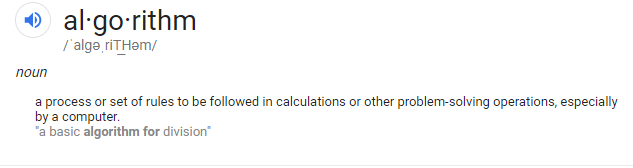
Let’s start at the most basic point, what is an algorithm? A quick Google search returns this:

It calls out specifically that an algorithm can be as basic as for division. So, I think it’s fair that many people use the word algorithm over “computer program” because it sounds magical and difficult to understand. Now, there are plenty of algorithms that are very complicated, like the original algorithm for page rank.

However, the most common algorithm used is the basic regression model. This looks something like ax + c = y. You should recognize this as the most basic equation for a line. Each ‘x’ is a conscious decision of what to include. For example, let’s say you want to calculate fuel economy for the vehicle. In this case, x could be your speed at steady state, such as driving down the highway. If you want to make it more accurate, you need to include other factors, like temperature, your acceleration habits, the time between accelerations, how much weight you have in the vehicle, time between oil changes, you get the idea. This would look like a*speed + b*temp + c*acc+d*freqAcc + e*weight + f*oil + g = y.

Each factor that you include is a choice of the person making the algorithm. In fact, there are tools, like sum of least squares which helps you identify factors that are actually significant (important) to properly estimating y. Furthermore, how you gather the data in your underlying set is also a choice. This is called sampling. There are statistical tools to allow a person to get closer to matching the actual population, but given how large the population is, it’s unreasonable to collect data on the entire population. So you’ll necessarily be estimating for a large portion of the people in your data set.

So, if your goal is to calculate interest on a loan using a regression model (algorithm) you have to pick which factors to include in your regression model. You have to pick how you sample the population. You have to pick the values you’re trying to get. You have to pick if you think something could be a proxy for race. You have to decide if you are going to do something about that.

Any bank will know all the factors that represent race. Zip code, high school, university, names, etc… In this case, they made the choice to ignore how these factors could be skewing the credit score and therefore the interest rate.

Anyone telling you that they had no way of knowing an algorithm is racist, is lying to you, thinks you’re stupid, or shouldn’t be trusted with your money. Probably all three. Reporters need to be more critical about accepting “iT wAs ThE AlGoRiThM” from any company.

Book Review: What You Do Is Who You Are

What You Do Is Who You Are: How to Create Your Business CultureWhat You Do Is Who You Are: How to Create Your Business Culture by Ben Horowitz
My rating: 5 of 5 stars

As someone hired at a small company to implement change, determine how and where to change the culture has been a big challenge. “What you do Is Who You Are” really helps with clarifying limitations I am operating under as someone that cannot change our CEO’s vision of our culture. I’ve felt for a long time that culture is something a CEO owns and that any bad behavior should be pinned to the CEO and that CEO should be fired if they cause something like a financial crash. It is their culture that allowed and pushed someone to make a multi-billion dollar bet.

This book demands that the CEO takes ownership of the culture. It also elevates culture to one of the most important thing a CEO must consider. It is something that, Horowitz argues, must be continually reinforced in little action. He argues that to earn the trust of your employees, you have to do things that show you trust them. That you need to make sure they understand the ultimate goal for the company and to see WHY you’re saying this thing is part of your culture.

Horowitz uses some rather extreme examples to show how you can change the culture of an organization as a leader. He uses the slave revolt in Haiti and a prison gang leader. Both show that if you explain why to the people that report to you, that you can get them to radically change their behavior. For example, you’d expect former slaves to butcher and pillage the lands of their former slave masters. Louvatore refused to allow his troops to do this, because he wanted to create a healthy free state. If the land was razed there’d be no economy for all the freedmen in the country.

Similarly, Shaka Seghnor believed that for any gang to be successful, they must live by the code of ethics they claimed. It would lead to hard decisions and often forced contradictory behavior. Such as forcing one of his gang members to apologize rather than attacking someone that the gang member had robbed.

There were some real gems in this book and I strongly recommend every CEO or aspiring CEO read this book. it provides great ideas of what your culture could be and how to get there. It also includes great recommendations for how to have a healthy inclusive culture.

View all my reviews

Book Review: Immortal Hulk Issues 1-25

Link to Book  Image result for immortal hulk5/5 Stars

Alright, this isn’t my normal book review, but these comics moved me in a way that not much media. From what I understand the Author, Al Ewing, originally planned the Immortal Hulk only to be 25 issues, it’s now gone beyond that by a handful and looks like it will continue to move forward. However, I think this initial arc will likely be the most impactful of the Immortal Hulk stories. Or at least of telling a story about the costs of abuse on individuals, their relationships, and society as a whole.

So, most of you are used to seeing Hulk and Incredible together. Well, that character was killed. Bruce essentially committed suicide by way of Hawkeye. After some Avengers tomfoolerly Hulk was brought back to life by the Grand Master during a chess match. This resulted in the Hulk becoming the Immortal Hulk.

*Spoilers ahead!*

Hulk is still on the run, as is normal in his comic books, but there’s a decided different tone about the chase and the fight. Mostly, because Hulk isn’t just chased by the military, but he’s chased by the ghosts of his past, literally, his father (who Bruce Banner killed) attacks him. There are also multiple Hulks in this. The ones I’m going to discuss are Devil Hulk (very intelligent, but well, evil), Savage/Child Hulk (The Hulk in the MCU, dumb and innocent), and Bruce Banner. There are a few others, but I’m not going to bring them up here.

I’m going to present a few key scenes that I think really convey a theme and discuss the themes below. The first scene that resonated with me is a scene where Bruce’s father comes home to find Bruce playing with a toy that’s significantly more advanced than what he should be playing with. This enrages his father, who lashes out at the boy. He throws a full glass of booze at Bruce. He slaps the boy, then demands Bruce’s Mother go with him leaving the boy. He then becomes the Breaker-Apart. The first signs of his rage.

The second scene that hit me is when Hulk goes to hell (it makes a lot of sense in the story, believe me). However, when he’s in Hell, he looks sickly and is wasting away, so he doesn’t look like the hugely strong being we’re used to seeing. While down in Hell, he and his reporter sidekick (McGee), begin to meet people they’ve lost. One of the people Devil Hulk comes across is Thunderbolt Ross, Bruce’s Father-In-Law. Devil Hulk flies into a rage while being the deadman and turns into Savage Hulk. Afterwards, McGee stops the Child Hulk and Hulk responds by saying “Why does Hulk hurt, why is Hulk always hurting.” Tears are streaming down his face. Rather than hugging or supporting the child Hulk, McGee demands to speak with Devil Hulk. Devil Hulk responds that Ross could have been a father to Bruce.

After going through Hell, Hulk finally finds Bruce. He’d been held captive by his father in Hell. Bruce wants to give up and stay in Hell, never going back to earth. Just ending it. The Devil Hulk offers a hand, Bruce asks why, Devil Hulk says “Cause I love you kid.” Bruce looks at him with tears in his eyes. Hulk continues, “Someone had to.”

The next scene is one where Bruce meets his ex-wife Betty Ross. She’s angry that he didn’t immediately reach out once he came back to life (it’s been about 8 months at this point). At first she’s really welcoming, but during their conversation she decides to end it. However at this time she’s murdered by someone chasing the Hulk. This of course enrages Bruce and he chases after the bad guy. An issue later we find Devil Hulk fighting the abomination, who eventually blinds Hulk and cuts off each limb – at this point Hulk is Child Hulk. We suddenly see Betty as the Red Harpy, her own Hulk manifestation. Child Hulk begs for help and love, instead Betty decides to literally rip Hulk’s heart out and eat it.

Eventually this all ends in the final chapter, where the Hulk becomes the last being in the Universe and is given immense powers as a guardian in the next. However, being Hulk, he consumes and disrupts everything. We see near the end that the Hulk is massive and is clothes lining planets, destroying them. The Great Breaker-Apart he is called. A being sees into the Hulk, inside there’s an infinite number of Bruce’s screaming in pain. There’s a great Hulk crying that out in torment. In the end, the Hulk is all that is left. Alone.

To me, this is a story about abuse. Emotional. Physical. Bruce was diagnosed with Dissociative Personality Disorder, which is clearly a result of the trauma he experienced as a child. The gamma bomb turned that trauma into a literal monster, the Hulk. The series indicates that without strong support of people around us to counter that trauma (specifically the McGee scene in Hell), that Trauma will turn us into monsters. That we then turn everyone around us into Monsters. That there’s parts of us, however monstrous, that need love and support to get through it. If we don’t get it, in those opportunities, someone else will provide it that might be malignant. Bruce created the Devil Hulk as his ultimate dissociation, where even the Hulk would turn to in his deepest pain. Bruce turned to that Monster, who wants to tear down society, because of Bruce’s pain.

There are things about the Devil Hulk’s plan to destroy society that make it the right target for his scorn. Society as a whole drove Bruce’s father to act the way he did in some regards. We often reject people in pain, in many cases they disgust us – in some cases because they remind us of our own weaknesses. Furthermore, the world itself inserts its demands on us, which in many ways are more important than our needs. Hulk NEEDS love while he’s in Hell. McGee isn’t able to give it because she’s afraid, but also because she’s in literal Hell and Devil Hulk is the only one to fix it. So Hulk dissociates so he can deal with the world. Trauma isn’t dealt with. Devil Hulk becomes dominant.

This is a really sad comic. It’s amazingly written. The art is fantastic. I strongly recommend checking it out.