Grants to build out networks rules change

Recently there have been a serious debate between the FCC and major telecoms about the minimum rate for broadband. It’s pretty obvious that there’s a strong disagreement between most customers and their ISPs. For the most part rural ISPs are pretty terrible. If you live outside of a major city it’s unlikely that you’ll have a very fast internet service. For a country of our size and population, we have an extremely large portion of our population that does have access to the internet, however we don’t have the deepest penetration of the internet in the world. Which for a country of our wealth that is something of a shame. We’ve been investing, through governmental grants since the middle of the 90’s and we haven’t seen the expected return on investment that we’d expected as investors. We paid for companies like Verizon and Comcast to invest in our network, and I mean we, as in the tax payers. We’re paying for them to get rich off of grants.

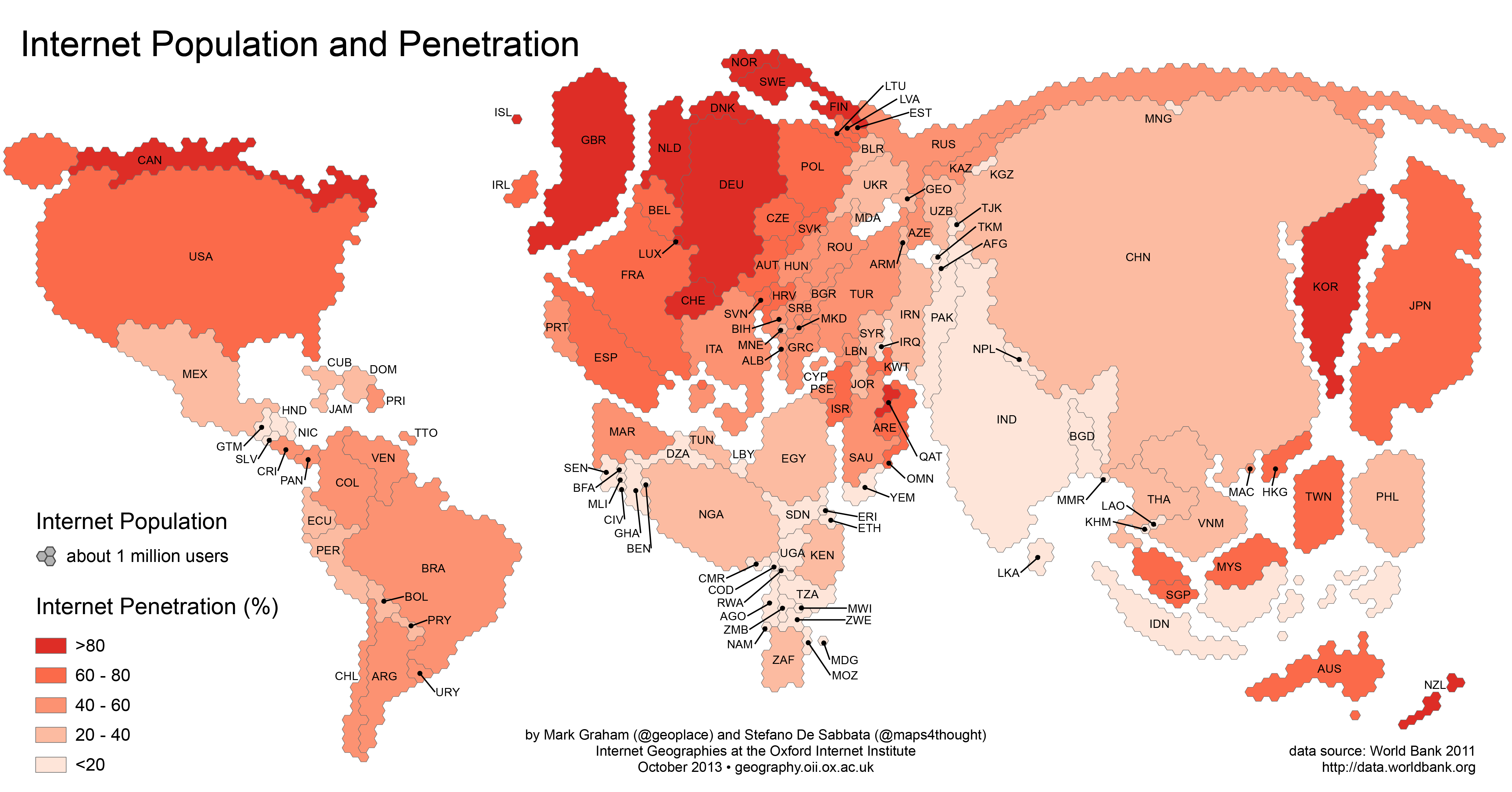
Internet Population and Penetration

Smaller countries like the Netherlands and the UK have significantly greater penetration. Sure they have smaller populations than we do, but they also have significantly faster internet speeds than we do across the board including rural areas. Korea has speeds an order of magnitude higher than we do, despite the fact that we’re a significantly richer country than South Korea.

One of the first moves in a long time that the FCC has done that is a positive move in a really long time. As of today, the FCC has decided that the minimum speed for broadband must be 10mbps which is a huge step in the right direction. This will change the minimum threshold for any investment by a company to earn a grant to increase from 4mbps to 10mbps. This is the right direction for our country and I’m really excited about the possibilities. It means that the FCC is starting to really understand that the telecoms don’t fully have our best interests in mind when they make their arguments. We’ll see what happens in the upcoming months.

Book review: Enchanted objects

In my last post I briefly mentioned the book Enchanted Objects which is an interesting book about how the future of technology might go. I’ll tell you this up front, the book is biased without a doubt. You can tell this from the beginning. That being said, I think the bias is a fair one and not subtle and really, if you’re reading a pop technology book and you don’t expect bias, then you’re kind of an idiot. This book is pretty full of technoptimism, which if that’s you’re thing you’re going to absolutely love this book. I mean, it really gives some great ideas about how to take an ordinary object add an app to it, connect it to the cloud and other devices and it will realyl solve a lot of problems.

I think this is a really great approach for a limited scope of objects. Not to say that the scope of objects is small, but more that it’s limited to the scope of objects. In some ways, it’s small thinking. I don’t think that’s a limitation on the potential. No, David Rose (the Author) actually does a good job making arguments that this could be a massively connected network that could be part of an even larger network. He envisions using enchanted objects to help manage diabetes care in such a way that it continually informs doctors, patients, hospitals, and insurers of the status and well being of the patient. Even so far as to tell the patient what foods to eat when in the event of a diabetic shock.

The big holistic vision is there, but I really can’t but think that a lot of these ideas he covers, Ambient Orb for example, are really first world problem solving tools. His idea around a garbage can that will automatically reorder a good when you throw it out seems to push consumerism rather than conservation (to be fair he does talk about trying to turn the garbage cans in a neighborhood into a game where the “greenest” or smallest waste house wins).

The major problem I see with these enchanted objects, isn’t that there’s a lot of potential to make them, it’s more what is the additional value gained to the consumer by having these enchanted objects? Rose argues that we need to move away from the swiss army type devices, like a tablet which is an attempt to do everything, towards more specialized devices. For example an umbrella that connects to the local weather to glow and recommend taking it with you when you head out the door. I could see some value in this, living in Portland, Oregon, but I hate umbrellas so I’d never use it (too many of them have hit me in the eye, so i think they should all be destroyed). Other people likely will find value in this product. However, is that enough to make you buy the special one, or do you think that you’d just still buy the $10 one that when you lose it, you won’t morn its demise? Maybe a connected umbrella stand would be more appropriate.

I think the biggest problem with this book, isn’t the general idea. I think connected objects will happen and I think there is something of an air of inevitability around them. My largest concern, however, is the lack of concern over safety and privacy within these applications. It’s likely that this umbrella will have to have a GPS radio in it. Which suddenly means, I’m carrying about multiple GPS radios. My phone, my tablet, my umbrella, my watch, and probably my running shoes (so I can share my results on mapmyrun and then Facebook, of course!). All of these devices will likely end up following under the purview of law that will require them to store that data for some amount of time. In many cases, App designers also tend to requet access to a larger portion of a phone or tablet than they strictly need. This opens end users up to greater risk than really neccessary. If I bought a product, shouldn’t that information be under my control? If it’s free how is that company using my data once they requested access for it?

These answers are lacking. I don’t really believe it’s because the author doesn’t think they are important questions. I think he just doesn’t know how to answer them. He actually mentions some of these topics in the book, but doesn’t have a statisfactory answer to them. I would like to see him work with Evgeny Morozov to answer many of these questions. I think then, I’d feel more comfortable purchasing these enchanted objects.

I’d recommend this book to anyone in design, aspiring to be an entrepreneur, or that really loves technology. It’s not as blind in its faith in technology the way that “What technology wants” but it has the right level of optimism to help keep someone that is trying to change the world keep trying and to hopefully make the design of that product just a little bit more magical. I do plan on using what I’ve learned in this book to help with my projects and any sensor based device my wife designs on her side projects.

Overall, I give this book a 4/5 

Silicon valley, new tech, and how we use it

Last night as I was watching Hulu, an interesting comercial came on that was all about jabbing Silicon Valley and its love for the newest of the new. I think it was for a new Toshiba Tablet. This comercial was really self-aware of the environment in which they sell as well as the types of people they are actually trying to sell their devices to. I think that the commercial also does a great job pointing out that the Internet of Things and 3d Printing both might be part of a hype machine that is out of control. All of these technologies could do great things, but they aren’t preordained to do anything amazing. It’s up to the user to really enable that.

I think that the book I’m reading “Enchanted Objects” does a bit of this as well. I’m torn if I should love these ideas or hate them. The Smart scissors mentioned in that ad would definitely fit under the definition of Enchanted Objects because it’s something ordinary that through sensors, haptic feedback or other do-hickeys has some extra-ordinary capabilities. Many of these things seem gimicky and unlikely to catch on. Others, like the author’s Glow Pill – which is a lid for a pill container to remind people to take their pills – would be really helpful to a lot of people out there.

I also agree with the author’s sentiment that the black screens we peer into day in and day out, are somewhat ugly, unweildy and have never lifted up to their hype. Which means that they likely haven’t made our lives significantly better and mostly just incrementally. I think this is born out through the drop in sales in tablets, the saturation of the smart phone market, and the resurgance of sales in PCs. People have found the tablet ecosystem limited in someway and awkward to use and have opted to refresh their capability with a cheap laptop rather than springing for a new tablet (an exception to this trend could be a Surface 3, but we’ll see how that pans out in the long term). Another concern with all these devices is of course security and safety from prying eyes. I’ve been talking about this for a number of years, but I believe that people will actually start listening after seeing the result of the Ferguson MO police action. Your twitter feed and location is on twitter, the police can find that. What other data are you sharing out there without truly understanding it. How can it be used against you by a militarized local government?

I think much of this goes back to my questions of ethics and technology. At what point does a technology become unethical or, rather, the use of a technology become unethical? Is a smart trashcan ethical because it helps you save the environment and support local business, what happens if that impacts your taxes or gets you on an eco-terror watch list? We don’t understand how our data is being used and to me that is scary.

I think this is played out a great deal with the fact that AirBnB, Uber, Lyft, and similar sites are the biggest booming sites in Silicon Valley. These aren’t truly technological innovations, they are business model innovations, which is why they are so devastating. Sure they are leveraging technology in an appealing way, but they aren’t really technology companies. Their innovation is in the way they engage with their customers, the delivery method is the same in many cases, a room or a car, as their competitors. The competitors haven’t been able to figure out how to combine the nimbleness of the app with a dynamic business model. Based on historical evidence, it’s unlikely that they will be able to catch up and compete. Which is fine, because I’m sure their data usages will be as opaque as the new companies. We don’t know how they are collecting our data or what they are doing with it.

Net Neutrality, Let your Voice be heard

The FCC is currently taking comments on the net neutrality issue. Please contact them. The agency is currently completely overwhelmed with the feedback on Net Neutrality, but even still, more voices might help tip the scales that are pretty obviously stacked against us. It’s like the scales used to weigh if the witch weighs the same as a duck in Monty Python’s Holy Grail. One of the most important things about net neutrality is the scope that the ISPs actually own in this debate. They are dictating the terms of this debate through money – they make the most, they charge the most, and they have monopolies. This cartoon really helps explain what the ISPs actually own (click here or the picture to see all of the comic).

Economix comix depiction of Net Neutrality

That’s right, basically if you live off a street that says “road not maintained by such and such county”(lots of them where I live) THAT’s the portion the ISP maintains. That’s why a lot of these arguments are over “the last mile.” Basically it’s the mile from their data center that connects to the backbone of the internet to your house. In other industries it might be maintained by one company, but any company can use it. Think about back when you had a modem. You could have that service provided by ANYONE – that’s why AOL got so big they offered free time to just about everyone. Almost everyone signed up and anyone could because the last mile wasn’t maintained by your phone company and had to be shared. DSL still has that requirement only Cable and FiOS don’t and that’s because they were classified as a “information service” rather than a common carrier. The highway above is a common carrier.

If you’d like to see this changed, please go to the FCC and comment (if you can) the link is here: http://www.fcc.gov/comments click on 14-28 and try to leave a comment.

It’s up to us to fight for net neutrality. I’ve left at least two comments. I’ve signed several petitions. I’ve donated to mayone.us all because one of these alone isn’t enough. I’ve contacted by Senator and I know he supports Net Neutrality. If your company is an internet company or uses a large amount of bandwidth on a regular basis see if your company will come out in support of Net Neutrality. It’s the only way we’ll win. We need to get over whelming support.

Business, processes, and things to drive improvement

About a week ago I was at PegaWorld. I’ll tell you what, for a rather dry business application – business Process Management, those guys know how to party. That being said, it is a really powerful platform to help automate existing processes or to interact with other systems to put a wrapper around the inputs and outputs of that system. That’s pretty powerful. Pega is one of those pieces of software that has the potential to “disrupt” the way traditional software is built. Essentially it eliminates the need to actually develop software the old fashion way, and allows users to create process flows that then generate the underlying Java. Now that doesn’t mean all coding will go away, especially at the interface API level, but it’s still a huge step forward to leveling that playing field.

I think this raise an interesting point, software is going to eat the world according to a lot of VC type folks. However, what happens when a piece of software enables more people to do what software was enabling people to do? I think it’d drive down the cost of enabling automated solutions. Not only are there super high level “languages” like Pega, there’s also a great deal of higher level programming languages out there, such as Ruby on Rails, JavaScript, Python, and others that help to develop the application as you’re building it. Swift from Apple is another such language. It shortens the learning cycle. I’m partially through building an App in Rails and I’d never used it before, it’d be a lot harder to do the same in Java alone.

All of this really drives a concern – we could just automate bad processes. Things that doing faster don’t actually help any customer or ourselves actually accomplish any sort of goal. This is a problem if you don’t actually understand what you’re trying to do. This is something that I think a lot of startups miss – who cares that I can really efficiently do something, when some thing isn’t really worth doing? It’s a waste of time, energy and activity to do that. Software eating the world or other types of automation are only useful to anyone if they actually work to improve the underlying structure they are being built upon. PegaWorld had some interesting talks of people that looked into this, but it was basically tangential when it needs to be at the core of everything that’s happening.

Apparently in the show, Silicon Valley, every startup ends up saying that this product is going to make the world better. Simply saying that doesn’t make it so – I’m sure that Ubisoft and EA believe that their games are going to make the world a better place. You could argue that by excluding something from the next Assassins Creed game really did make the world better by driving a conversation about the choices that developers and companies make when bringing a product to market – and how poorly those decisions can go for the company that makes them. It’s important to understand the root cause of a problem as well as any risks changes pose to the business when you don’t deliver on something you are selling.