Words, what are they good for?

At work, I’ve recently been given the task of redesigning all my training documentation and plans for Lean process improvement to something else. Apparently, despite successes, some of my leadership team doesn’t believe in Lean. However, they fully expect improvements such as reduced turn around times, quality improvements, and reduced non-value add activities to just happen. That it’s simply expected to occur without any top down pressure or support. Without clear direction or proper tools to measure improvement or even productivity, how can anyone expect to drive improvement in their organization?

Lean is a tool to do that, but since some leaders don’t believe that’s the proper way to drive improvement, we’re having to monkey with the idea of what it means to be an efficient organization. Therefore, I’m going to be rebranding everything to Process Innovation because Innovation. This does an interesting thing, it forces us to change the language we use for continuous improvement. We can’t use words like Gemba (the place where work is done), Kaizen (continuous change), Jidoka (automation with a human touch), Poka-Yoke (idiot proofing). or Muda/Muri/Mura (waste, overburden, unevenness). Using these words isn’t just to try to force people to learn some Japanese. It forces people to slow down and think differently.

Regardless of your thoughts on Malcolm Gladwell, he raises some really valid points about language in his book Blink, where he discusses the example of Korea Air and the usage of English as a language in the flightdeck because it changes the way the first officer and captain think about each other. Lean emulates this idea by forcing English speakers to use Japanese words. It forces people to stop and think about what they are doing. Yes, it’s a foreign word, but the meaning drives a change in behavior simply because it forces the people listening to slow down and think. According to Daniel Kahnman, system 2, deep and introspective thinking, is lazy and lets system 1, Blink thinking, do most of the work. A change of language and specific words triggers system 2 to actually pay attention and not just accept what is said as fact.

Now with Process innovation, I’m going to have to invent my own language and rules to try to force a similar behavior. I’ll have to lean heavily on Lean, Six Sigma, and other improvement methodologies rather than just Lean. However, this might confuse Lean folks.

It’s amazing the impact of a few phrases on changing the way people behave and it’s amazing how they can cause people to react in a negative way. Figuring out how to work around other people’s language hang ups is key for a successful work life, unfortunately.
Customers, Companies, and Power – imbalances drive inequities

I’ve been in the process of buying a house for the past month. It’s been a rocky process. Some of it has been on us, but a lot of it has been on the side of the lender. The first problem came when they basically started the process they day we were supposed to sign. This precipitated a series of events that as lead to the fact that it’s unlikely for us to actually fund the house on the last day we possibly could. Furthermore, they have been rather cavalier about the fact that we can just move closing dates without a problem. Essentially their poor processes have required us on multiple occassions to modify a private contract. We’ve been punished again and again because of their inability to meet their obligations. This strikes me as a serious inequity, especially since it’s not a big deal for them that we essentially lost out on a full month’s of rent from the seller. We have minimal to no recourse to address this loss.  On top of this, they still get paid. In my mind they’ve provided little to no value in this process and have in fact simply added a great deal of waste. They should no be paid and in fact should pay us the loss in rent we should have received from their inability to meet deadlines.

This sort of behavior is rampant in industries and companies that are essentially monopolies. Either their customers are fully locked in to a specific company because it is expensive or difficult to extract personal data or some other technical issue or the customers have no other option. In either case the company is able to act with a great deal of disregard for their customers. The goal of the business then becomes to extract maximum rents from their customers not to provide maximum value to the customer. This can create existential issues for a company that undergoes this transition, because many of the people that made that company great are pressured and have the quality of their employment decline without understanding why. Essentially these folks still try to do the right things and in many cases don’t agree with their corporate leadership. In many cases, such as with a Telecom, it’s likely they are exempt from the full rent seeking behavior of the company.

Thinking about these things have made me really frustrated the past few weeks. My job is to help my company deliver more value to the customer so seeing these actions is increasingly frustrating and counter productive to Lean principles. If companies aren’t adopting principles that improve value for end customers, then what can we do? Well, I think that in each of these cases the root cause comes from two totally different policy actions. First many of the issues we’re having are designed to protect customers so we enacted policies to that end. While the other problem, rent seeking behavior comes from the lack of policies to protect customers.

In each of these cases different government actions have lead to different actions for end customers. In actually these painful delays for our loan may for many other people, truly protect them. However, in our case, they aren’t. In the case of push deregulation on telecom the result has been monopolies and behavior designed to continually take more money from their customers. In each cases, these derive from two different philosophies around the value of government regulation. I think these situations highlight the nuances in this area.

In the end it’s important that we have real conversations about the underly reasons for different policy decisions. We need to understand that there are imbalances of power between customers and companies. In many cases those companies will exploit them to their best advantage. Unfortunately, these imbalances extend to the realms of politics as well. This of course is another area where we have issues and will continue to have issues. It is unclear how to address these imbalances, i’m not confident that we’re going to be able to do this in the next few years. If we cannot address these issues I believe they will continue to get worse as the economy remains flat in it’s growth.

Work, Lean, and Health

I just visited a nutritionist today. I’ve had issues with Gluten for years and I’ve also been diagonosed with Hypoglycima which is a condition where my blood sugar levels aren’t well regulated by my body. The combination of the two has caused me no end of issues. At this point, it’s been difficult to tell the difference between a glutening and low blood sugar, at least a low level glutening anyway, a serious glutening it’s pretty obvious. I feel drunk within a few hours and then have the shits the next day or two. It’s pretty bad. Anyway, the combination has been pretty difficult to pull a part. When i have spikes in my blood sugar it makes me feel out of it as well. So, I’m going to really address both of these issues through better nutrition and probably more working out as well.

How does this connect to work and lean process improvement though? Well, at Cambia, we get a discount for eating salad’s and other healthy foods, so I’ve already been doing that, but that’s not the work connection I’m talking about. I just started reading a book called “Lean is Healthcare” which I picked up because I thought it was actually a book on Lean in Healthcare – pretty understandable confusion I think. I’ve only read a few pages, but as a lean practitioner it really ressonated with me. The premise is that Lean is a way of improving your employee’s health. Thinking about it now, it’s pretty obvious, but it definitely was an Ah HA moment when I read that.

Lean helps create flow in work. This is for both the product as well as the worker. Flow can be described as feeling you get when everything is just clicking. It’s like when a basketball player can’t miss a basic, they are in a state where they are relaxed and feeling good. It’s similar to a meditative state – think about any of the projects that you’ve gotten into and time just flew by. When you think about work, you never think about flow like that. I’m sure you’ve had bits and pieces of flow – but they don’t last very long. However, imagine if you were able to get into a job where everything you did flowed like that. Where you walked into the office and you walked out feeling accomplished, got things done, and excited to come back tomorrow.

I think there are a few companies that encourage that – companies that encourage creative coding and design are likely the best at this type of work. Why? Because they are all about thinking and connecting ideas and concepts to each other. It’s easy to get into a meditative state when you’re really jamming away at code. I feel a similar mode of thought when I’m blogging with a keyboard that works.

Work like this makes you feel better. It’s better for your health, better for your life balance, and better for your confidence. With that in mind, shouldn’t it be a moral imperative for a company to shift to enabling work like this? Work that makes you feel accomplished, healthy, and productive? Isn’t it also a financial imperative as well as all these things increase the value the company gets out of you as an employee?

I think the answer is yes to all these questions. I will be thinking about this as I work at Cambia continually driving towards for productive work and healthier stress balance for the employees.

Healthcare: the Value Stream of care

In Lean process improvement, one of the first steps you ever take is to walk the process. For manufacturing this means to go down to the floor where the product is made and walk with one piece from beginning to end. This provides the manufacturer insight into where there’s a great deal of waiting for product to come, leading to idle workers, where there’s a lot of inventory piled up – a bottle neck, if there’s a lot of rework – fixing defects like re-etching a person’s name on the back of an iPhone, and how the material flows around the floor. This works pretty well with doctor’s offices too. You can draw a map to all the different places the Dr. walks, the nurses walks, and where the patient walks. Any transportation in a Lean system is waste, so reducing that is important.

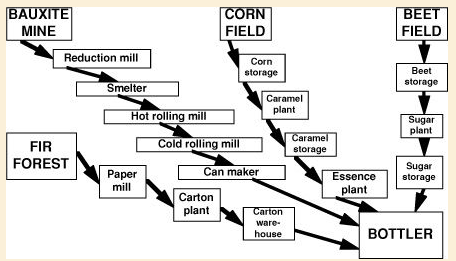
Mapping value streams essentially take this to the next level. You map all the major steps that the material that goes into your product step through before and after you. This allows a manufacturer to see all the waste before and after them, enabling them to partner with their suppliers and customers to reduce waste and unnecessary processing. For example, many of us have worked retail. Some times when you do stocking you’ll find shirts that are in bags that are in a box. This is non-value add because it’s highly unlikely that the bag would protect the shirt from getting wet in the case of a flood. So, it’s a waste of plastic for the bag, putting the bags on the shirts, and removing the bags from the shirts are all waste. Which increases the cost of a shirt. However, there’s a beginning and end of the value stream likely starting with cotton and ending with the final sale to the customer. In the case of a can of cola, it takes 319 days from the mining of bauxite to the consumption of the cola with only a total of 3 hours of actual processing of the material (Lean Thinking, Womack).

Value Stream for a can of cola through bottling (Womak Lean Thinking)

Why such a long introduction? Well, the value stream for healthcare is completely different. The beginning is when you’re born and the end is when you die. Otherwise, every activity you partake in impacts your health and the eventual cost of any episode of care. An episode of care is what happens when you directly interact with a provider, hospital, or health insurer. Arguably, these are the exception to your normal behavior and take you out of your normal routine.

Thinking about health in a value stream like this is non-intuitive for providers and insurers alike. As both have accounting practices and treatment plans that focus mainly on the episodes of care and minimize the remainder of the activities a member does. Thinking in this manner places more importance on preventative care, longer term plans for mental and physical rehabilitation, and care networks for long term diseases. This is a serious shift that is starting to occur in many insurance organizations, but aren’t very effective yet. The most effective portion of those three are the networks of patients that have a similar disease, such as Crohn’s Disease.

I believe that looking at care in this fashion will help redesign the manner that care is designed as it will focus on different portions. As my friend Rachel pointed out, behavioral health issues are typically undervalued in the value stream of healthcare. However, with this model long term care issues should be given priorities as they impact the highest percentage of the value stream. It would also force insurers and providers to look at addressing care holistically and providing the best care in the best way when they can. Sending patients to clinics that can quickly treat conditions as cheap as possible.

I’m extremely interested in how this will play out at my company as we think more holistically about value streams for health care. Checkout my last two blogs about health care:
http://scitechkapsar.blogspot.com/2013/11/heathcare-how-insurance-company-decides.html

http://scitechkapsar.blogspot.com/2013/11/healthcare-why-do-we-need-medical.html

Lean as a tool for new and mature companies

Today, I finished the book “The Lean Startup” by Eric Ries. Despite the focus on entrepreneurship, I think this book has applications at many levels. First though, I must say that I’ve been using Lean for several years and I walked into this book with an understanding of Lean and how  to apply it at a company. What does Lean mean though? Well, it certainly doesn’t mean cutting staff, reducing the amount of money you have or anything along those lines. It’s a methodology for managing projects, processes and products. It does this by basing decisions on actionable data.

What is actionable data? Well, it’s data that you can do react to quickly if the data is showing trends. This could be a positive trend or a negative trend. If you see something going well and a process is improving over time, (which is abnormal processes typically go out of control over time) then you want to understand how and why it is improving. If it is getting worse over time, you want to understand why and work to improve the process. This isn’t just for machines but also for business processes.

Once you have valid metrics there are several different things you can do. You can simply jump in and try to fix whatever problem is there or you can take a different track. The other track is to do some root cause analysis of the situation. This is called the Five Whys. This is a series of questions that ask Why to understand the real cause of the problem. In one case you may have had a new employee upload something to the production server and it kills the production server. Understanding why might not be as simple as saying, don’t do that again. First you might want to know why the action of the employee took down the server, was it something he did that no one else would have done or was it something else. As you dive down you may realize part of the problem was lack of training but there were issues that would have arisen eventually from someone else. This deeper understanding allows you to make changes at multiple levels rather than installing knee jerk reactions.

That’s a reactionary use of Lean, some other interesting uses of Lean have to deal with experimenting with your product. Ries argues that most companies wait to long to engage customers and put too much effort into the first version of the software. He argues that a company should create a minimum viable product that can be tested to get the basic point across of the end product. Doing this early allows for experimentation with customer feedback. In the software world this is pretty easy to do. You can get to something that early adopters can use and then test changes. As you can route different users to different versions of your website for the product you can have slightly different tests to see what increases the metric that matters. Getting people to continue using your product, but you need to have very targeted metrics to understand what is actually happening with your software. If you use the incorrect metric you will do a lot of work that isn’t driving usage and isn’t driving your revenue.

If you decide to change the way users interact with your GUI, it would be useful to have a goal metric to truly understand if the GUI is an improvement over the previous GUI. This could be tracking the number of clicks it takes to get to an important function. The number of times the user uses your product, the number of times a new user uses the product, but stops using a specific GUI. Once you see your metric moving in the correct direction and you can be sure that it is the result of your changes, then you should end you experiment understand why the users reacted the way they did and try to learn what you should test next.

The early goal is rapid experimentation with purpose and data to back up the decisions you make. These techniques will work with any company, but will also be very successful for a startup.